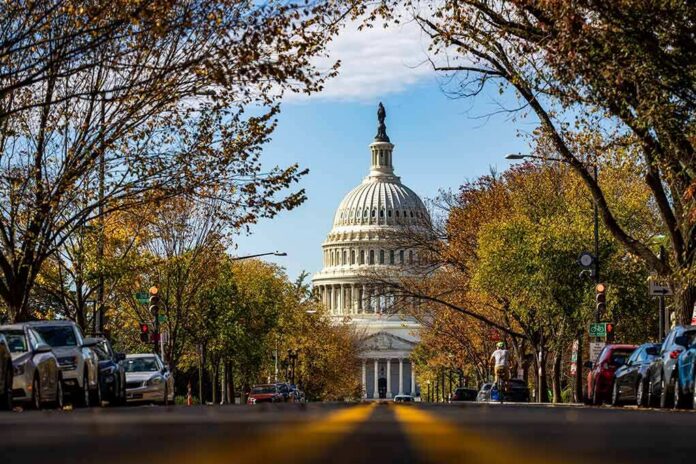
As Lindsey Graham’s flag‑draped casket entered the Capitol Rotunda, Washington paused to honor him even as a deeper worry grew about who really runs the country now.
Story Snapshot
- Senator Lindsey Graham died suddenly at 71 from an aortic tear linked to heart disease, according to preliminary medical findings.
- His casket lay in honor at the United States Capitol and a funeral at Washington National Cathedral drew President Trump and foreign leaders.
- Graham’s death opened a Republican Senate seat from South Carolina and raised fresh questions about power, succession, and the “permanent” Washington class.
- The focus on ceremony and speeches has so far overshadowed hard answers about what changes for voters and policy now.
A sudden death that shocked a Capitol already on edge
Senator Lindsey Graham, a 71‑year‑old Republican from South Carolina and close ally of President Trump, died on a Saturday night after what his office called a “brief and sudden illness.” Emergency crews were sent to his Capitol Hill home for a cardiac arrest call, but doctors could not save him. A preliminary report from the District of Columbia medical examiner said Graham suffered an aortic dissection caused by arteriosclerotic cardiovascular disease, a severe tear in the body’s main artery. His family asked for privacy, and officials said the death certificate would stay pending until more tests were complete.
News of his death spread quickly through Washington, catching both allies and critics off guard. Graham had just returned from yet another trip to Ukraine, where he had pushed for strong United States support against Russia. President Trump later said he spoke with Graham only hours before the senator died, claiming they discussed the SAVE Act and other legislation and that Graham sounded tired but focused. That account has been widely repeated but is still based only on Trump’s recollection, not on released call records or transcripts. The mix of grief, shock, and instant political storytelling fits a pattern that many Americans now recognize and distrust.
Honors in the Capitol Rotunda and National Cathedral
Graham’s body was brought to the United States Capitol Rotunda for a formal arrival and memorial ceremony, a rare honor reserved for national figures. Coverage of the event showed lawmakers lining the Rotunda, hands over hearts, as the casket was carried past the statues and paintings that celebrate earlier generations of leaders. Speakers from both parties praised Graham’s three decades in Congress and his role in shaping foreign policy, judicial confirmations, and many back‑room Senate deals. The ceremony signaled that, whatever citizens think of Washington today, insiders still take care of their own when one of them falls.
The memorial continued at Washington National Cathedral, where President Trump delivered a eulogy and praised Graham as a fighter for America and a loyal partner. The service drew world leaders, including Israel’s Prime Minister Benjamin Netanyahu and Ukraine’s President Volodymyr Zelenskyy, underscoring how deeply Graham had tied himself to United States foreign policy debates. Their presence turned the funeral into almost a small summit, with cameras tracking handshakes and side conversations as closely as prayers. For many watching at home, it was another reminder that decisions about war, peace, and taxpayer dollars are often made in closed rooms while citizens look on from a distance.
Senate vacancy, succession, and the question of who benefits
Graham’s death immediately opened a Republican Senate seat in South Carolina, putting new pressure on the state’s governor to appoint a replacement and on party leaders to protect their majority. Reports noted that an interim senator would serve until the term ends, setting up a high‑stakes race in a year when control of Congress already hangs in the balance. Yet there is still no public record showing exactly how this change will shift votes on immigration, spending, energy, or foreign aid. For citizens worried about Washington’s direction, that missing detail may matter more than the speeches and wreaths.
What we do know is that Graham was a key player on issues many Americans see as central to the country’s future. He pushed hard for strong military aid to Ukraine and Israel, backed aggressive stances on Iran, and helped shepherd judges through confirmation fights that will shape the courts for decades. His close tie to President Trump also made him a bridge between “America First” instincts and traditional hawkish foreign policy. With his seat now empty, lobbyists, party strategists, and donors are already working behind the scenes to decide who fills that role, even as regular voters are still processing his death.
Ceremony versus answers in an era of deep distrust
President Trump ordered United States flags flown at half‑staff across federal buildings and embassies, a formal sign that Graham’s death was a national moment, not just a local loss. That gesture fits long tradition, and many Americans welcome it as basic respect for service. At the same time, major outlets raced to shape the story, repeating phrases like “brief and sudden illness” and echoing Trump’s “last phone call” narrative before medical reports and other records were complete. In a country already skeptical of the “deep state,” that speed can feel less like clarity and more like spin.
Ukrainian President Zelensky said he had a ‘good meeting’ with US President Donald Trump at the White House, where the two discussed defence cooperation and efforts to revive diplomacy.
Zelensky said talks included licenses for Patriot interceptor production and other measures… pic.twitter.com/GH6EPceFXa
— APT News (@APT__News) July 28, 2026
So far, preliminary medical findings and statements from Graham’s office and law enforcement show no evidence of foul play and point clearly to heart disease and an aortic tear. Fact‑checkers have already pushed back on online conspiracy theories that tried to tie his death to secret plots or vaccines. Still, gaps remain: the final medical report is not public, Senate leaders have not shared detailed plans on committee shifts, and phone records from Graham’s last day are unknown. When government honors are full and facts feel partial, many on both the right and the left see one more example of a system that explains just enough to keep people calm but not enough to make them feel truly informed or in control.
Sources:
facebook.com, nbcnews.com, nytimes.com, npr.org, cnn.com, politico.com, bbc.com, youtube.com, pbs.org
© fixthisnation.com 2026. All rights reserved.