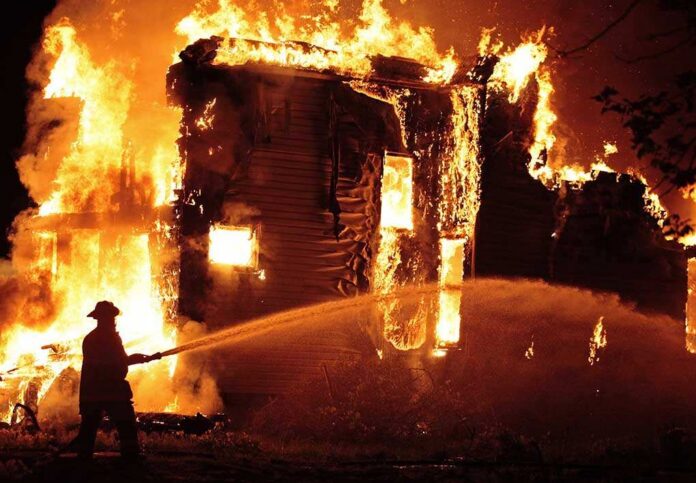
A suspicious arson attempt at a massive Kansas City warehouse tied to ICE detention rumors shows how quickly political passions can spill into real-world danger.
Quick Take
- A woman allegedly sprayed or threw an unknown substance on a south Kansas City warehouse, ignited it, and fled just before 5:50 p.m. on Feb. 12, 2026.
- The Kansas City Fire Department put the fire out before it spread; no injuries were reported, and police are treating the case as arson.
- The building had recently been toured by DHS and ICE as a possible detention facility, but the owner said it would not proceed with a sale to the federal government.
- Authorities have not released a suspect description or announced an arrest as of Feb. 13, leaving motive and identity unconfirmed.
What Happened at the Botts Road Warehouse
Kansas City police and fire officials responded to a reported fire at a warehouse at 14901 Botts Road near Missouri Highway 150 in south Kansas City on Feb. 12, 2026. Witnesses told local outlets a woman approached the building, sprayed or threw an unknown liquid onto parts of the structure, ignited it, and ran from the scene. Fire crews contained the blaze quickly, and officials reported no injuries.
Watch: Unhinged Woman Sets Fire at Building in Kansas City, MO, Reportedly Considered for ICE Facilityhttps://t.co/C0xe7dOneO
— RedState (@RedState) February 13, 2026
The Kansas City Police Department’s Bomb and Arson Unit opened an arson investigation, but as of late Feb. 12 and into Feb. 13 reporting, authorities had not announced an arrest or provided a public description of the suspect. That lack of basic identifying information makes it difficult for the public to assess whether the attack was random, targeted, or part of a broader effort to intimidate someone connected to the property.
Why This Building Became Politically Charged
The warehouse is not just any commercial site. Local reporting says the roughly 900,000-square-foot building drew attention after Department of Homeland Security and ICE personnel toured it earlier in 2026 as a possible immigration detention facility. Jackson County Legislative Chairman Manny Abarca also visited the site around that time and publicly discussed what DHS had indicated. Those developments placed the property squarely into the ongoing national dispute over immigration enforcement and detention capacity.
On Feb. 12—before the fire was reported—Platform Ventures, the property owner, said it would not move forward with a sale to the U.S. government. That timeline matters because the arson attempt happened only hours later, fueling speculation about a political motive. At the same time, the available reporting does not establish motive, and the suspect’s intent cannot be confirmed without an arrest, charging documents, or a clear statement from investigators.
What Authorities Have Confirmed—and What Remains Unknown
Across local reports, the core facts match: the alleged arson occurred shortly before 5:50 p.m., a woman is the suspected perpetrator, the fire was extinguished quickly, and no injuries were reported. Where the accounts vary slightly is in the description of the accelerant—some reports describe the woman “spraying” something, while others describe liquid being thrown on windows. Investigators have not publicly identified the substance or explained whether any incendiary device was recovered.
Authorities also have not publicly detailed the amount of property damage, whether surveillance video captured the suspect’s face or vehicle, or whether there were prior threats tied to the detention-center discussion. Without those specifics, the public is left with a timeline that looks politically sensitive but a case file that remains incomplete. From a law-and-order perspective, an arson investigation should be handled on evidence, not assumptions—especially when national politics are involved.
The Broader Stakes for Public Safety and Rule of Law
This incident underscores a basic point many Americans have learned the hard way: political rhetoric can turn into direct attacks on property and public safety. Even though the owner reportedly backed away from a federal sale, someone still allegedly tried to set the building on fire, risking first responders and nearby communities. When activists or extremists decide that intimidation is acceptable, constitutional self-government erodes because policy disputes shift from ballots and courts to threats and violence.
For now, the responsible takeaway is narrow and factual: a suspect remains at large, the arson unit is investigating, and the public has limited verified detail about motive. Anyone with legitimate information should provide it to authorities rather than inflame rumors online. If investigators later establish that the target was tied to immigration enforcement, it will raise fresh questions about how local and federal agencies protect facilities and personnel involved in carrying out the law.