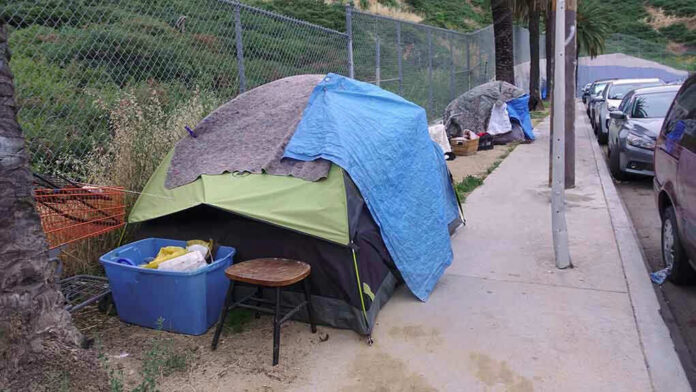
When even Barack Obama calls Los Angeles’ tent-city chaos “an atrocity,” it signals Democrats are finally admitting what everyday Americans have been forced to live with for years.
Quick Take
- Obama publicly criticized Los Angeles encampments as an “atrocity” and urged clearing tent cities while offering treatment and temporary housing.
- Obama warned Democrats that tolerating highly visible encampments erodes public support for broader, long-term solutions.
- Newsom has pointed to a reported 9% drop in unsheltered homelessness, but analysts stress point-in-time counts have limits.
- California’s approach has involved billions in spending and escalating pressure on local governments to show results.
Obama’s Break with Newsom Puts Encampments Back at Center Stage
Barack Obama’s Feb. 14, 2026 remarks targeted a reality voters can see with their own eyes: sprawling encampments in Los Angeles, including downtown areas. Obama called the situation “an atrocity” for a wealthy nation and argued that leaving tent cities in place is politically and practically unsustainable. His message paired enforcement with services, urging clearances alongside drug treatment and temporary housing rather than simple displacement.
Obama’s political warning mattered as much as his moral framing. He argued that the “average person” does not want to navigate a tent city to reach work, school, or public spaces, and that normalizing encampments becomes a “losing political strategy” for Democrats trying to maintain support for expensive interventions. For voters frustrated by disorder and declining standards, the statement sounded like a late recognition of problems many Californians have been flagging for years.
Newsom’s Reported Progress Faces Data Limits and Public Skepticism
Gavin Newsom has defended his record by highlighting a reported 9% drop in unsheltered homelessness, presented during his 2026 State of the State messaging. Analysts and experts cited in coverage say point-in-time counts are the best available tool for tracking homelessness trends, but they are not perfect and can miss movement, migration, and year-to-year volatility. That makes “progress” hard to prove conclusively to taxpayers.
The gap between statistical claims and street-level experience is the political danger for Sacramento. Los Angeles’ visible encampments remain a symbol of governance failure to many residents, even when statewide numbers appear to improve. Obama’s comments sharpen that vulnerability because they come from a leading national Democrat, not a conservative critic. For voters who prioritize public order, safe streets, and accountable spending, the question is whether measured declines translate into cleaner sidewalks and safer transit.
Billions Spent, Local Blame, and the Accountability Problem
California’s homelessness crisis grew over the 2010s and intensified in the 2020s amid high housing costs, shortages, untreated mental illness, and drug addiction. Newsom’s administration has directed major funding toward shelters, housing initiatives, and related services, while also criticizing cities and counties for inefficient use of grants. Reporting describes Newsom using funding leverage and threats of withholding to push local governments toward clearer outcomes, reflecting an internal dispute over who owns the results.
Encampment Clearances Expand, but “Humane” Enforcement Is Hard to Define
More jurisdictions across California have moved toward stricter anti-camping rules and increased encampment clearances, partly in response to public pressure over safety, sanitation, and access to public spaces. Obama’s formulation—clear encampments while offering temporary housing and treatment—aims to thread a needle between compassion and enforcement. The practical challenge is capacity: services and housing must exist at scale, or clearances risk cycling people from one block to the next.
Coverage also underscores an unresolved tension: California can spend heavily and still fail to deliver affordability or visible stability if housing production lags and addiction and mental-health systems remain strained. Experts quoted in reporting tie the crisis to housing shortages, while political commentary highlights the risk of spending without measurable results. For conservatives who favor limited government and clear outcomes, this is the central test—whether government can prove it is solving problems, not sustaining them.
What This Means for 2026 Politics and Public Confidence
Obama’s criticism pressures Democrats to adopt a tougher posture on street encampments, even as they insist on wraparound services. Newsom, meanwhile, must defend his progress claims while facing a reality check from within his own party and from residents who judge leadership by what they see outside their doors. With public frustration already high after years of inflation and government mismanagement nationwide, California’s approach has become a high-profile case study in whether one-party rule can deliver basics.
“It’s An ATROCITY” – Obama SLAMS Newsom For LA’s Homelessness EPIDEMIC pic.twitter.com/NhFxMgLKSN
— PBD Podcast (@PBDsPodcast) February 16, 2026
For families and working taxpayers, the immediate issue is not ideology—it is whether public spaces remain usable and whether policies restore order without abandoning people in crisis. The reporting does not show a single silver-bullet fix, and data limitations make sweeping claims risky. But Obama’s blunt “atrocity” label confirms something voters have sensed: the political class can no longer pretend that tent cities are normal or acceptable in America.
Sources:
Obama splits with Newsom on homelessness, labels LA crisis an ‘atrocity’ and demands action
Is Gavin Newsom really turning the corner on homelessness?
Homelessness crisis adds to Newsom’s political liabilities