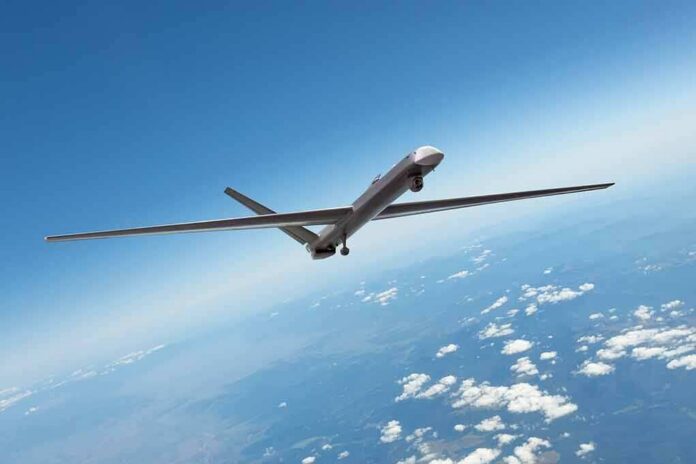
Outsourced aerial surveillance has become the quiet fulcrum of modern border control: the aircraft and sensors are undeniably capable, the contracting is lawful, and yet the line between targeted security monitoring and broad, minimally transparent data collection remains contested and largely invisible to the public.
At a Glance
- Metrea is a specialist provider of airborne intelligence, surveillance, and reconnaissance (AISR), with government contracts that include border-monitoring missions abroad and recent flights along the U.S.–Mexico border.
- Defense and homeland-security authorities acknowledge contracting private operators but decline mission-specific detail for operational security; they assert established legal and privacy safeguards govern such activities.
- The technical capacity of modern ISR platforms far exceeds what most residents imagine—high-end optics, radar, and data links—raising recurring questions about scope, secondary use, and retention of collected data.
- Independent oversight of border surveillance has gaps; GAO-flagged privacy-compliance shortfalls and civil-liberties critiques keep pressure on agencies to prove that paper safeguards translate into practice.
What the aircraft can do: capability, not conjecture
Start with the uncontroversial: Metrea is not an air taxi. The company styles itself as an “effects-as-a-service” provider to national-security partners, explicitly delivering integrated airborne intelligence, surveillance and reconnaissance solutions—turnkey packages that combine airframes, crews, sensors, communications, and analytical workflows. This is the industry’s center of gravity today: persistent sensing, fused with networked command-and-control, delivered as a contracted service rather than a capital acquisition or ad hoc lease. The company’s own materials make that scope clear, which is why communities watching flight tracks over the southern border infer sophisticated surveillance payloads onboard, even when the government does not spell out sensor lists or mission logs.
The firm’s recent awards overseas reinforce that reading. Australia’s Department of Home Affairs and the Australian Border Force selected Metrea to provide advanced aerial surveillance—eleven fully crewed aircraft, short- and long-range coverage, operating twenty-four hours a day, year-round. That program is explicitly framed as national border monitoring and maritime domain awareness, the same mission family that concerns residents along the Rio Grande or the Arizona borderlands when they look up and see a high-altitude pattern begin to tighten into orbits.
How we got here: from government fleets to “surveillance as a service”
Two trends intersected. First, border agencies faced a persistent, distributed problem set—cross-border smuggling, irregular migration flows, and search-and-rescue obligations—best addressed with persistent sensing and flexible coverage rather than episodic flyovers. Second, the private market matured: business jets and turboprops can be outfitted with stabilized electro-optical/infrared turrets, maritime or ground-moving-target-indication radars, signals relay packages, and secure beyond-line-of-sight communications. Operators like Metrea built standardized, export-compliant sensor stacks and crews practiced in intelligence collection tradecraft, then offered the outcome—surveillance effects—on contract. Governments with budget constraints or lifecycle burdens on their organic fleets leaned in, particularly for surge, coastal, and border work.
This model is hardly confined to one region. Metrea has run test campaigns for Frontex, the European Border and Coast Guard Agency, under conventional aviation and data-protection rules, including encrypted storage for telemetry and sensor recordings—signals that privacy controls can be embedded in operations, at least on paper and in controlled trials. The point is not that every mission uses the same payload; it is that the architecture exists to mix and match sensors with disciplined procedures, which is precisely why it is attractive to border authorities and disquieting to civil-liberties advocates.
What officials say—and don’t say—about U.S. border flights
When pressed about contractor-operated aircraft flying along the U.S.–Mexico border, Defense Department officials confirm the broad fact pattern: Metrea is among the companies the department uses to support operations worldwide. They also draw a hard line on specifics—no mission-by-mission disclosure for operational security—and point to Attorney General–approved procedures designed to protect constitutional rights, legal rights, privacy, and civil liberties. That is the familiar formula: acknowledge the capability, decline the details, cite the rulebook.
Homeland Security, for its part, indicates it is updating its privacy-impact assessments (PIAs) to account for newer surveillance modalities—ground and maritime radar, enhanced video, seismic and imaging sensors, and the use of commercially available location data. A PIA is not a press release; it is an internal risk assessment and a public-facing summary of how data will be collected, used, retained, and shared. Updating it signals both technology churn and an attempt to square that churn with documented safeguards. For residents under the flight paths, the question is whether those safeguards are specific, enforced, and auditable in practice.
The real friction line: oversight credibility versus capability expansion
It is not disputed that border surveillance exists or that private firms now execute substantial portions of it. The crux is whether oversight is adequate to the capabilities at hand. On one side, government statements emphasize procedures and compliance frameworks; on the other, watchdogs and civil-liberties groups point to repeated shortfalls, especially where data persistence and cross-agency sharing are concerned. The Government Accountability Office, summarized by the Electronic Frontier Foundation, found CBP had failed to meet six of six baseline privacy protections across three surveillance programs—towers, aerostats, and unattended ground sensors—hardly a confidence boost when agencies ask for deference on the specificity of airborne missions.
That gap between formalism and field practice matters because today’s ISR payloads are not merely binoculars with wings. Even absent any signals intelligence, stabilized multispectral cameras can map patterns of life; synthetic-aperture radar can image through cloud or at night; and data links can stream and archive everything. Add commercially available location data to target monitoring zones and the mosaic effect becomes powerful. DHS’s own privacy documentation acknowledges the need to assess such capabilities systematically, which is the right instinct; the onus is now on agencies to demonstrate that assessment yields restraint and measurable controls, not just updated paperwork.
Comparisons that clarify, not alarm
Look to Australia’s program design for a sense of what “surveillance as a service” looks like when spelled out: sustained coverage, mission-tailored aircraft, and explicit border-security and fisheries-enforcement tasks. The ABF’s public framing—eleven fully crewed, technologically advanced aircraft providing all-weather coverage—is instructive precisely because it normalizes the concept and stakes the government’s credibility on its performance. It does not answer every privacy question, but it defines the operating picture citizens can expect. In the U.S., where border politics run hotter and operational secrecy runs deeper, the same class of capability invites more speculation. The facts we do have—contractor involvement, ISR orientation, and government assertions of legal compliance—support a straightforward conclusion: this is professionalized, high-end surveillance operated under national-security contracts, not an improvised or rogue effort.
The absence of a public sensor manifest for the southern-border flights does not, by itself, imply illicit collection; it reflects standard operational security. The legitimate democratic question is narrower and sturdier: are the privacy protections officials cite specific, enforced, and externally reviewable at the level that modern ISR warrants?
The private military contractor Metrea Aerospace is conducting surveillance operations along the United States-Mexico border, utilizing King Air 350 aircraft equipped with DRT 3300 "dirtbox" systems (cellular tracking) and "Windjammer" systems (geolocation and jamming), etc.
— Worldwar_x (@worldwar_x) August 14, 2026
What meaningful accountability would look like
Three practices would align capability with public trust without compromising mission effectiveness. First, program-level transparency: publish updated, plain-language PIAs and system-of-records notices that describe data types, retention periods, and sharing pathways, and tie them to the particular airborne program lineage—fixed-wing ISR, not just generic “border surveillance.” Second, measurable controls: adopt and disclose sensor-use policies (e.g., geo-fencing, minimization thresholds, audit flags for prolonged tracking) and require contractors to log operator actions in tamper-evident systems subject to inspector general review. Third, outcome-linked oversight: commit to periodic, public GAO or inspector general audits that sample real missions for compliance against those policies, with corrective action plans and timelines where gaps appear. DHS’s move to update its PIA framework is the door; metrics and independent verification are what need to walk through it.
Why this matters now—and will continue to matter
Border surveillance is not a temporary patch; it is an infrastructure layer. Outsourcing its operation to firms expert in AISR makes operational sense—specialization, surge capacity, and advanced integration are difficult to replicate in-house. But infrastructure hardens norms. The longer high-end aerial monitoring is routine, the more crucial it becomes that its boundaries are articulated, enforced, and reviewable. That is not an argument against the capability; it is an argument that enduring powers require enduring guardrails. Officials already claim those guardrails exist. Communities under the flight paths deserve proof—clear program documents, sensible limits, and audits that check the work.
Sources:
zerohedge.com, metrea.aero, digit.site36.net, aerotime.aero, abf.gov.au, azmirror.com, visahq.news, bombardier.com
© fixthisnation.com 2026. All rights reserved.