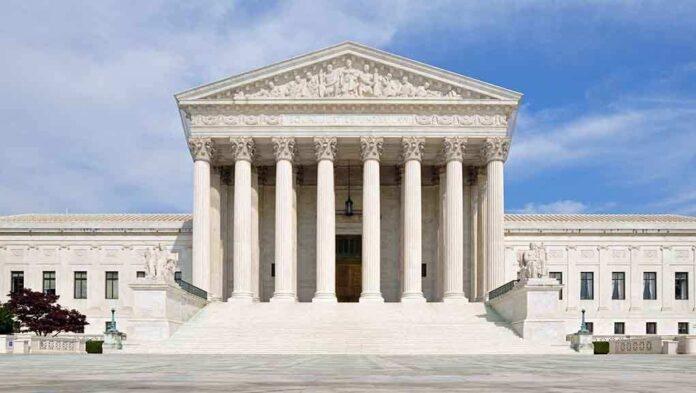
The Supreme Court just delivered a massive victory for election integrity, ruling 7-2 that candidates can challenge shady post-Election Day ballot counting without jumping through leftist hoops.
Story Highlights
- Supreme Court grants standing to Rep. Mike Bost and electors to fight Illinois’ 14-day mail-in ballot extension, remanding for merits review.
- Chief Justice Roberts’ majority opinion affirms candidacy itself gives concrete interest in fair election rules, bypassing old harm requirements.
- Judicial Watch hails it as the most important election law ruling in a generation, boosting nationwide efforts against voter fraud.
- Case revives after years of lower court dismissals, signaling stronger federal oversight ahead of 2026 midterms under President Trump.
Supreme Court Rules for Standing
On January 14, 2026, the U.S. Supreme Court issued a 7-2 decision in Bost v. Illinois State Board of Elections, granting standing to Rep. Mike Bost (R-IL), presidential electors Laura Pollastrini, and Susan Sweeney. The plaintiffs challenge Illinois law allowing mail-in ballots postmarked by Election Day but received up to 14 days later. Chief Justice John Roberts wrote the majority opinion, joined by Justices Thomas, Alito, Gorsuch, and Kavanaugh. Justices Barrett and Kagan concurred, while Jackson and Sotomayor dissented. This procedural win revives the 2022 Judicial Watch lawsuit after dismissals by district and Seventh Circuit courts.
🚨 BREAKING: Major win for election integrity at the Supreme Court this morning.
In a 7–2 ruling authored by Chief Justice John Roberts, SCOTUS said Rep. Mike Bost does have standing to challenge Illinois’ mail-in ballot policy, which allows ballots to be counted up to two weeks… pic.twitter.com/BhWDnXFeE6
— Digital Gal (@DigitalGalX) January 14, 2026
Judicial Watch’s Long Fight Pays Off
Judicial Watch filed the suit on May 25, 2022, in U.S. District Court for the Northern District of Illinois against the State Board of Elections and Executive Director Bernadette Matthews. Lower courts dismissed for lack of standing, requiring proof of financial harm or likely election loss. The Supreme Court rejected that barrier, ruling candidacy confers a concrete interest under Article III. Judicial Watch President Tom Fitton called it a historic victory for election integrity. Lead attorneys Robert Popper, T. Russell Nobile, and Paul Clement drove the effort. Rep. Bost praised it as a critical step to restore voter trust.
Roberts emphasized preventing post-election chaos from late ballots, aligning with federal law setting Election Day as November 5 in even years under 2 U.S.C. § 7. The ruling invokes the Electors Clause and Elections Clause, criticizing extensions that undermine finality. Judicial Watch’s nationwide work has removed over 5 million ineligible voters, winning cleanups in states like Illinois, Oregon, and California. This decision lowers hurdles for similar challenges, including Mississippi’s 5-day extension now before the Court.
Reactions and Dissenting Views
Fitton urged Americans concerned about rigged elections to celebrate, crediting the team for restoring candidate rights against unlawful rules. Bost highlighted its role in rebuilding confidence shattered by 2020’s mail-in expansions. Roberts warned against disruptive late interventions. Concurrences by Barrett and Kagan applied standard standing without special rules. Dissenters Jackson and Sotomayor claimed it opens floodgates to frivolous suits, risking excessive litigation without proven injury. Conservative groups filed amicus briefs supporting plaintiffs.
The ruling expands federal court access for candidates nationwide, pressuring states with lax deadlines. Short-term, it remands for Seventh Circuit merits review on constitutionality. Long-term, it promises more pre-election challenges, deterring fraud while avoiding post-election messes. Amid President Trump’s 2026 agenda, this bolsters integrity efforts, countering past open-border voting abuses that eroded family-valued communities.
Broader Implications for 2026 Elections
Candidates gain tools to enforce Election Day finality, protecting against globalist-style extensions that invite fraud. States like Illinois face scrutiny, potentially striking laws in mail-heavy areas. Political impact favors integrity advocates, polarizing access debates but enhancing trust through accountability. Economic effects remain minimal, though campaigns may spend more on poll-watchers. Parallels voter roll cleanups, signaling cleaner 2026 midterms. Conservative victories like this reaffirm constitutional limits on government overreach.
Sources:
Politico: Supreme Court vote-counting ruling
ABC News/WCIV: Supreme Court revives GOP lawmakers’ challenge to Illinois election law
Fox17: Supreme Court revives GOP lawmakers’ challenge to Illinois election law
Riverbender: Bost Supreme Court Rules Bost Election Integrity Case Can Proceed
Washington Times: Supreme Court allows challenge Illinois mail ballot law counting