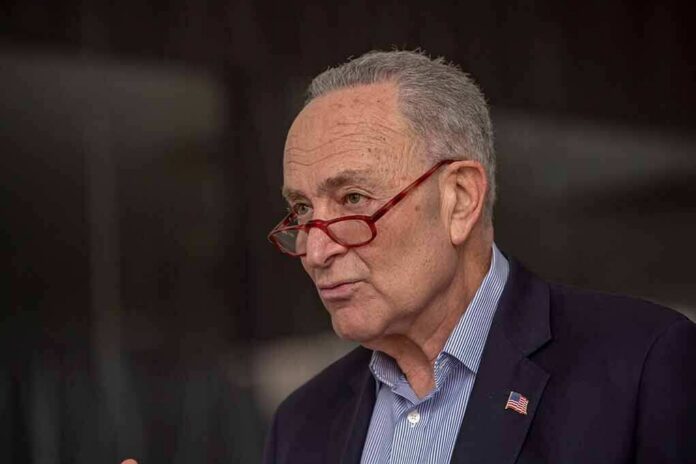
Chuck Schumer’s “Jim Crow 2.0” attack on the SAVE Act hit a wall on live TV when CNN’s Jake Tapper put overwhelming voter-ID polling in front of him.
Story Snapshot
- Jake Tapper cited polling showing roughly 83% of Americans support voter ID, including majorities of Democrats, Latinos, and Black Americans.
- Schumer condemned the GOP-backed SAVE Act as “Jim Crow 2.0” and claimed it could disenfranchise more than 20 million poor and minority voters, a figure not substantiated in the reporting provided.
- The SAVE Act recently passed the House and would require proof of U.S. citizenship to register to vote, expanding federal data-sharing and involving DHS in verification.
- DHS Secretary Kristi Noem drew backlash for saying her agency would ensure “the right people” are voting, as funding fights and partial DHS shutdown pressures mounted.
Tapper’s polling fact-check exposes the political gap
Jake Tapper’s February 16, 2026, exchange with Senate Minority Leader Chuck Schumer on CNN’s State of the Union crystallized a reality many voters have felt for years: elite Democratic messaging on election rules often collides with broad public support for basic safeguards. Tapper cited survey results putting voter-ID support around 83% nationwide, including majorities among Democrats and across racial groups, and the moment briefly left Schumer searching for a response.
Chuck Schumer did not retreat. Schumer continued portraying the GOP-backed Safeguard American Voter Eligibility (SAVE) Act as “Jim Crow 2.0,” arguing the proposal would make it too difficult for certain Americans to obtain identification and participate. The polling Tapper referenced matters because it narrows the distance between “common sense” and “controversial” in the public mind. It also highlights that the core disagreement is less about popularity and more about power, procedure, and implementation.
What the SAVE Act would change in voter registration
House Republicans passed the SAVE Act the week before the interview, and the bill now faces a tougher road in the Senate, where it would need 60 votes under current rules. As described in the research, the legislation would require proof of U.S. citizenship for voter registration, expand data-sharing with federal authorities, and formalize a Department of Homeland Security role in verifying voter rolls. Supporters argue that citizenship verification protects the integrity of elections.
Critics argue the same structure risks eligible voters getting caught in paperwork problems or administrative delays, especially people with limited resources or difficult-to-replace documents. Schumer’s claim that “over 20 million” could be disenfranchised is a serious allegation, but the materials provided do not document a concrete methodology for that number. That gap matters in a constitutional republic: restricting lawful voting is wrong, but so is diluting lawful votes through sloppy verification standards.
DHS, funding brinkmanship, and the fight over enforcement optics
The debate intensified because it unfolded alongside a broader Washington fight over DHS funding and enforcement posture. The research notes a partial DHS shutdown beginning February 14 amid disputes, with Democrats pressing demands related to limiting ICE presence near polling places or schools. Those talks created a high-stakes backdrop for election administration arguments: whichever side controls the narrative can frame the other as either inviting chaos or inviting intimidation, even when the legislative language is more technical than theatrical.
DHS Secretary Kristi Noem added fuel with a line that critics interpreted as exclusionary—saying her agency would ensure “the right people” are voting to deliver reliable elections. The phrase may have been intended as shorthand for “eligible citizens,” but the wording made it easier for opponents to claim the administration wants to pick winners and losers at the ballot box. For conservatives focused on limited government, the lesson is straightforward: precision in language matters when federal agencies touch elections.
Why this lands with voters who are tired of “woke” spin
The Tapper-Schumer clip went viral because it connected to a wider frustration: Americans are exhausted by political branding that treats reasonable rules as moral atrocities. Voter ID and citizenship verification are widely seen as normal guardrails in everyday life, from boarding planes to cashing checks. When national Democrats label those guardrails as “Jim Crow,” it risks sounding less like civil-rights vigilance and more like ideological theater—especially when polling shows strong support among the very demographics invoked.
That does not mean every implementation detail is automatically harmless. A conservative approach should insist on secure elections and accessible compliance—clear rules, straightforward documentation paths, and transparent appeals if someone is flagged incorrectly. The larger point from Tapper’s polling citation is that this is not a fringe demand from “MAGA” America; it reflects a durable, cross-partisan expectation. If Senate Democrats block the SAVE Act, they will have to explain why.
Jake Tapper Cited Voter ID Polling to Chuck Schumer and the Pause Could NOT Have Been More Awkward https://t.co/8no5kqcrGC
— Twitchy Updates (@Twitchy_Updates) February 16, 2026
Sources:
Schumer says Dems will fight voter ID push ‘tooth and nail,’ balks at DHS role in elections
Schumer spurns SAVE Act despite support
Trump: voter ID required to vote
Kristi Noem’s “right people voting” quote