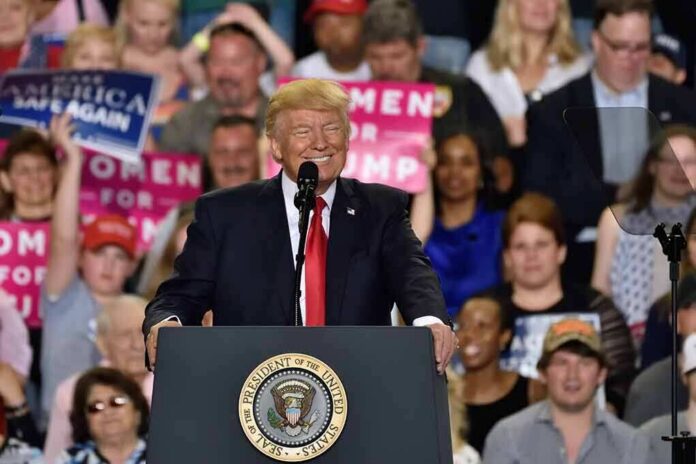
Trump’s endorsement of Saritha Komatireddy in the New York attorney general race is not just another campaign flourish; it is a deliberate attempt to nationalize a state office that has become a focal point of his long-running feud with Letitia James, with consequences for fundraising, media attention, and how voters interpret what an attorney general should be.
The Short Version
- President Trump issued a “complete and total endorsement” of Republican Saritha Komatireddy to challenge Attorney General Letitia James.
- Komatireddy is a former federal prosecutor and prior Trump judicial nominee who is running on a law-and-order message.
- New York Republicans unified behind Komatireddy early, avoiding a primary and elevating a relatively low-profile office into a national proxy fight.
- Research shows Trump endorsements reliably mobilize partisans but have mixed or negative effects in general elections, especially in blue states like New York.
What Trump did, and why it matters in a state AG race
President Trump publicly endorsed Saritha Komatireddy as his choice to unseat New York’s incumbent attorney general, Letitia James, calling her an “America First Patriot” and promising his full backing. The endorsement, delivered in the familiar superlatives of Trump’s campaign rhetoric, defines the attorney general contest as a continuation of the Trump–James rivalry—James has pursued high-profile legal actions involving Trump and his businesses, and Trump has, in turn, cast her as a partisan antagonist. The New York Post captured the endorsement language and the frame: an explicit bid to help “oust his longtime political foe.”
Komatireddy’s candidacy is not a placeholder. State Republicans lined up behind her early, sparing a primary fight and presenting a single, prosecutor-profile challenger to James. Reporting on the state party’s decision underscored how quickly the GOP consolidated behind her after rival contenders bowed out at the deadline. In a race where ballot access and party infrastructure matter as much as raw charisma, this kind of early unity is strategic: it buys time for statewide name ID, fundraising, and contrasts with an entrenched incumbent.
Who Komatireddy is: résumé, message, and how it maps onto the office
Komatireddy is running as a former federal prosecutor with a law-and-order pitch—precisely the archetype Republicans prefer in down-ballot legal offices. Spectrum and local outlets have highlighted her background and how she is positioning the campaign: emphasizing public safety and a back-to-basics view of the attorney general’s mandate. Importantly, she has also publicly tied her trajectory to Trump’s earlier confidence in her, noting she was nominated for a federal judgeship during Trump’s first term; that credential helps reconcile a national endorsement with a state office’s technocratic demands.
Why her profile matters: New York’s attorney general is the state’s chief legal officer, with expansive civil authority and selective criminal jurisdiction, particularly over multijurisdictional financial crimes and certain referrals. The office has been elected statewide since the mid-19th century and has historically launched prominent political careers; winning it requires stitching together a coalition across New York City, its suburbs, and upstate communities with very different views on public safety, corporate regulation, and culture-war issues. In that terrain, a prosecutor’s pedigree can be an asset, but success turns on whether voters see the AG’s job as apolitical law enforcement or as a policy lever in its own right.
How Republicans made this a clean contrast
The mechanics of nomination mattered. By avoiding a primary, Republicans circumvented an intraparty fight over tone and electability that can be especially damaging in a blue state. Coverage of the state convention describes a relatively swift consolidation around Komatireddy after another contender withdrew; that left months for a disciplined contrast with James rather than weeks of family feuding. The general election field, as reflected in mainstream outlets’ election trackers, is now set: James, first elected in 2018 and reelected in 2022, versus Komatireddy, uncontested on the Republican side.
James’s recent margins provide the reality check. She won reelection in 2022 with a comfortable statewide lead, consistent with decades in which Democrats have dominated the office, though Republicans have occasionally been competitive. Any GOP path requires shifting or energizing suburban and outer-borough voters without hemorrhaging moderates turned off by national Republican branding—a perennial strategic dilemma.
What a Trump endorsement does—and doesn’t—do in a general election
Trump’s backing is best understood as a mobilization and attention device. Academic studies examining the effect of Trump endorsements across cycles and settings generally find limited or even negative effects on overall general-election vote share, with some work estimating an average penalty of roughly one to two points for endorsed candidates. The mechanics are intuitive: Republicans become slightly more enthusiastic, Democrats become markedly more motivated against, and independents divide by context and information. In high-salience, blue-state contests, the liabilities tend to outweigh the gains.
Experimental work reaches similar conclusions. A peer-reviewed study found that learning a Republican candidate had Trump’s endorsement reduced general-election support overall, driven by sharp declines among Democratic voters and only modest increases among Republicans. The effect is not uniform—endorsement impact varies with race salience and what else voters know about the candidates—but the broad pattern is clear: the endorsement nationalizes the race and polarizes the electorate. For a challenger who needs crossover votes or soft independents, that can complicate the path even as it boosts fundraising and media oxygen.
The strategic upside for Komatireddy despite the risks
Why accept the endorsement if the average effect can be negative? Because visibility is currency. State attorney general races typically operate below the public’s attention threshold; a presidential endorsement yanks the contest into national conversation, accelerates small-dollar fundraising, and helps lock in law-and-order branding that aligns with the challenger’s résumé. The Republican coalition in New York, particularly on Long Island and in parts of the Hudson Valley, has shown it can surge on public safety messages even when statewide headwinds are strong. The bet is simple: if the campaign can harness the attention to define James as partisan and itself as professional and prosecutorial, the net may still be positive in the only audience that matters—persuadable suburbanites.
There is also the logic of fit. Endorsements are more credible when they affirm something intrinsic about a candidate. Komatireddy can point to concrete prosecutorial experience and to Trump’s prior decision to nominate her to a federal judgeship; that through-line can make the endorsement read as recognition of competence rather than purely tribal signaling. In interviews and profiles, the campaign has leaned into that framing, emphasizing courtroom work and operational leadership over ideological flourish.
How this contest will likely be fought
Expect two arguments to define the closing months. From the Republican side: the attorney general’s office should focus on crime, consumer protection, and nonpartisan enforcement—implying that James has over-politicized the role. From the Democratic side: continuity of an activist AG who has taken on powerful interests, including Trump, corporations, and national issues with state spillovers. Those frames will be layered onto New York’s electoral math, where Democratic turnout advantages in New York City meet Republican strength in suburban and exurban counties. The resulting campaign will be less about arcane legal jurisdiction and more about which version of “top cop” voters want.
A final point on baselines helps separate heat from light. Democrats have held the New York attorney general’s office for most of the last three decades, and even strong GOP cycles have not always translated into statewide victories for this post. That structural reality does not preordain the outcome—Republicans have occasionally broken through—but it sets expectations: for Komatireddy to win, she will need near-maximal performance in the suburbs and outer boroughs, solid margins upstate, and a meaningful contraction of the Democratic edge in the city. Trump’s endorsement guarantees attention; it does not supply those margins by itself.
Trump has thrown his "complete & total endorsement" behind Saritha Komatireddy for NY Attorney General to unseat Letitia James 🗳️
Calling James corrupt, Trump praised the former federal prosecutor & DEA chief’s track record ⚖️
Komatireddy thanked Trump as she aims to win this Nov pic.twitter.com/BvEE9aXSI2— Robert F. Kennedy Sr (@RobertFKJnr) August 16, 2026
The bottom line
Trump’s “complete and total endorsement” of Saritha Komatireddy turns a traditionally low-salience statewide legal race into a national proxy fight. The move gives Komatireddy oxygen, money, and a clear lane to prosecute a law-and-order case against Letitia James; it also imports the liabilities that come with national polarization in a deep-blue state. The scholarship on endorsements is unromantic: they mobilize, they polarize, and their net vote effect depends on context. For New York’s attorney general race, that means the contest will be decided not by the endorsement itself, but by whether Komatireddy can translate the spotlight into credibility with voters who like prosecutors more than partisans—and whether James can convince those same voters that activism is, in this office, the point.
Sources:
facebook.com, en.wikipedia.org, nationaltoday.com, nypost.com, timesofindia.indiatimes.com, nytimes.com, knowledge.uchicago.edu, onlinelibrary.wiley.com
© fixthisnation.com 2026. All rights reserved.