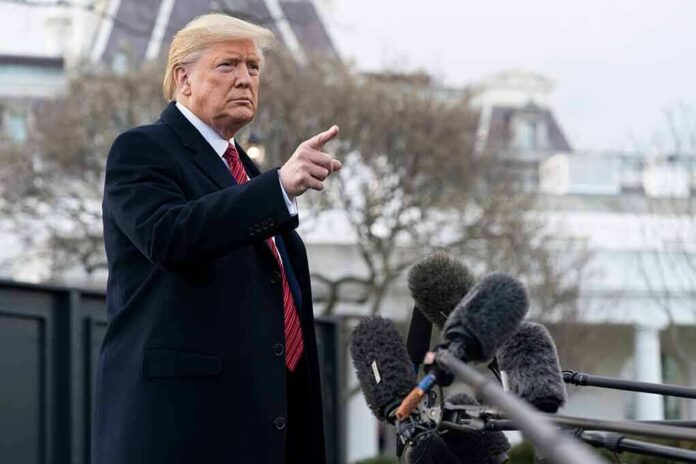
Trump is moving to crush what he calls “Democrat‑enabled crime,” using federal power, new legislation, and public shaming of left‑wing officials who, in his view, turned America’s cities into war zones.
Story Snapshot
- Trump is making crime, illegal immigration, and sanctuary policies the centerpiece of his second term agenda.
- A sweeping “Comprehensive Crime Bill” aims to roll back soft‑on‑crime reforms and tighten bail and pretrial release.
- Progressive prosecutors and Democrat‑run cities face intense federal pressure and potential funding threats.
- Trump’s clash with Democrats over “sedition” highlights the fierce battle over who truly defends the Constitution and rule of law.
Trump’s Core Charge: Democrats Turned Crime into a Crisis
For years, many conservative Americans watched homicide spikes, smash‑and‑grab robberies, and migrant crime stories and wondered why Democrat leaders seemed more interested in protecting criminals than families. Trump has given that anger a clear label: “Democrat‑enabled crime.” He argues that blue‑city mayors, radical prosecutors, and Biden‑era border chaos combined into a perfect storm, unleashing lawlessness while dismissing victims’ fears as overblown or “racist” talking points.
Trump Targets Democrat-Enabled Crime — Either Americans win, or the criminals do. https://t.co/sS7JKY8mqi
— American Thinker (@AmericanThinker) December 10, 2025
Trump’s message resonates with people who watched their neighborhoods decline while progressive elites in safe suburbs preached decarceration and bail reform. From his first campaign through his return to the Oval Office, he has tied rising crime and illegal immigration directly to Democrat policies like sanctuary cities, weakened prosecution, and relaxed pretrial rules. In his telling, this is not just mismanagement; it is a deliberate ideological experiment that sacrificed public safety on the altar of left‑wing social engineering.
The Comprehensive Crime Bill: National Pushback Against “Soft‑on‑Crime” Policies
Now back in power, Trump is not content to just criticize from the podium; he is driving a “Comprehensive Crime Bill” with Republican leaders in Congress. The emerging framework focuses on reversing the most dangerous features of recent left‑wing reforms. It tightens bail standards, widens the definition of violent offenses, and pushes for more electronic monitoring and pretrial detention for high‑risk suspects who previously cycled in and out of jail under Democrat‑backed rules.
For conservatives who watched repeat offenders walk free under progressive prosecutors, this national bill looks like overdue common sense. It builds on voter frustration in places like New York and Illinois, where bail changes became synonymous with preventable tragedies. Republicans are also examining ways to use federal funding as leverage, so local prosecutors who refuse to fully enforce the law or who shield illegal immigrants from cooperation with federal authorities could see key dollars at risk. That approach directly challenges the sanctuary‑city mindset that many readers blame for turning once‑great cities into cautionary tales.
Targeting Progressive Prosecutors and Blue Cities
Central to Trump’s strategy is confronting the new class of progressive district attorneys who campaigned on shrinking prison populations, declining whole categories of cases, and treating most offenders as victims of “systems” rather than individuals responsible for their choices. From Philadelphia to the West Coast, these prosecutors became heroes to activists but lightning rods for residents watching open‑air drug markets, retail theft, and random assaults spiral out of control.
Trump and allied Republicans are exploring ways to expose and rein in these prosecutors, including forcing transparency on case referrals and tying federal justice grants to basic enforcement benchmarks. To many conservative voters, this is not an attack on local control but a defense of it—protecting law‑abiding citizens whose voices were drowned out by well‑funded ideological campaigns. The message is simple: if you take federal money, you cannot simultaneously run a local experiment that effectively decriminalizes large swaths of the penal code.
National Guard Deployments and the “Sedition” Firestorm
The fight has moved beyond legislation into the streets of Democrat‑run cities. To crack down on violent crime waves and accelerate deportations of criminal aliens, Trump has ordered the federalization and deployment of National Guard forces in key urban centers such as Washington, Chicago, and Portland. Supporters see this as Washington finally stepping in where blue‑state leaders failed, protecting law‑abiding residents abandoned by their own officials.
Democrat politicians, however, rushed to the courts, accusing Trump of overreach and portraying the deployments as nearly authoritarian. The clash escalated when six Democratic lawmakers released a video to military and intelligence personnel, heavily emphasizing that service members must refuse unlawful orders. Trump blasted their message as effectively undermining lawful civilian command during a domestic security effort, branding it “seditious behavior” and calling for them to face consequences. The dispute lays bare a deeper divide over who is truly defending constitutional order.
For conservative readers, the episode raises hard questions: when Democrats spent years cheering bureaucrats, generals, and prosecutors who resisted Trump’s policies, was that not its own form of soft rebellion against elected authority? Yet now, when the administration signals it will not tolerate officials undermining lawful crime‑fighting orders, the same crowd suddenly invokes norms and fears of dictatorship. Many on the right see a double standard that punishes any serious attempt to restore order while excusing the policies that fueled the chaos.
What This Fight Means for Families, Communities, and the Constitution
Behind the partisan brawling is something every parent and grandparent feels in their gut: they want safe streets, secure borders, and a justice system that sides with victims rather than career criminals. Trump’s “Democrat‑enabled crime” framing may be blunt, but it speaks to residents who watched decades of proud neighborhoods hollowed out by drugs, gangs, and revolving‑door courts. They are tired of being told crime fears are exaggerated while locking their doors earlier every year.
At the same time, the tools Trump is using—federal deployments, aggressive funding leverage, and public hammering of specific lawmakers and prosecutors—will define the boundaries of federal‑local power for years to come. If successful, this strategy could reestablish a tougher national baseline on crime and illegal immigration, forcing blue jurisdictions to prioritize safety over ideological experiments. If it fails, progressives will take it as license to double down on policies that many conservatives believe already pushed America to the brink.
Sources:
Trump accuses Democrats of ‘seditious behavior’ over video aimed at troops
What is the Trump ‘Comprehensive Crime Bill’?
Mass Deportation and the Future of American Democracy