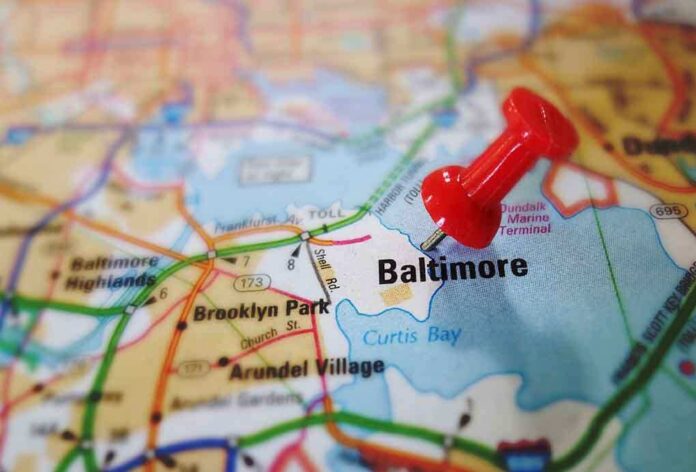
The proposed congressional map in Maryland threatens to eliminate the state’s only Republican seat, raising constitutional concerns and prompting nationwide debate.
Story Overview
- Maryland’s redistricting proposal aims to eliminate the state’s sole Republican-held congressional seat.
- The plan shifts the delegation from a 7-1 Democratic-Republican split to an 8-0 Democratic majority.
- Senate President Bill Ferguson criticizes the map as unconstitutional, raising concerns about the one-person-one-vote principle.
- The proposal could disrupt Maryland’s primary election schedule, necessitating a shift in filing deadlines.
Maryland’s Redistricting Proposal: The Political Shift
Maryland’s Governor’s Redistricting Advisory Commission has recommended a new congressional map that would eliminate the state’s sole Republican-held U.S. House seat, transforming the delegation from a 7-1 Democratic-Republican split to an all-Democratic 8-0. The proposal specifically targets the district of Republican Representative Andy Harris, seeking to redraw it in favor of Democratic candidates. This move is part of a broader national trend, characterized as a “redistricting arms race” by Democrats, responding to Republican gerrymanders in other states.
The commission’s recommendation, approved on January 21, 2026, now moves to the Maryland General Assembly for consideration. The proposal comes with significant timing constraints, as the primary election filing deadline is set for February 23, 2026. If enacted, the map could potentially disrupt the primary schedule, pushing deadlines and elections further into the year.
Constitutional and Procedural Concerns
Senate President Bill Ferguson, a Democrat from Baltimore City, has raised substantial objections to the proposed map, labeling it “objectively unconstitutional.” Ferguson argues that the process was “pre-determined” and lacked proper legal briefings and map analysis. He emphasizes that the map violates the one-person-one-vote principle and could fragment more neighborhoods and communities than the current map.
Governor Wes Moore and U.S. Senator Angela Alsobrooks, who chairs the commission, defend the proposal as a transparent and bipartisan effort. They highlight the extensive public input and engagement that informed the recommendation. However, internal Democratic dissent, exemplified by Ferguson’s critique, suggests deeper constitutional and procedural concerns that could lead to legal challenges.
Maryland Proposes New Congressional Map to Cut Lone GOP Seat https://t.co/0h2oRf4kx8
— @JBellamy1 (@JBellamy110) January 21, 2026
Implications for Maryland and Beyond
The proposed redistricting map’s enactment would eliminate Republican representation in Maryland’s congressional delegation, directly impacting Representative Andy Harris’s political future. This shift in representation could significantly alter Maryland’s political landscape, with broader implications for national House dynamics as the 2026 midterms approach.
Maryland’s move adds to the growing trend of mid-decade redistricting, with potential to set a precedent for other Democratic-controlled states responding to Republican gerrymanders. This may fundamentally alter the traditional once-a-decade redistricting cycle, complicating the political landscape in various states.
As the Maryland General Assembly prepares to debate the proposal, stakeholders on all sides will closely watch for its potential impacts on electoral fairness, community representation, and constitutional compliance. The outcome could influence national redistricting trends, potentially leading to further legal scrutiny and political debate.
Sources:
Maryland Redistricting Commission New Congressional Map
Maryland Moves Forward with Redistricting Plan
Eric Holder Statement on Maryland Redistricting
Redistricting Maryland Official Website
Map to Make Maryland 8-0 for Democrats Heads to General Assembly