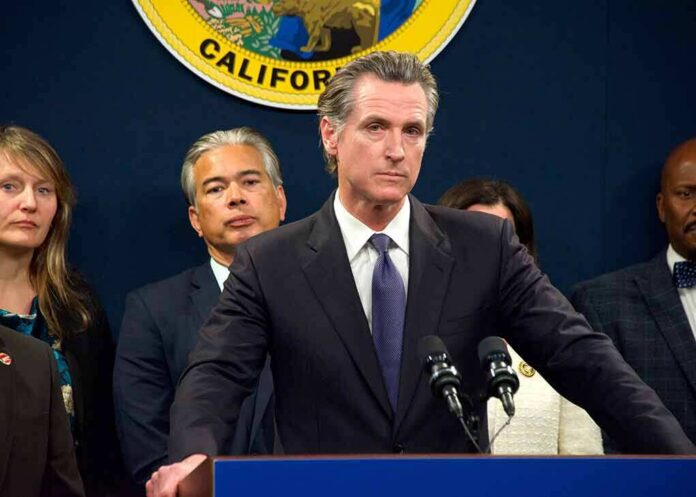
Intra-party detentes are rarely about friendship; they are about sequencing power. Gavin Newsom’s public vow not to run for president in 2028 if Kamala Harris runs is best understood as a strategic constraint designed to shape the Democratic field, donor behavior, and media narratives—valuable even if it never needs to be tested.
At a Glance
- Newsom issued a clear, on-record conditional pledge: he would not run if Harris runs, reiterating it across major outlets.
- The language is precise but conditional—classic political signaling that preserves flexibility while projecting unity.
- Skeptics frame the vow as tactical theater, not a binding commitment; no concrete counter-evidence contradicts the quote itself.
- The real effect is field-shaping: it lowers intra-party conflict risk, steadies donor networks, and positions Newsom if Harris passes.
What Newsom Actually Said—and Why It Matters
California Governor Gavin Newsom stated unambiguously that he would not enter the 2028 presidential race if Kamala Harris does, telling CNN, “I wouldn’t run if she ran,” and amplifying the point with reasoning about avoiding a destructive intra-party clash. The same conditional commitment appeared across leading outlets, quoted in substantively identical language—a sign of message discipline, not offhand improvisation. This is the core fact: a specific, on-record, conditional refusal to oppose Harris. That makes the pledge a live variable in every early conversation about the Democratic field and a lever over donor and activist expectations.
The content of the vow is strategic in two ways. First, it narrows uncertainty for one subset of potential candidates—if Harris jumps in, she effectively receives “right of first refusal.” Second, it reduces the probability of a California-anchored, resource-burning duel that would advantage rivals and fracture overlapping donor circuits—an outcome Newsom himself framed as an electoral gift to everyone else.
How Conditional Pledges Function in American Politics
Conditional commitments are a staple of pre-campaign positioning: they signal respect, shape expectations, and temper conflict without closing doors that might need to be opened later. Unlike a “Shermanesque” refusal—an absolute, no-conditions statement that forecloses a run—conditional language places the contingency at the center of the promise. That is the point. It offers clarity about one scenario while leaving others intact, which is why ambitious politicians favor it when the field is fluid and incentives may shift as entrants, money, and polling evolve.
Political science literature on pledges and conditional rhetoric captures this logic: promises endure when both incentives and capacity align, and practitioners routinely draft them to preserve room for maneuver. Conditional clauses, used deliberately, project credibility and calm key audiences—especially donors—without binding a candidate beyond the stated trigger. Newsom’s wording fits that template exactly: narrow, specific, and anchored to a single counterfactual—Harris runs.
The Skeptical Read—And What It Does and Doesn’t Prove
Commentators quickly characterized the pledge as tactical. Chris Cillizza argued that such statements are often reversed and may reflect a bet that Harris won’t run, allowing Newsom to appear magnanimous while keeping his options open. Ben Domenech made a harder-edged claim: that Newsom is likely to run regardless and that the vow is a sound bite, not a commitment. A broadcast roundup echoed the consensus view that he “absolutely” wants to run in 2028 and that avoiding Harris would be savvy to prevent donor cannibalization.
This skepticism is analytical, not evidentiary. It does not dispute the accuracy of Newsom’s quote or produce counter-documents; it argues about intent and durability. That matters—voters and donors track credibility—but in weighing the record, the on-the-record pledge stands. The tactical reading is a plausible interpretation of why he said it; it is not proof he didn’t mean it.
Field Dynamics: Donors, Calendars, and the California Problem
The most immediate effects of Newsom’s vow are structural, not sentimental. Donor networks dislike zero-sum intramurals between politicians who court the same financiers; the result is higher burn rates and weaker general-election posture. By deferring to Harris conditionally, Newsom signals to funders and operatives that they won’t be forced to choose between two California titans—unless, crucially, Harris actually enters. That stabilizes early money conversations and keeps allied organizations from splitting staff and list assets prematurely.
It also addresses calendar psychology. Early endorsements and bundled commitments harden before formal announcements; a looming Newsom–Harris standoff would freeze many players in place. The pledge effectively thaws those relationships just enough for preparation to continue, while preserving the option set if Harris bows out. That asymmetry—clarity if she runs, flexibility if she doesn’t—is the strategic dividend of conditional language.
Thankfully Gavin Newsom has officially pledged not to run for president in 2028 if Kamala Harris decides to run. Let’s hope Kamala Harris pledges the same thing. 🤣
California Gov. Gavin Newsom has made his clearest statement yet about a potential 2028 presidential campaign,… pic.twitter.com/UlukltHdGH
— SANTINO (@TheRealSantino) September 15, 2026
Comparing the Statement to Alternatives: Why Not Go “Full Sherman”?
An absolute refusal would have signaled finality but at significant cost: it would forfeit leverage if Harris later declined and would cede narrative territory to other contenders. A non-committal answer would keep maximal flexibility but invite speculation about a fratricidal primary, spooking donors and energizing rivals to exploit the potential split. Between those poles, Newsom’s conditional pledge is the median, lower-risk instrument: it reduces the downside of an intra-party knife fight while retaining the upside if the contingency never occurs.
He reinforced this posture earlier in the cycle, stressing that he had never obstructed Harris’s ambitions—language that frames deference as part of a longer-running modus vivendi rather than a one-off tactical move. Whether that is principle or positioning is open to interpretation; what matters structurally is the constraint it communicates to the marketplace of money and endorsements.
How to Judge the Vow Over Time
Three tests will tell you whether this conditional holds. First, the trigger: if Harris formally enters, does Newsom remain out? The metric is behavior, not rhetoric. Second, the incentive environment: do donor flows, polling, and endorsements shift in ways that either increase the cost of defection or make deference rational? Research on pledge-keeping suggests promises endure when incentives and capacity align; expected benefit is a better predictor than moral suasion. Third, the narrative: does the party’s broader electability argument evolve in a way that reframes the pledge as harmful to the coalition? Conditional statements are inherently revisable if the condition changes—or if the party does.
Bottom Line
Take the pledge for what it is: a clear, on-record, conditional constraint deployed to reduce intra-party conflict risk and shape early-field behavior. The quote is uncontested and specific; the skepticism speaks to motive and probability, not to fact. In the practical world of pre-primary politics, that is enough to move money, manage expectations, and buy time. If Harris runs, Newsom has publicly set his boundary. If she doesn’t, he has cleared narrative space to proceed—without having spent a dime fighting his own coalition.
Sources:
youtube.com, nytimes.com, yahoo.com, axios.com, facebook.com, californiaglobe.com, wjla.com, latimes.com, thedemocraticstrategist.org
© fixthisnation.com 2026. All rights reserved.