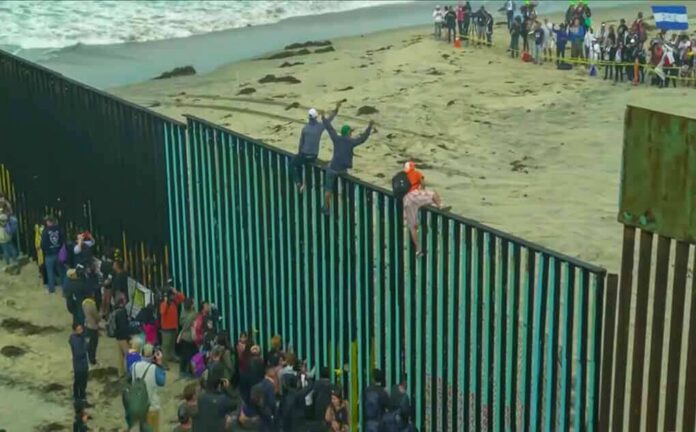
Border shocks like Ceuta’s are not singular events; they are system tests that expose how migration policy, geopolitics, and local capacity interlock—and how quickly they can all be stretched to a breaking point.
The Short Version
- Ceuta’s 2026 surge was simultaneously a humanitarian emergency, a public-order strain, and a geopolitical signal; all three frames are true at once.
- Local leaders and residents described an overwhelmed enclave and fear about safety and recurrence, while Madrid centralized control and rapidly expanded policing and shelter capacity.
- Tens of thousands crossed in hours; many returned within days, but several thousand remained, stressing services and politics.
- The trigger was not singular: enforcement shifts, rumor dynamics, smuggling networks, and Morocco–Spain coordination all played roles.
What Ceuta Revealed: A Border, A City, A System Under Stress
When a short maritime frontier becomes briefly porous, the result is not just a crowd on a beach; it is a cascade through policing, shelter, health, commerce, and politics. In late July 2026, that cascade hit Ceuta—an autonomous Spanish enclave in North Africa—with unusual speed and scale. Local authorities called a humanitarian and security emergency as swimmers and fence-jumpers entered en masse, and residents reported fear, shuttered shops, and uncertainty about what would happen next. Spain’s central government, facing a compressed timeline and a small city at capacity, federalized the response and surged forces and temporary accommodation to contain the shock. Both views capture part of the truth: the city was overrun in operational terms, and the state moved to reassert control.
Numbers carried much of the story. Contemporary reporting put crossings at “tens of thousands,” with some estimates between 60,000 and 70,000 over the peak—figures extraordinary for a territory of roughly 85,000 residents. As quickly as the flow materialized, it partially receded: Spanish officials said roughly 69,500 people returned to Morocco within four days, easing the acute crush but leaving several thousand in place—large enough to strain a compact urban service grid and saturate public space. In that combination—instant overload, rapid partial reversal, stubborn residue—lie the operational lessons for border governance.
Mechanism: How A Short Frontier Can Fail Fast—and Recover
Ceuta’s geography invites suddenness. A narrow littoral, swimmable distances, and urban adjacency to Morocco mean that marginal changes in enforcement or rumor can translate into thousands of attempts within hours. In 2026, people-smuggling networks and false social-media claims about returns policy reportedly amplified the signal that the border could be breached, drawing in not only sub-Saharan Africans but also many Moroccans looking for work or passage into Europe. Once the flow began, the physics of crowd dynamics took over. Fences and shoreline patrols designed for steady-state interdiction became inadequate for surge conditions; on the Spanish side, leaders warned of an immediate humanitarian and security emergency as facilities filled and logistics buckled.
Containment depended on two levers: upstream cooperation and downstream capacity. Morocco–Spain coordination resumed, and Spanish authorities centralized command, deploying the army and augmenting police and civil guard presence by the thousands, while expanding temporary accommodation from hundreds to several thousand beds within weeks. Those measures blunted the surge’s tail, reduced street concentrations, and created processing space—evidence that rapid, centralized mobilization can stabilize a border-adjacent city after a shock, even if it cannot erase the initial overload.
Local Experience: Fear, Closures, And The Uneven Burden
For Ceuta’s residents, the distinction between “perception” and “reality” of insecurity collapses when daily life is disrupted. Reports described businesses advised to remain closed until security could be assured; residents spoke of feeling unsafe and of pressure on services, while protests both for calm and for stronger measures drew thousands. Local leaders used the word unsustainable to describe several thousand people still in the enclave weeks later—an understandable assessment in a compact jurisdiction where beaches doubled as makeshift camps and schools, clinics, and sanitation faced demands for which they were not built. Migrants themselves, many of whom returned quickly, cited hunger, closed shops, and inability to move onward as reasons to leave, a reminder that disorder harms everyone in proximity to it.
This is where border management meets municipal governance. A city is not a holding facility; sidewalks, parks, and waterfronts are designed for circulation, not encampment. When shelter capacity is outpaced and street presence spikes, residents feel it first as a safety concern, authorities measure it as a sanitation and health risk, and businesses treat it as an operational threat. All are describing the same stress from different vantage points.
Competing Frames: Crisis, Control, And What Each Gets Right
Was Ceuta 2026 a breakdown or a managed emergency? Both frames have evidence behind them. The breakdown thesis points to the sheer volume, the initial lack of control at the frontier, the humanitarian toll, and the visible disorder; the managed-emergency thesis cites the accelerated centralization, force deployments, swift expansion of shelter capacity, and the rapid return of tens of thousands within days. Treating these as mutually exclusive misses the structural point: border regimes are probabilistic, not absolute. They rely on cooperation upstream and deterrence at the line; when either slips, even briefly, system load skyrockets. Effective state action can re-stabilize the system, but not without frictions that communities will experience as insecurity in the interim.
As for causation, single-bullet explanations do not fit. Analysts and officials highlighted the confluence of rumor, smuggling networks, and shifts or perceived shifts in returns policy, all operating against the backdrop of Morocco–Spain border politics. In other words, signal plus opportunity plus facilitation equals surge. That pattern is not unique to Ceuta; it is visible wherever geography and geopolitics compress distance between aspiration and access.
Implications: Designing For Surge, Not Just Steady State
The lesson for policymakers is unglamorous but decisive: build surge elasticity into border and city systems. That means pre-negotiated cross-border protocols that can be activated within hours; modular shelter and processing capacity that can expand tenfold on short notice; and an operational doctrine that treats rumor control as infrastructure, not afterthought. Centralization of command during the acute phase helped in Spain’s case, as did rapid increases in police and civil guards, but the larger payoff comes from preventing the boundary conditions for suddenness—resilient coordination with Morocco and credible, communicated pathways for lawful mobility and swift, fair returns.
What Endures After The Cameras Leave
Ceuta’s surge has faded from the headlines, but the architecture it tested remains. Residents carry the memory of fear and closures; migrants carry the scars of risk and return. The Spanish state carries the reminder that a border that holds 360 days a year can still fail spectacularly for two—and that recovery, while possible, depends on pre-built muscle, not improvisation. Seen this way, Ceuta was not an anomaly; it was a stress test whose results were legible in real time: initial overload, partial rapid relief, lingering strain. Preparing for the next test is a choice, not an inevitability, and it starts with acknowledging what the evidence showed.
Sources:
thegatewaypundit.com, euronews.com, bbc.com, reuters.com, theguardian.com, cnn.com, democracynow.org
© fixthisnation.com 2026. All rights reserved.