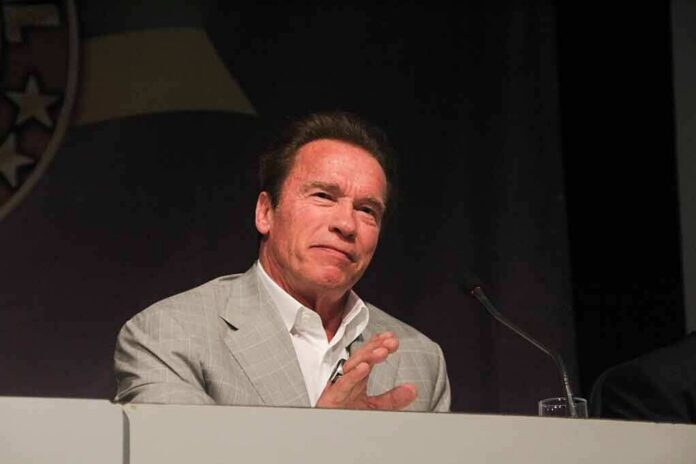
Quiet rooms, not rallies, are where big-city campaigns often find their footing; Arnold Schwarzenegger’s off-the-record session introducing Los Angeles mayoral candidate Nithya Raman to Hollywood, business, and nonprofit figures is a textbook example of how access, not formal endorsements, shapes a race long before votes are cast.
At a Glance
- Schwarzenegger hosted an off-the-record meeting at his Los Angeles office to introduce Nithya Raman to influential figures across entertainment, business, and civic groups.
- The format prioritized questions over choreography; attendees were invited to ask Raman anything, with no endorsement announced or implied.
- Topics reportedly ranged from policing and unions to Los Angeles’s “mansion tax” and city management, and the discussion ran for more than an hour.
- Multiple outlets converged on the same core account within hours, underscoring the event’s substance within the city’s political network.
What Happened: A Private Introduction Built for Serious Questions
According to aligned reports, Arnold Schwarzenegger convened an off-the-record meeting at his Los Angeles office to introduce mayoral contender Nithya Raman to a select room of power brokers drawn from entertainment, finance, and civic organizations. The session was not staged as a donor rally or photo-op; it was structured as an open-question discussion in which attendees could probe Raman’s priorities and approach to governing, with no endorsement announced by Schwarzenegger. That framing matters: in the grammar of elite political access, a host’s willingness to “open the room” is itself a consequential signal, even when the language of endorsement is withheld.
Reporting places representatives connected to United Talent Agency, Main Street Advisors, After-School All-Stars, the Los Angeles Cleantech Incubator, and the USC Schwarzenegger Institute among those invited—institutions that intersect the city’s cultural capital, investment channels, and policy shop floors. The conversation reportedly ran more than an hour, a duration that typically indicates a substantive exchange rather than a courtesy lap.
The Room and the Questions: What the Vetting Focused On
The focal points, as described by subsequent coverage, tracked with the city’s live-wire policy debates: public safety and policing, the voter-approved “mansion tax” on high-value property sales, labor dynamics, and the machinery of city government itself. On policing, Raman reportedly pushed back against the “anti-police” label while arguing for more effective city management—positions that attempt to square progressive reform instincts with residents’ demand for visible order and accountability. The inclusion of unions and the mansion tax signaled a willingness to engage constituencies that underpin Los Angeles politics: organized labor’s leverage in municipal operations, and the property and development interests that influence housing supply, capital flows, and campaign finance ecosystems.
In short, this was classic big-tent vetting: a potential mayor tested by gatekeepers who map Hollywood’s attention economy to the city’s investment and policy pipelines. The setting allowed for granular probing—what would change, who would be at the table, how trade-offs would be handled—without the performative constraints of a press conference.
Why This Type of Meeting Matters in Los Angeles
Los Angeles campaigns are structurally built for access politics. Direct contributions to mayoral candidates are capped relatively low, while independent expenditure committees can marshal much larger sums so long as their spending is not coordinated with campaigns. That architecture shifts the practical center of gravity from formal endorsements to introductions: who gets the room, who can knit together donor networks, and which policy entrepreneurs gain a candidate’s ear early. In that context, a convening hosted by Schwarzenegger—whose profile straddles entertainment, business, and policy—offers a candidate exposure to multiple influence lanes at once, from talent representation to clean-tech investment to civic program operators.
This is not novel in Los Angeles; it is how modern municipal coalitions are assembled. Private forums enable the exchange that public debates rarely allow: detailed trade-off testing, constituency mapping, and credibility checks across communities that care about permitting timelines, labor standards, public safety baselines, and the housing pipeline’s friction points. A host’s neutrality—no endorsement declared—can even be additive, signaling that the point is to vet, not to crown.
How the Coverage Converged
The event moved quickly through the city’s news bloodstream. TMZ reported the off-the-record format and named categories of attendees, emphasizing Schwarzenegger’s role in opening doors and the cross-sector mix in the room. The New York Post and syndicated summaries echoed the non-endorsement frame and the topics on the table—policing, unions, mansion tax—while noting Raman’s efforts to position herself as pro-effective governance rather than anti-police. Fox News Radio captured the same basic structure: a private introduction in Los Angeles, with movers and shakers present, and no formal backing announced. In media terms, that convergence—same host, same format, same issue set—suggests a shared core of facts rather than dueling narratives.
One sensible caveat in any off-the-record setting is that direct transcripts are not released; here, coverage relies on informed sourcing rather than on-tape remarks. That does not diminish the significance of the convening itself, which multiple outlets place at Schwarzenegger’s office and describe in consistent terms.
Implications for the Race: Access as Early Leverage
For Raman, the value proposition is straightforward: enter a room calibrated to Los Angeles’s power map and demonstrate fluency on the city’s hard problems. Clear, well-argued answers on policing, fiscal tools like the mansion tax, and labor relations are not merely box-checking; they are preconditions for being taken seriously by donors and cross-pressured civic leaders who have to live with policy consequences. For attendees, the upside is intelligence gathering: test the candidate’s operating system, identify who she trusts, and assess whether her instincts on service delivery, public safety, and housing production will align with durable city governance.
For Schwarzenegger, the move is consistent with a public life built around convening—less kingmaker than connector. Hosting without endorsing allows him to play catalyst while preserving independence, and it positions his office as a neutral ground where entertainment capital, policy shops, and investment circles can interrogate would-be leaders without the varnish of stagecraft.
Arnold Schwarzenegger hosts private meeting with Nithya Raman and LA bigwigs https://t.co/HuunQdS9uD pic.twitter.com/lbDQOs7BWa
— New York Post Metro (@nypmetro) September 26, 2026
What to Watch Next
Private introductions rarely produce immediate headlines, but they often set off a chain reaction: follow-on meetings with individual stakeholders; policy memos tailored to concerns surfaced in the room; and, eventually, visible coalition signals—committee chairs, co-host lists, and the emergence of aligned independent expenditures within the legal boundaries that govern coordination. If this session achieved its purpose, the next indicators will not be quotes but calendars: more rooms opening, more policy specificity, and the gradual hardening of a governing coalition capable of navigating Los Angeles’s thorniest trade-offs.
Sources:
nypost.com, yahoo.com, tmz.com, www-origin.tmz.com
© fixthisnation.com 2026. All rights reserved.