When a moving vehicle becomes a weapon, the question that decides both criminal liability and public meaning is intent—and in the Bangor case involving Maine Wire reporter Joe Sokol, the evidence to date supports prosecutors’ view that the driver deliberately steered toward the journalist rather than merely making a bad maneuver.
At a Glance
- Video and police charging decisions point to deliberate vehicle movement toward a reporter on public property, consistent with criminal threatening and reckless conduct.
- The suspect, identified by police as Ryan Hayward, was arrested and charged; the core counts reflect an allegation of intentional endangerment with a dangerous weapon (a car).
- Hayward has denied an intent to kill but admitted anger at the reporter’s work, a partial counter-narrative that does not erase the physical facts captured on video.
- Incidents where vehicles are used in confrontations with journalists are part of a broader, documented threat environment for the press, where motive and intent must be proven case by case.
What the evidence shows: sequence, charges, and the intent question
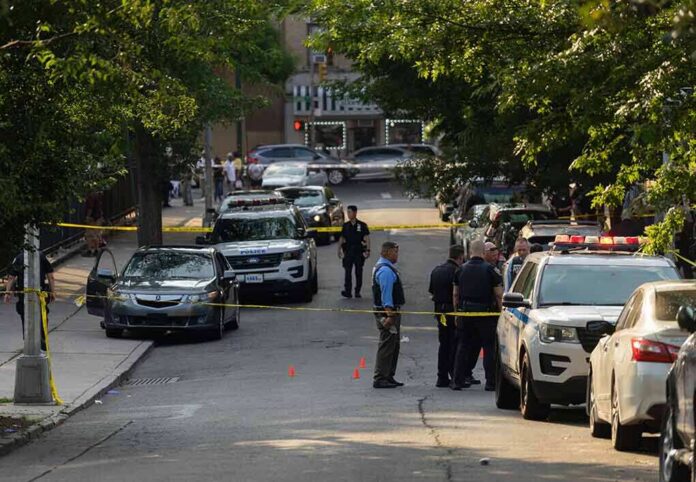
The Bangor incident unfolded just before 8 a.m., on Odlin Road, while Sokol was filming from public property outside the Bangor Comprehensive Treatment Center. Video captured by The Maine Wire shows a driver approach, depart, turn around, and then drive onto the grass toward Sokol, forcing him to evade the oncoming vehicle. Bangor police later identified the driver as 38-year-old Ryan Hayward and arrested him; he faces charges including reckless conduct with a dangerous weapon, criminal threatening with a dangerous weapon, driving to endanger, and violation of conditions of release. Those charging decisions matter. Prosecutors do not need to prove attempted murder to allege weaponized driving; Maine law treats a car as a “dangerous weapon” when used in a way capable of producing serious injury, and the threat count addresses intent to place the victim in fear of imminent bodily harm rather than to kill.
Two elements anchor the state’s theory of intent. First is the vehicle’s path—leaving the travel lane and crossing onto grass to the reporter’s position—which is hard to square with inadvertence. Second is the driver’s behavior before and after: a prior verbal exchange, a departure, and a return that culminates in acceleration toward a known, visible pedestrian. Local outlets that reviewed the footage described this sequence consistently; the police, after investigating, filed charges that align with purposeful endangerment rather than a traffic misjudgment. While an arrest is not a conviction, the combination of visible conduct and charge selection provides a coherent evidentiary spine for the allegation.
The counter-narrative: denial of murderous intent, admission of anger
Hayward has publicly denied trying to kill anyone. In a phone exchange described by The Maine Wire and echoed by other summaries, he rejected the claim of attempted murder while acknowledging that Sokol’s coverage angered him—language that locates motive in grievance but attempts to sever it from lethal intent. As defenses go, this is narrower than it may appear. Criminal threatening and reckless conduct charges do not require homicidal purpose; they require that the defendant either intentionally placed another in fear with a dangerous weapon or recklessly created a substantial risk of serious bodily injury. Anger at content, if anything, can supply mens rea—state of mind—by explaining why a driver would choose a confrontational path rather than a careful one. Denying an intent to kill may rebut the most extreme characterizations, but it does little to undercut the core counts that police actually brought.
This is why the video matters and why prosecutors tend to charge what they can prove. Short clips rarely capture every angle or mindset; yet a vehicle leaving the roadway to close distance to a pedestrian will almost always be read by factfinders as a choice. The remaining dispute, then, is not whether the car endangered the reporter—it did—but whether that endangerment was intentional, reckless, or some idiosyncratic accident. The present public record, including the path of travel and the return pass toward the reporter, favors the first two possibilities and weighs against the third.
How we got here: why vehicles feature in assaults on the press
Journalists work in open, uncontrolled environments; the same openness that makes newsgathering possible also exposes reporters to aggrieved individuals who can translate grievance into force quickly, using whatever is at hand. A vehicle, with mass and acceleration, turns seconds of pique into lethal proximity. Press-freedom trackers treat these confrontations as a distinct threat type precisely because they often pivot on contested intent and because the harm potential is high even when injury is avoided. In the United States and abroad, incident databases and case reports show recurring patterns: crews boxed in by cars, vehicles steered toward camera teams, news vehicles damaged or used as proxy targets when a reporter cannot be reached. The point is not to universalize motive—politics, personal anger, and opportunistic intimidation all appear—but to understand the mechanism that makes a grievance consequential at street level.
That mechanism is visible in Bangor: an initial verbal challenge to filming in public, a grievance about coverage, and then an escalation using a car. Reporters are frequently told to “just call the police” or “move along,” but on a public right-of-way they are within their rights to record; it is precisely that lawful presence that can aggravate those who feel recorded against their wishes. Responsible outlets respond with de-escalation training and positioning discipline—maintaining distance, keeping escape routes, and situationally aligning near curbs, bollards, or fixed barriers. Those are not abstractions; they are literal survival tactics when a driver decides to test proximity.
What counts in court: evidence that persuades judges and juries
In vehicular assault cases involving the press, four evidentiary categories tend to drive outcomes. First, trajectory evidence: tire tracks off pavement, steering inputs, and visible lines of travel in video. Second, opportunity to avoid: the presence of clear alternatives the driver chose not to take. Third, temporal sequencing: a cooling-off interval between an argument and the vehicle’s approach, which undercuts claims of reflexive error. Fourth, post-incident statements that reveal motive or mindset. Bangor investigators appear to have at least the first three; local reporting references the vehicle leaving the roadway, a turnaround maneuver, and video that captures the approach and Sokol’s evasive movement. Post-incident statements—anger at coverage, denial of murderous intent—fit neatly into that framework without neutralizing it.
The legal architecture is equally settled. A car is a dangerous weapon when used to menace or strike; “reckless conduct” criminalizes extreme indifference to known risk, and “criminal threatening with a dangerous weapon” hinges on intentional fear inducement, not bodily injury. Prosecutors often prefer these counts because they are both tailored to the behavior shown and resilient to the standard defense that “I didn’t mean to kill him.” The case will ultimately rise or fall on how convincingly the state links the steering choices to a conscious objective—however brief—to frighten or punish a reporter for doing his job.
This is why some reporters stop going into the streets.
Not because they're afraid of asking hard questions.
Because once you're out there, you don't control what happens next.
Joe Sokol of the Maine Wire was reportedly confronted by a man who backed up his vehicle and then…
— JonathanFrye (@jonathan_f32966) October 1, 2026
Why it matters: protecting newsgathering without mythologizing risk
There is no need to inflate the incident into something it is not; there is every reason to treat it as exactly what it appears to be—a journalist forced to jump aside as a driver left the roadway to confront him, followed by charges that fit the conduct. That kind of escalation chills coverage, not through law but through fear. Editors factor it into assignment planning; insurers price it; younger reporters watch the clip and decide whether they want this line of work. The appropriate response is neither fatalism nor panic, but the unromantic discipline of risk management and the unambiguous reinforcement of legal consequences when vehicles are weaponized against the press. Bangor’s charging posture reflects that clarity; so should our expectations of accountability.
Sources:
redstate.com, themainewire.com, bangordailynews.com, newscentermaine.com, thegatewaypundit.com, townhall.com
© fixthisnation.com 2026. All rights reserved.