Israel’s March 2026 push for a “forward defense area” inside Lebanon signals a dangerous shift from border skirmishes into a Gaza-style ground-and-air campaign with major regional blowback risks.
Quick Take
- Hezbollah’s 2–3 March missile-and-drone attacks on major Israeli bases triggered a rapid Israeli escalation across Lebanon, including strikes in Beirut.
- Israel says its 16 March move is a “targeted ground operation” designed to build a “forward defense area” and reduce the threat to northern Israel.
- The escalation is tied to the wider regional shock of late-February U.S.–Israeli strikes on Iran and the killing of Iran’s Supreme Leader, Ali Khamenei.
- Reports of white phosphorus use and major strikes in dense urban areas have intensified humanitarian and legal concerns.
From “Ceasefire” to Near-Daily Strikes: The War That Never Fully Stopped
Israel and Hezbollah have operated under what amounts to a paper ceasefire since late 2024, yet reporting describes near-daily Israeli strikes inside Lebanon through early 2026. The timeline in the research places the current escalation on top of a long-running conflict arc, including the 1982 invasion, the pre-2000 security zone model, and the 2006 war pattern of rockets versus airpower.
That constant pressure matters because it frames March 2026 less as a surprise eruption and more as a transition into a new phase. Israel’s repeated targeting of Hezbollah infrastructure—across southern Lebanon and as far as the Lebanon–Syria border—built a baseline of routine cross-border violence. The research also notes roughly 500 deaths in Lebanon over the late-2024 to February 2026 period, underscoring the steady toll before the latest escalation.
The March 2–8 Escalation: Hezbollah Attacks, Israeli Strikes, and High-Profile Assassinations
Hezbollah’s 2–3 March attacks targeted Israel’s Ramat David Airbase, the Meron monitoring base, and Camp Yitzhak using missiles and drones, according to the research brief. Israel answered with heavy strikes on Hezbollah strongholds and hit Al-Manar TV’s headquarters in Beirut. Israeli forces were also ordered to seize positions described as “strategic areas” in southern Lebanon, paired with evacuation warnings for nearby towns.
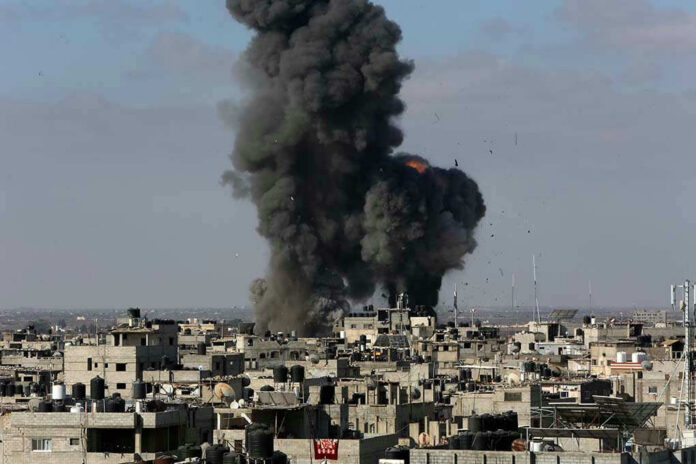
Israel expanded the intensity on 6 March with night strikes described as hitting suspected Hezbollah headquarters in ten high-rise buildings in Beirut, along with drone-warehouse targets. Hezbollah continued firing rockets and artillery toward the Golan Heights and Haifa. On 8 March, an Israeli strike on Beirut’s Ramada hotel killed multiple senior IRGC Quds Force commanders tied to an alleged “Lebanon Corps,” illustrating how quickly the fight broadened from Hezbollah to Iranian-linked command networks operating in Lebanon.
Israel’s “Targeted Ground Operation” and the Logic of a Buffer Zone
On 16 March, Israel announced a “targeted ground operation” in southern Lebanon aimed at establishing a “forward defense area.” Defense Minister Israel Katz said operations would continue until Hezbollah no longer posed a threat to northern Israel, and the research notes he explicitly compared the approach to Gaza operations—Rafah, Beit Hanoun, and tunnel warfare. That language signals expectations of extended clearing operations and sustained pressure on fortified networks.
The stated strategic goal—pushing Hezbollah away from the border—echoes the earlier Israeli “security zone” concept that existed before Israel’s 2000 withdrawal. The research also reports that displaced Lebanese would not be permitted to return to homes in the south until Israel’s goals are met. That condition indicates the operation is not simply a raid-and-exit model, but one that could function as a de facto buffer administered through military control and firepower rather than a negotiated settlement.
Humanitarian and Legal Concerns Complicate an Already Collapsing Lebanon
Lebanon’s weakened state capacity—driven by economic collapse and political paralysis in the research—raises the stakes for civilians when fighting escalates. The research highlights major strikes in dense Beirut areas and anticipates high displacement and civilian harm, especially if the campaign expands. It also cites reports of white phosphorus use in Yohmor causing fires in residential homes, a claim that—if confirmed—would intensify scrutiny under international humanitarian law.
For American readers who care about stability and realism in foreign policy, the key limitation is what the research does not establish: any clear, enforceable post-conflict mechanism that removes Hezbollah’s capabilities south of the Litani River. UN Security Council Resolution 1701 is referenced as calling for disarmament and deployment, yet the research notes Hezbollah retained significant capabilities in practice. Without a workable enforcement plan, the “forward defense area” concept risks becoming an open-ended security commitment.
Sources:
Timeline of the Israel–Hezbollah conflict (27 November 2024 – 28 February 2026)
Israeli operations in Lebanon against Hezbollah: January 19-25, 2026
Israeli operations in Lebanon against Hezbollah: February 9-15, 2026
Progress and challenges on Israel’s northern borders: Syria and Lebanon in 2026
Israel’s “double-edged” ambitions in Lebanon
Israel prepares ground invasion Lebanon; Hezbollah formally joins war