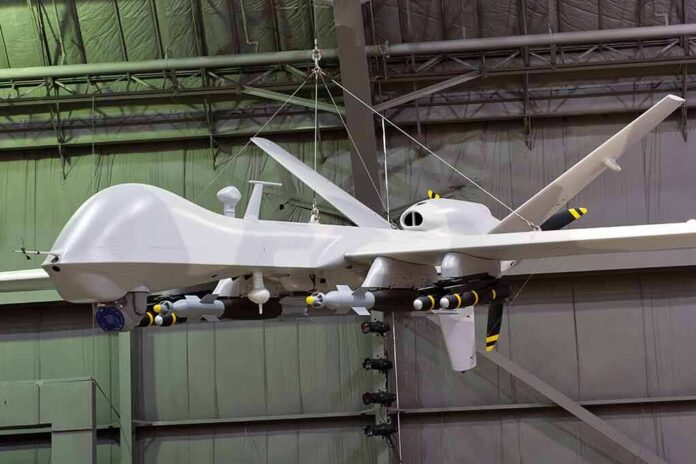
When a government bomb plant begins loading warheads for a startup’s battlefield drones, it signals more than a new product line; it marks the U.S. military’s deliberate conversion of its legacy ammunition base into a flexible engine for unmanned warfare at scale.
At a Glance
- The U.S. Army’s McAlester Army Ammunition Plant (MCAAP) has launched a production partnership with Perennial Autonomy, a drone maker.
- Under the arrangement, MCAAP will manufacture, load, and deliver explosive payloads for Perennial’s unmanned aircraft systems.
- The deal exemplifies how Army-owned facilities are being adapted to support rapid drone and munitions production through public–private models.
- MCAAP’s core competencies—Load, Assemble, Pack (LAP) and warhead production—make it a logical hub for arming attritable drones.
What was agreed and why it matters
The Army has confirmed a formal production partnership between the McAlester Army Ammunition Plant in Oklahoma and Perennial Autonomy, a company that develops specialized drones for the battlefield. At a ribbon-cutting hosted by MCAAP, the service described the arrangement as a transformative defense production partnership—short for the kind of public–private collaboration the Army Materiel Command has been cultivating across its industrial network. The program’s operational core is straightforward: McAlester will produce, load, and deliver the explosive payloads that turn Perennial’s unmanned systems into combat weapons, integrating the drones’ airframes and guidance with standardized, military-grade munitions processes inside a secure government facility.
This is neither a symbolic nor a marginal shift. MCAAP is one of the Army’s anchor plants for conventional munitions—and its mission set already includes warhead fabrication and the Load, Assemble, Pack (LAP) disciplines that knit explosives, fuzes, and cases into safe, shippable weapons lots. Leveraging that infrastructure for unmanned systems compresses timelines and reduces integration risk compared with building a parallel private line from scratch. The upshot: drones that can be armed, qualified, and delivered at tempo using an organic base designed for repeatable, high-consequence work.
How the partnership fits the Army’s industrial playbook
To understand why McAlester arming drones is consequential, situate it inside the Army’s broader industrial modernization. The service has spent the past several years refurbishing and retooling its government-owned, contractor-operated (GOCO) and government-owned, government-operated (GOGO) plants to increase capacity and adaptability for munitions, missiles, and now attritable unmanned aircraft—systems designed to be affordable enough to field in large numbers and, if necessary, to lose in combat. Public–private partnerships (often called P3s) are the connective tissue: they allow industry to tap government floor space, utilities, safety systems, and quality assurance regimes while the Army preserves and upgrades critical capabilities the commercial sector cannot quickly replicate.
Recent artillery projects are the canonical examples. New 155mm production facilities and line expansions—co-developed with private firms—are scaling output to levels measured in six figures of monthly shots. That same toolkit is now being applied to small drones and their effectors, treating them less like boutique aircraft and more like munitions: high-volume, modular, and tightly integrated with existing logistics. McAlester’s role—producing and loading the warheads while Perennial provides the airframes and guidance—mirrors this modular munitions logic.
What MCAAP brings that a startup cannot
Warhead integration is not just a mechanical chore; it is a highly regulated sequence that governs explosive safety, compatibility, environmental conditioning, lot tracking, and end-to-end test protocols. MCAAP’s mission set includes receiving and storing energetic materials, assembling and packing bombs, projectiles, and warheads, and then certifying them for shipment under military standards. It also conducts demilitarization and renovation—an industrial-scale feedback loop that makes the plant adept at handling legacy and next-generation energetics alike. In short, MCAAP already does the risk-heavy work at volume; attaching that competence to unmanned systems shortens the path from prototype to fielded, repeatable capability.
For Perennial, this arrangement offloads the most capital-intensive and compliance-heavy segment of the value chain. The company can concentrate on airframe design, guidance, autonomy, and human-in-the-loop control interfaces, while the Army’s plant ensures that the destructive component—the warhead and its safe integration—meets rigorous standards. The result is an attritable drone that behaves like a munition in the supply chain and like an aircraft in the battlespace.
A shift from bespoke drones to munitions-grade production
The global drone landscape is crowded with compelling demonstrations: loitering munitions launched from canisters, attritable systems controlled by a single operator, even swarms executing simultaneous strikes. But demonstrations do not win wars; production lines do. The Army’s approach—embedding unmanned systems into plants built for munitions—prioritizes rate, repeatability, and interchangeability. It is the difference between a workshop that can build dozens and an industrial base that can deliver thousands with serialized traceability and standardized effects. McAlester’s integration of drone warheads puts unmanned aircraft on that latter path.
Strategically, treating attritable drones as munitions rather than as miniature aircraft reshapes acquisition. Budgets move from one-off platforms to unit costs and lot buys; logistics treat drones as consumables with defined effects; training shifts to employment tactics over painstaking platform husbandry. Aligning with this logic, the McAlester–Perennial split—government handles energetics and final payload integration; industry advances autonomy and airframes—maps cleanly onto how the Army already buys and sustains other classes of munitions and missiles.
The airframe came from a 2023 startup. The warhead comes from Oklahoma.
McAlester will load payloads for Perennial's drones. The plant already has the chemists and the load-assemble-pack crews, and the Army says partnerships like this one help pay for its infrastructure…
— Tate Williams (@Tate_Williams86) October 6, 2026
What we know and what follows from it
Public Army materials and specialty defense reporting converge on the core facts: McAlester hosted the partnership launch, Perennial develops battlefield drones, and the plant will manufacture, load, and deliver the warheads that arm them for combat use. The Army’s characterization is explicit about the partnership’s role in modernizing the organic industrial base and using proven P3 mechanisms to accelerate next-generation capabilities. While announcements of this sort typically avoid disclosing contract vehicles, quantities, or delivery schedules, the industrial logic is consistent with other recent Army modernization efforts: pick a government site with the right energetics skill set, pair it with a private partner that owns the airframe and software stack, and then institutionalize the workflow.
Expect two near-term implications. First, safety and standardization will travel upstream into drone design; warhead interfaces, power budgets, and structural integration will be engineered to MCAAP’s LAP constraints from the outset, reducing rework and qualification risk. Second, munitions-grade documentation—lot acceptance testing, environmental qualification, hazard classification—will become routine artifacts for attritable UAV programs, blurring the historical line between an aircraft program office and an ammunition enterprise. Both shifts improve scale and reliability, which is exactly what operational demand now requires.
Why McAlester is a logical hub for arming drones
McAlester has done this kind of work since World War II, evolving from bomb assembly to a broad portfolio that includes production, storage, distribution, and demilitarization of conventional ammunition. Its infrastructure—magazines, explosive handling lines, environmental conditioning, quality systems—exists to manage energetic risk while producing to spec, at volume, for the joint force. Turning that machinery toward unmanned systems is not a leap; it is an extension. The plant’s own fact sheets emphasize LAP capabilities for bombs, projectiles, and warheads, precisely the competencies a drone partnership needs when the “payload” is not a camera but a controlled detonation designed to achieve a specific terminal effect.
Bottom line
The McAlester–Perennial partnership is a clear, concrete instance of how the Army is recasting its organic industrial base for the era of attritable unmanned systems. By anchoring warhead manufacturing and loading at a government plant built for munitions discipline, and pairing it with a private drone maker’s airframes and guidance, the Army is turning promising prototypes into repeatable, shippable combat power. In industrial terms, that’s the bridge from demonstrations to deterrence—and, when required, to decisive effects in the field.
Sources:
zerohedge.com, army.mil, defensecommunities.org, 163.com, oklahoma.gov, aschq.army.mil, mcaap.army.mil
© fixthisnation.com 2026. All rights reserved.