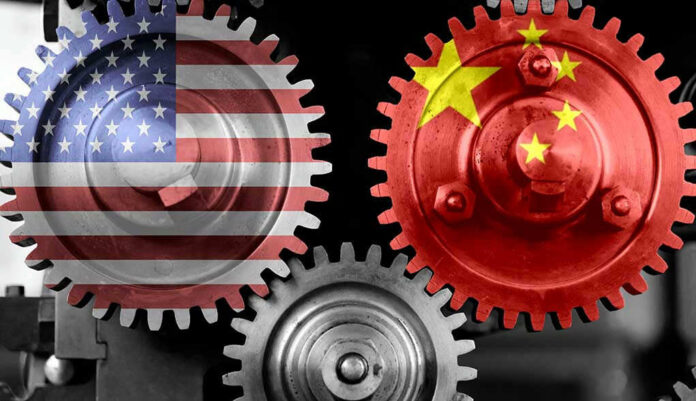
Half of Americans now name China as the greatest U.S. enemy, exposing the Chinese Communist Party’s predatory regime as a direct threat to American sovereignty and prosperity.
Story Highlights
- 50% of Americans view China as the top enemy per Gallup polls, with Republicans at 76%.
- U.S. trade deficit with China reached $295.4 billion in 2024, fueling economic coercion concerns.
- China’s military assertiveness in Taiwan Strait and tech espionage surpass Russia’s regional threats.
- Bipartisan consensus labels China a “foreign adversary,” shifting from outdated “competitor” rhetoric.
Public Perception Solidifies China as Top Threat
Gallup polls in 2025 show 50% of Americans naming China the greatest U.S. enemy, a position held for over three years. Republicans lead at 76%, while overall figures dipped slightly to 33% in Pew’s prompted questions. This reflects frustration across the political spectrum with federal responses to China’s economic dominance and military posturing. Older conservatives, 70% of those 65+, prioritize national security amid ongoing Taiwan tensions. Both parties recognize government failures in protecting American interests against CCP aggression.
Historical Shift from Competitor to Adversary
U.S.-China tensions originated with the CCP’s 1949 founding as a Marxist-Leninist dictatorship. Post-2001 WTO entry granted China market access without reforms, leading to repression rated 9/100 “Not Free” by Freedom House. Trade wars since 2018 failed to close the $295.4 billion deficit. COVID-19 origins and tech bans on Huawei elevated perceptions. Unlike Russia’s regional focus, China’s global leverage through subsidized EVs and supply chains uniquely endangers U.S. manufacturing and jobs.
Key Stakeholders and Power Imbalances
Xi Jinping directs CCP subsidies and surveillance to displace U.S. hegemony. U.S. governments from both parties designate China a “foreign adversary” and pursue de-risking. American public opinion drives policy, with 265,000 Chinese students in U.S. universities versus 800 Americans in China, creating espionage risks. Think tanks like Hudson Institute urge realism to harden institutions. Bipartisan hawks confront CCP opacity, but economic asymmetry persists despite U.S. military superiority.
President Trump’s second term leverages Republican control of Congress to counter these threats, yet deep state elements and past globalist policies hinder full decoupling. Conservatives demand America First measures to restore manufacturing lost to China’s state capitalism.
Why China is America’s Top Adversary https://t.co/VxTecnTVtZ
— ConservativeLibrarian (@ConserLibrarian) April 28, 2026
Economic and Strategic Impacts on Americans
Short-term tariffs raise U.S. costs while Taiwan risks strengthen alliances like QUAD and AUKUS. Long-term, budgets shift to deterrence as global order splits between authoritarian and democratic blocs. U.S. workers suffer from distorted competition eroding factories; researchers face espionage. Sectors like EVs endure industrial coercion, weakening rules-based trade. Expert Miles Yu warns “competitor” labels breed complacency—China aims to undermine the U.S.-led order.
Frustrations unite left and right: elites prioritize reelection over tackling deficits and immigration weaponized by CCP. Traditional values of liberty and self-reliance demand limited government action to shield citizens from foreign predation.
Sources:
Views of China as a Competitor and Threat to the US
Why Washington has made China its central strategic adversary
China Not a Competitor, America’s Top Adversary – Miles Yu
Americans Continue to View China as Greatest Enemy
China Weaponizing US Immigration System