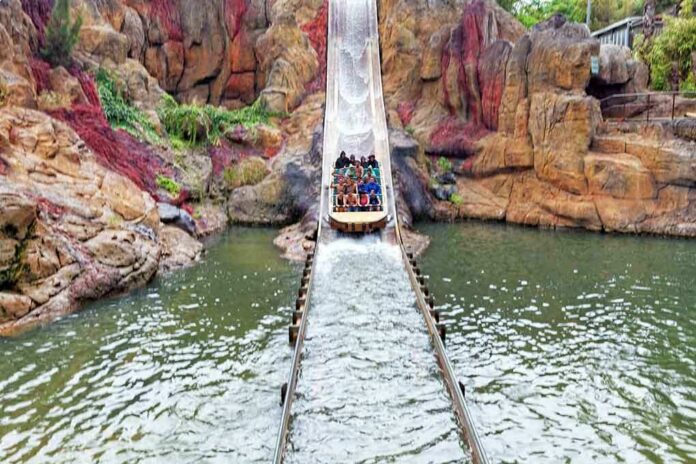
When a 13-year-old boy slid down the 50-foot waterfall drop at Tiana’s Bayou Adventure, the incident exposed a tension that runs through every log flume ride in America: the gap between what a safety system is designed to prevent and what it is physically incapable of stopping.
At a Glance
- A 13-year-old exited the ride vehicle at the top of Tiana’s Bayou Adventure’s final 50-foot drop and slid down the waterfall, sustaining cuts and scrapes before being taken to a hospital for evaluation.
- Multiple witness accounts indicate the boy jumped out voluntarily rather than falling involuntarily — a distinction with significant implications for liability and safety design.
- Cal/OSHA inspected the attraction after the incident and found no mechanical problems; the ride resumed operations without further regulatory action.
- The attraction uses no lap bars or seat belts — standard for log flume design — meaning guest compliance is the sole behavioral restraint at the critical moment before the drop.
- Key facts remain unverified: no official Disneyland statement, no released ride-control logs, and no independent confirmation of whether the stop mechanism engaged in time.
What the Evidence Actually Shows
The core facts of the incident are not seriously in dispute. On the evening of June 21, 2026, a 13-year-old boy exited the log flume vehicle at the crest of Tiana’s Bayou Adventure’s signature drop — the ride’s climactic 50-foot plunge — and slid down the waterfall structure, suffering cuts and scrapes. [1] He was transported to a hospital for evaluation. The ride halted roughly a minute after the incident and remained closed for the remainder of the evening. [3] That sequence is corroborated by multiple independent witness accounts, however informal their origin.
Where the evidence diverges is on two questions: whether the boy exited voluntarily or was somehow propelled out, and whether the ride’s automated stop system functioned as designed. On the first question, the weight of witness testimony points clearly toward a deliberate exit. Reports from WDWNT and Reddit eyewitnesses consistently describe the guest jumping out of the vehicle rather than tumbling involuntarily. [3] An anonymous Reddit commenter went further, stating flatly that the guest exited on his own and that the children involved bore responsibility. [5] No witness account on record describes an involuntary ejection. On the second question — mechanical function — the evidence is thinner and less conclusive, though what exists leans away from negligence: Cal/OSHA conducted an inspection and found no problems, allowing the attraction to resume operations. [1]
The Stop-Mechanism Question: Real Uncertainty, Weak Evidence of Failure
The most consequential unresolved claim comes from an anonymous Reddit user, u/MrMiggenzz, who alleged — citing current or former Disneyland employees — that the ride’s stop mechanism either failed to engage or engaged too late to halt the vehicle before the drop. [4] This claim has circulated widely, but its evidentiary foundation is thin: no names, no documentation, no engineering records. TheDisneyScoop, which aggregated the account, explicitly acknowledged it could not independently verify the claim. The approximately one-minute delay between the incident and the ride halting, noted by witnesses, is suggestive but not diagnostic — operators must visually or electronically confirm an anomaly before initiating a stop, and a 60-second response window is not inherently abnormal.
Cal/OSHA’s inspection, conducted before the ride resumed Monday, found no mechanical problems. [1] That finding is not a comprehensive engineering audit — regulatory inspections at this stage typically assess whether a ride is safe to operate, not whether every automated system performed optimally during a specific incident. Ride-control logs, which would show the precise moment the stop signal was triggered relative to the vehicle’s position at the drop threshold, have not been released. Until they are — through litigation discovery or a regulatory request — the mechanical-failure narrative rests entirely on unverified social media testimony and should be weighted accordingly.
Log Flume Design: A Known Trade-Off
Tiana’s Bayou Adventure, like virtually every log flume attraction in the world, operates without lap bars or seat belts. [2] This is not an oversight; it is a deliberate design choice rooted in the ride’s physics and loading requirements. Log flumes move slowly through most of their course, require guests to board and exit without mechanical assistance, and are engineered so that the vehicle’s geometry — a deep, enclosed trough — provides passive containment during the drop. The assumption baked into that design is that guests remain seated. When they do not, the system has no mechanical fallback.
Industry data reinforces how often human behavior, rather than mechanical failure, is the proximate cause of amusement ride injuries. According to a study of U.S. emergency room data spanning 1990 to 2010, an average of 12 children per day were treated for amusement ride-related injuries — and industry statistics consistently attribute most accidents to rider and operator error rather than defective mechanisms. [11] At Disney parks specifically, a review of historical fatal incidents found that only nine were caused by a direct ride accident involving a defective mechanism; the majority involved guests ignoring safety instructions or disengaging restraints. [16] The Matterhorn Bobsled has twice been the site of serious injuries when guests stood up or fell out of vehicles — a pattern that predates Tiana’s Bayou Adventure by decades.
The Voluntary Exit and Its Legal Weight
The distinction between a guest who falls out involuntarily and one who exits deliberately is not merely semantic — it is the load-bearing question in any potential negligence claim. California premises liability law, and the specific framework governing amusement parks under Cal. Bus. & Prof. Code Section 7902, requires plaintiffs to demonstrate that a park’s negligence was a substantial factor in causing the harm. If the boy exited the vehicle on his own volition, the causal chain runs through his own conduct, not through any failure by Disneyland. The park posts explicit warnings against standing or exiting ride vehicles; those warnings are legally significant. [17]
That said, a voluntary exit does not automatically foreclose all park liability. Comparative fault principles in California allow a jury to apportion responsibility — and if ride-control logs were to show that the stop mechanism should have halted the vehicle before the drop but failed to do so, that failure could constitute a contributing cause even if the guest’s behavior was the initiating one. That is precisely why those logs matter, and why their absence from the public record leaves the full picture incomplete.
What Disneyland’s Silence Costs the Narrative
Disneyland has issued no public statement about the incident — not to confirm the boy’s condition, not to address the stop-mechanism allegations, not to describe what procedural review, if any, it has undertaken. [2] That silence is a communications choice with predictable consequences: it cedes the narrative to Reddit threads and fan-site aggregations, none of which have been independently verified. The park’s reticence is legally understandable — any public statement about an incident that may produce litigation is a liability — but it means that the most specific and alarming claims, including the mechanical-failure allegation, circulate without official rebuttal.
The absence of an official statement should not be read as confirmation of wrongdoing. It is standard crisis-communications posture for any large organization facing potential civil exposure. What it does mean is that readers and reporters are left weighing anonymous employee claims against a regulatory inspection that found nothing wrong — and that is, for now, the honest state of the evidence.
The Honest Bottom Line
The evidence, weighted carefully, points toward a guest-conduct incident rather than a mechanical failure. Multiple witnesses describe a voluntary exit; Cal/OSHA found no problems with the ride; no prior safety complaints against the attraction exist; and the sole claim of mechanical failure traces back to a single anonymous Reddit post with no corroborating documentation. [1] [5] None of that means Disneyland is beyond scrutiny — the ride-control logs should be examined, the stop-mechanism response time should be audited, and the broader question of whether log flume design adequately accounts for adolescent impulsivity deserves serious industry attention. But the available evidence does not support the conclusion that the park’s negligence caused this boy’s injuries. What it supports is the more uncomfortable truth that no safety system, however well engineered, can fully compensate for a rider who decides to leave the vehicle.
Sources:
[1] Web – 13-year-old boy falls down waterfall of Tiana’s Bayou Adventure at …
[2] Web – 13-year-old boy falls down waterfall on Disneyland ride
[3] Web – Guests Scream as Child Falls Down 50 FT Waterfall Drop at …
[4] Web – Young Guest Jumps Out of Ride Vehicle on Tiana’s Bayou …
[5] Web – Boy Slides Down Drop at Tiana’s Bayou Adventure, Ride Closed for …
[11] Web – Tiana’s Bayou Adventure Ride Review: Failure, Flawed or Fantastic?
[16] Web – Tiana’s Bayou Adventure – latest details and construction progress
[17] Web – Hello, Will Tianas Bayou Adventure in Disney… – planDisney
© fixthisnation.com 2026. All rights reserved.