When a U.S. president pledges tariff relief from a stage, the words travel faster than the customs code; with Irish whiskey, President Trump’s public vow at the Irish Open to “take the tariffs off” is the policy signal that matters first, because in transatlantic spirits disputes signaling is often the opening move that sets the machinery of trade implementation in motion.
The Short Version
- At the Irish Open in Doonbeg, President Trump told the crowd he would remove U.S. tariffs on Irish whiskey, prompting loud applause.
- He framed the move as a direct response to requests from Irish leaders and golfers, then clarified it applied specifically to Irish whiskey, not broader EU goods.
- Contemporary reporting placed the prevailing duty in the 10% range, though some outlets referenced 15%; the announcement addressed Irish whiskey alone.
- In U.S.–EU spirits disputes, presidents often announce intent publicly before agencies formalize changes via proclamations and customs guidance.
What happened on the ground in Doonbeg
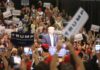
On the closing day of the Irish Open in County Clare, President Trump told spectators, “On behalf of the United States of America, I am going to take the tariffs off” Irish whiskey. The reaction was immediate—cheers and applause—and multiple international outlets captured the moment in real time. Reporters at the venue described it as a crowd-pleaser delivered during the trophy ceremony at Trump International Golf Links & Hotel in Doonbeg, cementing the promise in a high-visibility setting that ensured it would be heard in Washington and Dublin simultaneously.
Trump tied the decision to direct appeals from Irish figures. Accounts referenced requests from Taoiseach Micheál Martin and professional golfers, with several outlets naming Shane Lowry among those who pressed the case. The framing was deliberate: this was cast as a targeted relief for a distinctive national export—Irish whiskey—rather than a broad unraveling of U.S. tariffs on European goods. Later the same day, Trump reinforced that point with reporters, indicating the intent was to remove the tariff on Irish whiskey alone, not other EU products.
Which tariff—and how much—was at issue
Most contemporaneous reports anchored the prevailing duty at 10% on imports of Irish whiskey to the United States. A smaller subset referenced 15%. That discrepancy reflects the churn of competing trade frameworks in recent years and the habit of using round-rate shorthand in news copy. The thrust of the announcement, however, was unambiguous: the president intended to exempt Irish whiskey from the tariff regime then applied to EU-origin spirits. That focus was consistent across Reuters, Politico, AP via AJC, and others, even as the precise rate cited varied by outlet.
For readers who track spirits tariffs, the shifting numbers are familiar. Whiskey has been dragged into larger transatlantic disputes since 2018—first via aircraft and metals spats, later via broader tariff frameworks—so the applicable rate at any given time has hinged on the latest deal, suspension, or reset. The specific rate cited in a news report on a single day matters less than the policy direction signaled by the president: Irish whiskey pulled out of the penalty box, even as other EU goods remain under separate arrangements.
How a presidential tariff announcement becomes policy
In the United States, tariffs live in law and in instruments the executive can adjust—sections of trade acts, proclamations, and negotiated suspensions. Public declarations by a president are not the endpoint; they are the starter’s pistol. Implementation typically proceeds through a presidential proclamation or executive action, followed by operational guidance from U.S. Customs and Border Protection (CBP)—often via Cargo Systems Messaging Service (CSMS) notices—setting effective dates and instructions for brokers and importers. This sequence explains why high-profile tariff moves often appear first as headline-grabbing pledges and only later as line-item changes in entry summaries. It’s the normal lag between policy signal and customs execution.
The Doonbeg pledge fits that rhythm. The president created negotiating momentum and market expectation in a forum impossible to ignore in Ireland. Agencies then have to memorialize scope and timing: whether relief is immediate upon proclamation, prospective from a set date, or—more rarely—retroactive with refund procedures. Industry watchers in the U.S. and Ireland will look for those follow-on documents to translate the applause line into codes, rates, and dates at the port of entry.
Why Irish whiskey is often a proxy in bigger trade fights
Spirits tariffs are rarely about the spirit. They are leverage—popular, easily understood goods that send a political message without crippling entire sectors. In 2019, single malt Scotch, single malt Irish whiskey from Northern Ireland, and various liqueurs were caught up in the transatlantic aircraft dispute; later suspensions and resets showed how quickly these measures can be imposed and lifted when they serve as bargaining chips. Each shift ripples through distillers, distributors, bars, and retailers on both sides of the Atlantic. The Irish category, with heavy exposure to the U.S. market, has been particularly sensitive to even modest duty swings.
That sensitivity is economic as much as symbolic. Irish whiskey’s growth story in the United States has been an export-led renaissance two decades in the making. A 10–15% tariff does not destroy a premium category, but it compresses margins, complicates pricing ladders, and can stall distribution expansion in price-competitive states. By contrast, removing a targeted tariff can catalyze new placements, higher velocity at key price points, and incremental investment in brand-building. The Doonbeg message spoke directly to those mechanics—even if the final tariff-line relief must still be inked through the trade bureaucracy.
Why this announcement landed the way it did in Ireland
Context matters. The Irish Open is a showcase event; delivering tariff relief in that arena signaled recognition of the cultural and commercial importance of whiskey to Ireland’s identity and export economy. Naming specific Irish interlocutors—national leadership and a major-championship winner—cast the move as a response to allies rather than a concession to Brussels. The immediate ovation reflected both local pride and hard-headed economics: for producers, importers, and hospitality businesses, every point shaved from a tariff can be redeployed into wages, promotion, or price competitiveness in the U.S. market.
The president’s same-day clarification—this was about Irish whiskey alone—also set guardrails that matter in Brussels and Washington. It frames any follow-on negotiation as a bespoke carve-out, not a wholesale unraveling of other EU-related duties. In practice, that precision gives U.S. negotiators room to protect leverage in unrelated sectors while delivering a visible win to a close partner country. It is targeted de-escalation, engineered for maximum diplomatic and domestic resonance.
President Trump announced on Sunday at the close of a golf tournament in Ireland that he plans to remove a 15% tariff on Irish whiskey.
More details: https://t.co/BASvZRggip pic.twitter.com/DXwYpxTz5m
— WGN Morning News (@WGNMorningNews) September 14, 2026
What to watch next: from proclamation to port of entry
The operational test is straightforward. First, look for a formal presidential action or USTR communication defining scope: tariff lines that qualify, country-of-origin rules, and whether bottlings finished in Ireland but bulk-distilled elsewhere are included. Second, watch CBP for the effective date and broker guidance. Third, track how fast U.S. importers reprice and reorder—an early indicator that relief is live. Finally, observe whether the carve-out triggers parallel EU or UK moves on American spirits; in this arena, gestures tend to echo across the Atlantic.
Sources:
thegatewaypundit.com, aljazeera.com, politico.com, nytimes.com, ajc.com, essentiallysports.com, forth.news, finance.yahoo.com, reuters.com, cryptobriefing.com, rte.ie
© fixthisnation.com 2026. All rights reserved.