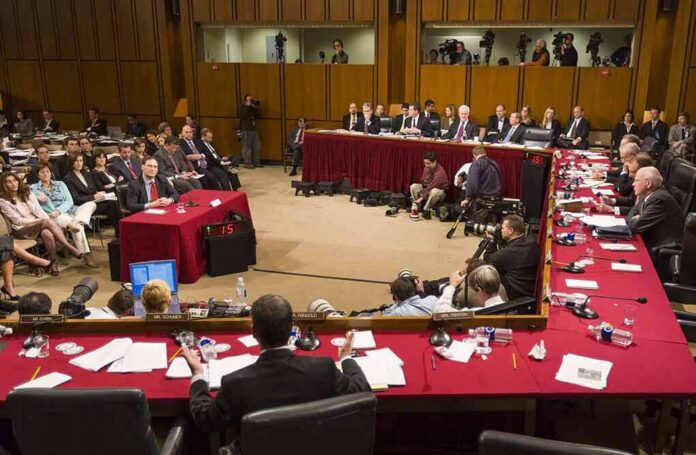
The durable truth in Washington’s cabinet dramas is not that senators love a fight, but that they avoid one—until management failures, personnel upheaval, and strategic drift force them to declare where their confidence really lies.
At a Glance
- Republican unease with Defense Secretary Pete Hegseth hardened from early skepticism at confirmation into open withdrawals of confidence from some GOP senators.
- The discontent centers on management: large-scale personnel actions against flag officers, perceived micromanagement, and difficulty aligning Hill support for budgets and war aims.
- Countervailing forces are real: President Trump’s backing, public defenses from Pentagon officials, and endorsements from retired officers have sustained Hegseth’s position.
- This standoff reflects how the Senate treats cabinet oversight in wartime: public deference to the president until doubts accumulate, then carefully phrased distance rather than a coordinated revolt.
What the GOP confidence debate is actually about
When a Republican senator says, on the record, that he no longer has confidence in a Republican president’s defense secretary, it is not a stray sound bite; it is a signal that private misgivings have breached the surface. Sen. Thom Tillis did exactly that, stating he had “lost” confidence in Pete Hegseth and describing him as “all over the place”—a formulation that points less to policy disagreement and more to concerns about executive control, process discipline, and how a massive organization is being led. Tactically softer but directionally similar was the pattern of GOP senators refusing to vouch for Hegseth’s stewardship and instead routing the question to President Trump—an institutional way of saying support is conditional and not owned by the Senate itself.
That guarded posture did not spring from nowhere. Hegseth’s confirmation was narrow, with several Republican defections, and required Vice President Vance’s tie-breaking vote; it established a low baseline of intraparty confidence and a high bar for performance to quiet doubts. Subsequent Hill reporting described GOP discomfort with reported firings or blocked promotions of dozens of flag officers and a perception that Hegseth’s management style strained the Pentagon’s senior ranks—claims that, taken together, explain why “confidence” became the organizing word for Republican critiques rather than overt calls for removal.
Mechanism: Why personnel and process dominate the critique
Defense secretaries do not directly fight wars; they steward institutions that do. Senators, especially within the president’s party, typically judge a defense secretary on four operational axes: clarity of decision rights between the secretary and the services; the quality and stability of senior personnel; the coherence of strategy-to-budget translation; and the signal sent to allies and adversaries through consistent execution. Republican grumbling has clustered around the first three. Reports that Hegseth removed or blocked the advancement of a large cohort of generals and admirals—changes that ripple through command chains and promotion slates—feed a narrative of churn and micromanagement that can depress confidence independent of any single policy dispute. The budget fights tell a similar story: when a secretary cannot organize his own conference behind major spending plans, senators read it as a sign that process and persuasion are misfiring, not just that numbers are high.
In that light, the on-the-record withdrawal of confidence by Tillis functions as a capstone on months of hedged, deflected, or anonymous critiques. It is substantively different from an ideological objection: it says the machine is not running well enough to prosecute a demanding portfolio and sustain political support for it at home.
Countervailing evidence: Presidential backing and institutional deference
None of this has occurred in a vacuum. President Trump has repeatedly defended Hegseth, describing him as dynamic and effective, and the Pentagon’s public line has echoed that, characterizing his leadership as executing the president’s program with precision. Within the party, some senators have offered unequivocal support—Rick Scott’s pre-confirmation endorsement framed Hegseth as the “right person for the job,” and others rallied during discrete controversies to rebuff calls for his dismissal. These statements matter because they reflect the Senate’s enduring equilibrium: cabinet oversight tends to bend toward deference when a secretary is carrying out the president’s stated agenda and when wartime politics make intraparty fractures costly.
History buttresses that instinct. Formal Senate rejection of cabinet officers is rare across two centuries; far more common is the slow dance of narrow confirmations, episodic criticism, and eventual resets only when the White House decides a change is necessary or the political math truly collapses. That pattern explains why so many Republican comments stop at “it’s the president’s call.” It is not a non-answer; it is a constitutional and political reality stating that, absent unmistakable scandal or catastrophic failure, cabinet tenure is primarily an executive decision, with the Senate reserving open revolt for the hardest cases.
Anonymous murmurs versus named breaks: Weighing the record
Critiques of Hegseth have included a mix of attributed remarks and unattributed sentiment. Anonymous sourcing—reports of GOP senators saying he would not be reconfirmed today, or that they want him to “move on”—is informative but inherently squishier than a roll-call tally or an investigative report. The strongest data points are the ones with names attached: the narrow confirmation with explicit Republican “no” votes and Tillis’s later declaration that his confidence is gone. Those are institutional breadcrumbs, not gossip, and they differentiate garden-variety grumbling from an erosion you can measure.
At the same time, the existence of named defenders, including the president and Pentagon spokespeople, keeps this from reading as a collapse in support. It reads, instead, as a contested midpoint—enough discontent to constrain Hegseth’s freedom of maneuver on Capitol Hill, not enough to trigger a Senate-led ouster while the commander in chief is invested in his tenure.
Hegseth headed for clash with GOP senators as frustrations grow #Senate #DOD #Senaterepublicans #Iran #Republicanshttps://t.co/Q8cKo9FdVe
— Mark Craddock (@mcraddock1967) September 6, 2026
Implications: How this ends—and what to watch
Defense leadership controversies normally resolve along three pathways. First, performance stabilizes: budgets get aligned, personnel pipelines calm down, and criticism fades into the background noise of wartime tradeoffs. Second, the White House manages a transition on its own timetable, framing it as “fresh leadership” rather than a repudiation. Third, pressure compounds—missed objectives, spiraling personnel attrition, repeated Hill defeats—and allies quietly conclude the political costs of continuity exceed the costs of change. Which path prevails here will turn on three observable markers.
Watch the promotions docket and service chief stability; if the tempo of forced departures slows and promotion slates clear with bipartisan comfort, management critiques will lose oxygen. Watch the budget votes; a defense secretary who cannot assemble his own conference for a core plan is negotiating downhill, and lawmakers notice. And watch for named, on-the-record statements beyond a single senator; one public break is a flare, several are a pattern. Against all of that, weigh the countervailing constant: as long as President Trump remains convinced Hegseth is executing his priorities well, institutional deference raises the bar for any Senate-driven change.
Sources:
mediaite.com, aljazeera.com, thehill.com, politico.com, theguardian.com, en.wikipedia.org, newsweek.com, cnn.com, rickscott.senate.gov, foxnews.com
© fixthisnation.com 2026. All rights reserved.