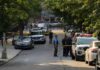
An ICE shooting that puts a loaded gun and a five-year-old child in the same frame is not just another enforcement statistic — it is the moment that turns an abstract immigration debate into a visceral argument about tactics, transparency, and who bears the risk when federal agents make an arrest on a residential street.
Key Points
- An ICE agent shot and wounded a man during a targeted arrest in the Marble Hill section of the Bronx on October 8, at roughly 4 p.m., with a child reportedly in the back seat of the car.
- DHS identified the man as a Dominican national with a prior criminal conviction and alleged gang associations; he survived and was hospitalized in stable, conscious condition.
- NYPD confirmed the shooting but was not involved in the operation, which was carried out entirely by federal agents.
- Protests formed at the scene within hours, and Mayor Zohran Mamdani publicly demanded a “full and transparent accounting” and spoke directly with President Trump about the incident.
- The episode lands inside a broader, documented accountability gap in ICE use-of-force incidents — one that predates this case and that body-camera policy has only partially closed.
What Happened on Marble Hill Avenue
Just after 4 p.m. on October 8, federal immigration agents converged on the corner of West 225th Street and Marble Hill Avenue to execute what the Department of Homeland Security called a “targeted enforcement operation” against a specific individual. During the encounter, an ICE officer discharged a firearm, striking the man agents were seeking. He was transported to a nearby hospital, where he remained conscious and in stable condition. The New York Police Department confirmed that a shooting involving federal law enforcement had occurred but stressed it had no operational role — the arrest, and the use of force, were entirely a federal matter, not an NYPD action.
The detail that transformed a routine federal arrest into a citywide flashpoint was the presence of a child. Mayor Mamdani said early reports indicated agents had surrounded the man and a five-year-old riding in the back seat of his car before firing multiple rounds. Eyewitnesses at the scene described a chaotic aftermath: one woman told reporters the wounded man pleaded “don’t let me die” as blood came from the back of his neck. ABC7 and other local outlets corroborated that a child believed to be around five years old was in the vehicle at the time shots were fired.
Who DHS Says He Is
DHS’s public statement framed the operation around the man’s criminal history rather than his immigration status alone. The agency described him as a Dominican national with a prior conviction and alleged affiliation with the Trinitarios gang, a street organization with a long record of violent crime in New York’s Dominican immigrant community. That framing is the backbone of the administration’s defense of the shooting: agents, DHS maintains, were not conducting a routine civil immigration sweep but pursuing someone it classifies as a public-safety threat. Critics of the operation have not disputed the man’s identity as a Dominican national or that DHS alleges a criminal record; the dispute that has emerged publicly centers instead on tactics — whether surrounding a vehicle with a child inside and discharging a firearm multiple times was a proportionate response, regardless of who the target was.
The Street Reaction and City Hall’s Response
Protesters assembled at the scene within the hour, confronting agents directly as news crews captured the standoff; video from the ground showed demonstrators shouting at and filming officers who remained posted at the intersection. The confrontation extended into the evening and drew sustained attention from local television and national outlets alike. Mamdani’s office issued a formal statement calling the shooting an incident that occurred “in a residential neighborhood” and said the mayor had personally called President Trump to discuss it, a notable step that signals how seriously City Hall is treating the episode’s political stakes. The mayor’s office added that New Yorkers deserve “a full and transparent accounting of the circumstances surrounding this incident” — a demand echoed by immigrant-advocacy groups.
Murad Awawdeh, a prominent immigrant-rights advocate, went further, accusing ICE of spreading what he called “unchecked, rampant violence” in the city and calling for an immediate investigation alongside release of any body-camera footage. That demand for footage is not incidental — it points directly at the structural weakness that has shadowed ICE accountability efforts for years and that this incident now tests in real time.
Why Body-Camera Footage Is the Real Pressure Point
ICE only began equipping officers with body-worn cameras in earnest under a February 2025 policy, and that policy gives the agency’s director discretion to withhold footage of fatal shootings and other serious confrontations whenever release is not judged to be “in the best interests of the agency”. That discretionary clause means the public’s access to footage from an incident like Marble Hill is not guaranteed even where cameras were rolling. Compounding the concern, a RAND Corporation assessment of ICE’s earlier body-camera pilot program found no statistically significant reduction in use-of-force incidents or complaints among camera-wearing agents compared with those without them. Cameras can document what happened after the fact, in other words, but the evidence to date does not show they change officer behavior in the moment — and whether footage from this shooting is ever made public will depend on agency discretion, not an enforceable right of disclosure.
What This Case Reveals About the Pattern
Marble Hill is not an isolated data point. Reporting around this incident places it among nearly two dozen ICE shootings documented over roughly the past two years, a frequency that has made such episodes a near-routine feature of heightened interior enforcement rather than a rare aberration. Each case tends to divide along the same fault line: supporters of aggressive enforcement emphasize the target’s criminal record and any gang affiliation, as DHS did here, while opponents emphasize tactics, bystander risk, and the absence of guaranteed transparency afterward. Both halves of that argument can be true simultaneously — a man can have a documented criminal history and the operation that wounded him can still raise legitimate questions about whether firing multiple rounds near a child was the only available option. Resolving that tension, case by case, is precisely what body-camera footage was supposed to make possible; whether this incident finally forces its release may determine how much public trust either side recovers.
NOW: "F you!" Anti-ICE Protest at BRONX ICE Shooting Scene.
A person was shot during interaction and detainement with ICE Agent, 5 year old child was in the back seat of the car.
Video by @newyorkcitypeople | Licensing @FreedomNTV [email protected] https://t.co/Id476gDSnU pic.twitter.com/TtqZnoFuCg
— Oliya Scootercaster 🛴 (@ScooterCasterNY) October 8, 2026
Sources:
amny.com, nyc.gov, brooklyn.news12.com, nbcnews.com, thegatewaypundit.com, cnn.com, aol.co.uk, lusa.pt, rmb.reuters.com, dw.com, nwahomepage.com, theepochtimes.com
© fixthisnation.com 2026. All rights reserved.