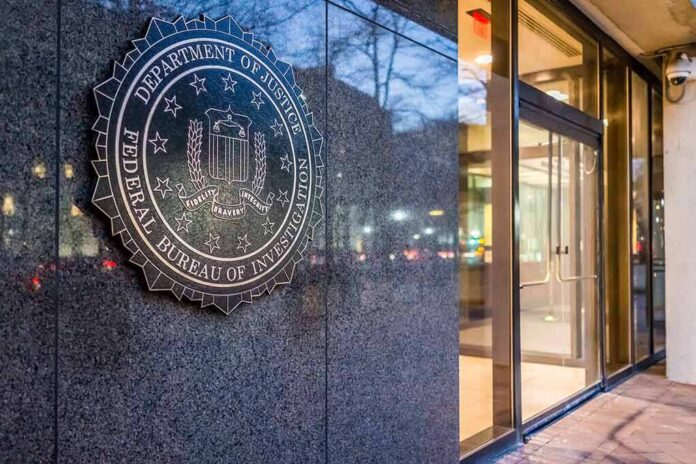
When a threat against a sitting president arrives paired with a firearm image and a plainspoken intent to kill, investigators do not wait for context to clarify itself; they move, because the law treats such communications as potential true threats, not political theater.
The Short Version
- Federal prosecutors charged an 18-year-old Massachusetts man by criminal complaint with threatening to kill President Trump on Instagram, allegedly writing “im gonna kill trump.”
- The June 21 Instagram message allegedly included a photo of the sender holding a scoped rifle with the caption “it’s time,” reinforcing prosecutorial claims of seriousness.
- Investigators say four Instagram accounts carrying violent content were linked to the same individual; he also allegedly threatened to “shoot up a school.”
- A firearm was recovered in a court-authorized search at the suspect’s residence; state firearm charges were also reported.
What prosecutors say happened and why it triggered a federal case
The U.S. Attorney’s Office for the District of Massachusetts announced a federal charge under the presidential-threat statute following an investigation into a cluster of Instagram accounts that, according to the complaint, contained violent rhetoric and explicit threats. Prosecutors allege that on June 21, the suspect used Instagram to send a direct message that included a photograph of himself holding what appeared to be a scoped rifle, alongside the messages “it’s time” and “im gonna kill trump.” Federal authorities characterize that communication as a direct threat to the President of the United States, sufficient to invoke 18 U.S.C. § 871, the long-standing statute that criminalizes threatening the president.
Contemporaneous reporting, drawing on the charging documents, echoes that sequence of events and emphasizes the rifle image accompanying the threat—a factual detail that matters legally and operationally because threats coupled with weapon imagery are treated as higher-risk signals by threat-assessment teams. Prosecutors also allege the individual issued other violent communications, including a threat to “shoot up a school,” broadening the risk profile beyond a single target.
Linking online accounts to a person and the role of corroborating evidence
Attribution is the hinge of any online threat case. Here, prosecutors state they identified four Instagram accounts and, through further investigation, associated each with the suspect rather than relying on one handle or a single screenshot. That claim of multi-account linkage matters: it suggests investigators used standard corroboration methods—device usage, login IPs, or overlapping content patterns—even if those technical specifics are not recited in public summaries. The case proceeded via criminal complaint unsealed by a federal magistrate judge, providing a formal record and triggering an initial appearance—again, an indicator that the government believes it can substantiate authorship and intent to a probable-cause threshold.
Search execution at the residence added a physical dimension. Reporting states a firearm was recovered—described in one outlet as a revolver-style handgun—and that state firearm charges followed. Other coverage, referencing charging documents, links the weapon to the rifle shown in the Instagram image, though summaries differ on whether a rifle, a handgun, or both were recovered. The operational takeaway is narrower than the headlines: investigators found a real firearm in proximity to the person they allege sent a rifle-bearing threat, a corroborative point that elevates concern even amid variation in weapon descriptions.
How the law draws the line: true threats versus hyperbole
Speech that focuses on politics, even caustically, is protected; a serious expression of intent to commit unlawful violence is not. That is the Supreme Court’s “true threats” doctrine, which has been applied specifically in presidential-threat prosecutions under § 871 since at least Watts v. United States (1969). In Watts, a conditional, crowd-pleasing remark about “getting [the president] in my sights” at a public rally was deemed crude political hyperbole, not a prosecutable threat, given its conditional phrasing and context. The doctrine, refined over decades and revisited in recent First Amendment cases, turns on context, intent, and how a reasonable person would interpret the words in situ—not on whether the speaker ultimately had the means to carry them out.
The facts alleged here differ in critical respects from Watts. Prosecutors describe a direct message pairing a declarative homicidal statement with a firearm image; the communication was not a conditional quip in a public debate setting. That pairing—the content and the presentation medium—shifts the analysis squarely into “true threats” territory as the government sees it. DOJ guidance itself underscores that § 871 prosecutions focus on communications that convey a serious intent to inflict harm on a protectee, evaluated in the full context of delivery, audience, and surrounding conduct.
Threat assessment logic: why an image can be as probative as a sentence
Modern protective intelligence treats words, images, and behaviors as an integrated signal. Decades of research on targeted violence finds that individuals who ultimately act often “leak” their intent beforehand—disclosing plans, showcasing weapons, or rehearsing narratives of violence. In one cross-sectional study of mass shooters, nearly half leaked their plans in advance, sometimes with specific details. Threat-assessment frameworks build on this empirical base, flagging acute “warning behaviors” such as identification with prior attackers, demonstration with weapons, and last-minute operational preoccupation—all proximal indicators that elevate risk even when formal charging standards remain distinct.
Against that backdrop, the government’s emphasis on the scoped-rifle image is unsurprising. An explicit kill statement buttressed by a firearm depiction, investigators would argue, moves the communication beyond vague anger and toward operational signaling. The alleged additional threat to attack a school compounds that judgment: multiple targets, multiple channels, escalating rhetoric—each a tick upward in risk triage for protectees and the public.
Process posture and what it does—and does not—resolve yet
The case arrived in court via a criminal complaint, a mechanism used to arrest and initiate proceedings before a grand jury decision on indictment. That posture reflects the government’s assessment that probable cause exists; it is not a conviction. The complaint’s unsealing by a magistrate judge provides a baseline judicial checkpoint and signals that more detailed affidavits, exhibits, and digital records typically follow during discovery and, if indicted, pretrial litigation.
For the lay reader trying to calibrate significance: the core point is straightforward. Prosecutors allege a direct, unconditional threat to kill President Trump sent over Instagram, visually anchored by a rifle image; they say they tied multiple accounts to the same individual; and they recovered a firearm at his home. Those facts, if proved, align with how § 871 is meant to function: to interdict serious, targeted threats against a president before words turn into action.
Why this matters beyond one defendant
Threats against presidents are not hypothetical risks—they are a recurrent feature of American life. The Secret Service’s historical review records multiple attacks on presidents since the 19th century, several of them fatal; that history justifies a protective posture that errs on the side of early investigation. At the same time, constitutional doctrine insists on preserving space for heated political speech. The balance is not accidental; it is the product of decades of jurisprudence, investigative practice, and painful experience. When a communication crosses the boundary from rhetoric into a serious expression of violent intent—especially when accompanied by imagery that suggests capability—federal law expects a swift response. That is the system working as designed.
Sources:
redstate.com, justice.gov, bostonherald.com, nbcboston.com, bostonglobe.com, bnonews.com, boston25news.com, massdailynews.com, ground.news, dailyvoice.com, jamanetwork.com, supreme.justia.com, govinfo.gov
© fixthisnation.com 2026. All rights reserved.