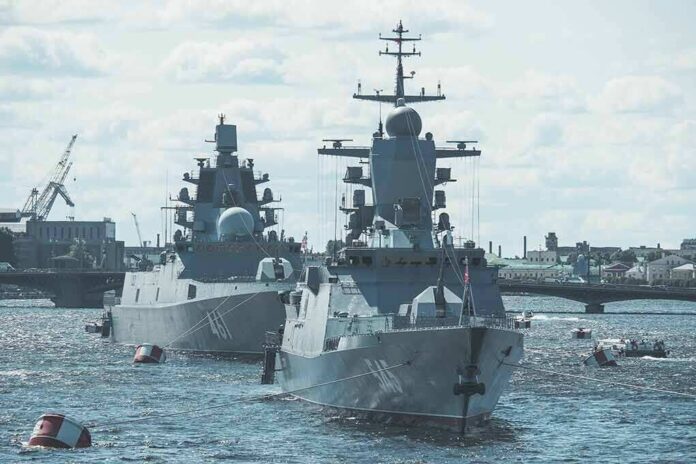
When chokepoints turn into bargaining chips, maritime law collides with gray-zone coercion, and the world’s energy and trade lifelines become instruments of strategy rather than neutral thoroughfares.
At a Glance
- Iran’s announced “closure” of the Strait of Hormuz and Houthi control around Bab el-Mandeb exemplify gray-zone maritime coercion: leverage without a formal blockade.
- Washington and partners frame these actions as unlawful threats to freedom of navigation and global supply chains; UN statements and maritime advisories document a recurring pattern of attacks and seizures.
- The legal regime is clear on paper—transit passage through international straits—but contested in practice when states and proxies use mines, drones, and boardings to reshape behavior.
- The strategic stakes are systemic: even partial disruption reroutes cargo, raises insurance, and compels multinational naval deployments.
Two straits, one playbook: coercion under the threshold of open war
Iran’s messaging that the Strait of Hormuz is “closed until the U.S. blockade is lifted,” coupled with warnings that approaching vessels would be treated as hostile, is the classic outline of gray-zone coercion—threats and selective force to deter traffic without declaring or enforcing a lawful blockade. In parallel, Houthi forces—aligned with Tehran—consolidated positions overlooking the Red Sea approaches near Bab el-Mandeb after Yemeni government withdrawals, giving them the capacity to menace shipping in that second critical chokepoint and to mount periodic attacks and interdictions. The point is not simply denial; it is leverage. By injecting calibrated risk into predictable trade patterns, an actor can extract political concessions while skirting the bright-line rules that accompany declared war.
For shipowners and insurers, labels matter less than the hazard environment. Advisories catalog a menu of threats—drones, anti-ship missiles, explosive-laden boats, small-arms harassment, and boardings—across the southern Red Sea, Bab el-Mandeb, the Gulf of Aden, and waters abutting Hormuz. The result is diversion around the Cape of Good Hope, higher premiums, and a rolling reallocation of naval escorts and surveillance assets.
Freedom of navigation versus “defensive” rationales
Washington’s case at the United Nations is direct: Iran and its allies are eroding freedom of navigation, attacking or detaining commercial vessels as tools of statecraft, and jeopardizing energy, food, and humanitarian flows through both Hormuz and Bab el-Mandeb. U.S. maritime bulletins identify specific incidents of Houthi attacks and Iranian seizures as exemplars of the risk profile. They also highlight the Houthis’ self-declared “embargo” against Saudi-linked traffic as a coercive regime imposed outside lawful authority. Regional partners echo the frame: a proposed Saudi-led maritime coalition describes itself as defensive and focused on securing trade routes and energy lines through the Red Sea corridor.
Tehran’s narrative casts these measures as responsive—deterrence in the face of external military pressure and economic strangulation—yet the techniques employed impose indiscriminate costs on neutral shipping and violate the legal guarantees afforded to international straits. That tension is the heart of modern maritime crises: a party may experience its actions as reciprocal defense even as the broader system experiences them as unlawful economic coercion.
The law is clearer than the practice: transit passage and its limits
International straits are governed by the transit passage regime, which guarantees continuous and expeditious navigation to all vessels, military and civilian alike; coastal states cannot suspend that right. The Strait of Hormuz, though bounded by Iranian and Omani territorial seas, qualifies as an international strait for global navigation, and the same functional logic applies to Bab el-Mandeb connecting the Red Sea and Gulf of Aden. In theory, this clarity should inoculate commercial traffic from coercive interruption. In practice, mines laid in shipping lanes, forcible boardings, and stand-off missile and drone attacks alter behavior long before lawyers can vindicate rights. That is the essence of the gray zone.
The 1980s “Tanker War” remains the cautionary analogue. As Iran and Iraq targeted each other’s oil exports, neutral-flagged ships were frequently struck, and the legal regime proved slower than the operational tempo of harassment, mining, and escort operations. The modern Gulf pattern—ship seizures, sporadic fires from shore, and navigational warnings that chill traffic—tracks that history uncomfortably well.
Mechanics of coercion: how risk is manufactured at sea
The maritime toolset is deliberately varied. A coastal force can seed moored or drifting mines at chokepoint approaches, complicating hydrographic clearance and raising insurance instantly. Armed fast boats can swarm, board, and detain; drones and shore-based anti-ship missiles can hold lanes at risk episodically, generating headlines and route deviations; and “administrative” seizures under disputed legal pretexts can tie up hulls and crews for months. U.S. advisories since 2024 have documented precisely these methods by both Iranian forces and the Houthis, with exemplars that include seizures of foreign-flagged tankers and a resumption of one-way UAV and missile attacks on commercial ships.
The strategic effect does not require continuous fires. A handful of well-publicized strikes or interdictions, plus authoritative warnings that “the strait is closed,” can induce a commercial pause disproportionate to the military effort. Even when CENTCOM or partner navies maintain lanes and convoy systems, the baseline cost of doing business rises; underwriters and charterers are pricing risk, not debating legal memos.
Why carrier deployments matter—and what they cannot do
Carrier strike groups are not a panacea for harassment at scale, but they are decisive for three tasks: suppressing coastal fires if necessary, protecting high-value units and convoys through layered air defense, and signaling resolve that deters the most escalatory moves. Rotational deployments into the region—publicly tracked and widely reported—are designed to stabilize expectations and reassure shippers that transit remains viable. Yet even three carriers cannot neutralize every drone, skiff, or mine in two straits spanning hundreds of nautical miles; persistent maritime security is a coalition, multi-domain endeavor that pairs naval presence with intelligence sharing, air and missile defenses ashore, and diplomatic pressure on sponsors of proxy forces.
Where the substantive disagreement lies
The factual dispute is not over whether attacks and seizures have occurred—they have, with specific incidents enumerated in official maritime notices—but over characterization and causality. Tehran and allied actors describe their posture as retaliatory and conditional; Washington and partners describe it as unlawful coercion that targets noncombatants. On the evidentiary ledger, the documented advisories, UN remarks, and coalition statements provide a granular record of hostile methods and their impact on commercial traffic; the legal framework of transit passage corroborates the conclusion that threats against neutral shipping breach international norms.
This does not erase the triggering grievances that motivate coercion—sanctions, strikes, and great-power contests—but it clarifies responsibility for risk imposed on third parties. In maritime security, the standard is simple: ships’ rights are not bargaining chips.
Practical implications for shippers and states
For industry, risk mitigation begins with routing and scheduling agility, strict compliance with maritime security advisories, AIS discipline balanced with safety, and rehearsed shipboard defense and citadel procedures. For states, the durable answer is layered: visible naval presence; rapid mine countermeasures capacity; integrated air and missile defense to blunt shore-based threats; and sustained diplomacy that raises the cost of proxy-enabled maritime aggression. The historical base rate warns that absent coordinated pressure and a credible off-ramp, cycles of seizure and retaliation tend to metastasize toward something that looks like the Tanker War redux.
Bottom line
The narrative contest around Hormuz and Bab el-Mandeb—defense versus coercion—matters politically, but the operating reality at sea is plainer. International law protects transit; documented attacks and interdictions erode it; and the techniques now in play are optimized to live in that gray zone. Strategy that treats these straits as pressure valves will continue to extract economic rents and diplomatic concessions unless matched by an equally integrated counter—legal, naval, and political—that restores the default expectation of safe passage.
Sources:
zerohedge.com, britannica.com, internazionale.it, economictimes.indiatimes.com, u.aa.com.tr, maritime.dot.gov, reuters.com, yahoo.com, upi.com, defence-institute.be, lawfaremedia.org, washingtoninstitute.org, onlinelibrary.wiley.com, congress.gov
© fixthisnation.com 2026. All rights reserved.