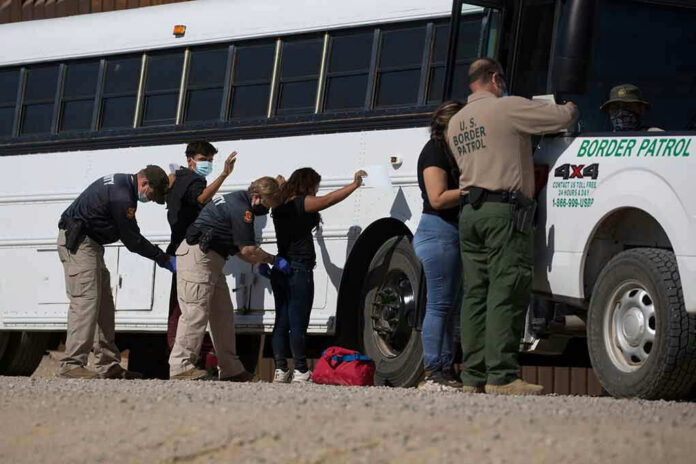
The “big beautiful bill” did not just boost Trump’s immigration agenda; it quietly rewired America’s enforcement machine for years to come.
Story Snapshot
- About $170–190 billion in long-term immigration enforcement funding locked in under one law
- Massive expansion of detention beds, ICE officers, and border wall construction through 2029
- Critics say the bill is a blank check with weak oversight and harsh cuts to healthcare and safety nets
- The fight over this bill exposes a deeper split on what “border security” should mean in America
How One Bill Turned Immigration Enforcement Into A Mega-Project
Congress used the One Big Beautiful Bill Act to do something that never survives normal political fights: it front-loaded almost a decade of immigration enforcement money in one shot. Instead of yearly budget battles, the Department of Homeland Security locked in around $170 to $200 billion for immigration enforcement alone, depending on how you count related programs. That bulk funding insulated Immigration and Customs Enforcement and Customs and Border Protection from shutdown drama that hit other parts of the government later.
The size of the immigration piece is staggering even by Washington standards. Reports from policy groups and news outlets describe roughly $75 billion for Immigration and Customs Enforcement, tens of billions more for Customs and Border Protection, and large sums for Coast Guard and state and local enforcement support. For American conservatives who want a secure border and predictable policy rather than endless stop-and-go funding fights, this kind of long-term commitment looks like long overdue follow-through.
Detention Beds, ICE Hiring, And The Push For Mass Deportation Capacity
The clearest way to see how this bill “supercharged” enforcement is to look at detention and manpower. The law sets aside about $45 billion to expand immigration detention centers, including facilities that hold families. That money is enough to push daily detention capacity from roughly tens of thousands of beds to levels that rival or surpass federal prison systems, and it stays available through fiscal year 2029. In simple terms, the bill built the hardware for large-scale detention and deportation rather than one-off crackdowns.
On top of beds, the bill pours around $30 to $32 billion into hiring and equipping immigration officers and running removal operations. That supports roughly 10,000 new Immigration and Customs Enforcement officers, more deportation flights, expanded transportation, and upgraded vehicles and technology. Supporters argue a serious enforcement system needs actual people on the ground, not just speeches about the rule of law. Critics reply that this skews resources toward arrest and detention instead of faster legal processing or more orderly legal immigration channels.
The Border Wall, Surveillance Build-Out, And The Quiet Discretion Fund
The bill also revives Trump’s border wall dream with more money than his first term ever saw. Analyses of the law point to roughly $46 to $47 billion for new wall segments and related infrastructure. That is on top of more than $6 billion for screening and surveillance technology, including systems that use artificial intelligence and advanced sensors to track crossings and possible smugglers. For conservative voters worried about cartel traffic and chaos at the border, this looks like finally matching tough talk with concrete miles of barrier and digital eyes.
The “big beautiful bill” that’s the Laken Riley Act and the broader border security funding package passed in 2025. The Department of Justice is touting how it’s giving them more tools: faster deportation of criminal illegal immigrants, mandatory detention for people charged with… https://t.co/DO4opDNriR pic.twitter.com/H7R90Szv9Z
— Patricia 🇺🇸 (@1109Patricia) June 27, 2026
Buried in the text is a quieter but important piece: a discretionary enforcement fund of around $10 to $22 billion that the Homeland Security Secretary can use for “any border enforcement purposes” with limited reporting rules. That kind of open-ended pot lines up with a common-sense desire for flexibility in fast-moving security situations. Yet it also raises a classic small-government concern: any time Congress hands billions over with fuzzy rules, taxpayers have to trust that future officials share their values. That is not always a safe bet.
The Trade-Offs: Debt, Health Care Cuts, And Oversight Concerns
The enforcement surge did not appear from thin air. Congressional Budget Office estimates show the full bill increases federal debt by roughly $4.1 trillion through 2034, with even higher costs over 30 years. To offset part of the spending, lawmakers cut deeply into healthcare and safety-net programs. Critics point to about $1 trillion less for Medicaid and around $187 billion less for nutrition support, paired with changes to “medical frailty” rules that make it harder for very sick people to keep coverage.
Patient groups like the American Cancer Society and Susan G. Komen publicly opposed these health changes, warning that some cancer patients and disabled Americans might lose life-saving treatment when they fail new, stricter tests for how illness affects work. That trade-off hits a nerve for many conservatives too. Strong borders and clear rules matter, but so do keeping promises to vulnerable citizens and guarding against bureaucrats redefining basic terms like “frailty” until regular families get squeezed.
Common Sense Questions: What Comes Next For This Enforcement Machine?
Across the political spectrum, opponents attack the One Big Beautiful Bill Act as a “blank check” for Immigration and Customs Enforcement and Customs and Border Protection, with very weak performance metrics, little spending transparency, and not enough money for immigration courts to handle the wave of new cases this enforcement push will create. Those criticisms are not just about compassion; they are also about whether a huge enforcement machine will work as promised or simply grow government power without solving root problems.
From a conservative, common-sense view, several questions now matter more than partisan talking points. Will this long-term funding reduce illegal crossings and criminal activity in a measurable way? Will the added officers and beds be used to target genuine threats, not families with deep ties and no serious record? And will Congress follow up with audits of unspent funds, clear benchmarks, and course corrections, instead of letting the system drift on autopilot? Big bills can build big tools. Whether they reflect American values depends on how those tools are used.
Sources:
reason.com, fwd.us, facebook.com, nilc.org, crfb.org, budgetlab.yale.edu, majorityleader.gov
© fixthisnation.com 2026. All rights reserved.