The core of today’s Catholic liturgy debate is not whether to change, but how to change without severing the living thread of tradition; under Pope Leo XIV, the governing principle is disciplined reform—organic, theologically grounded, resistant to improvisation—rather than rupture.
The Short Version
- Leo XIV frames reform and tradition as allies: preserve sound tradition while allowing legitimate progress.
- He warns clergy against improvising or altering rites on personal initiative; change must be organic and authorized.
- A new “Mass on Creation” exemplifies controlled innovation: new prayers, same structure, pastoral rationale.
- Commentary portrays his approach as a bid to reduce polarization by blending reverence, clarity, and measured development.
Leo XIV’s governing idea: disciplined reform in continuity
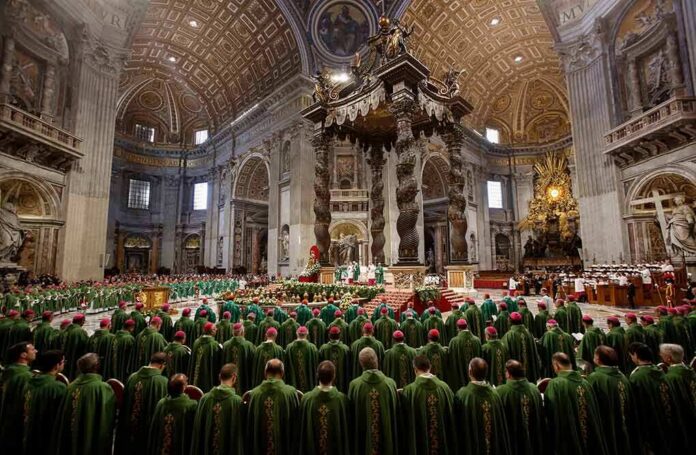
Pope Leo XIV has articulated a thesis that resolves a decades-old tension baked into the post–Vatican II era: authentic reform is not the negation of tradition, but its maturation under authority. In a general audience catechesis on the Council’s constitution on the liturgy, he invoked the Council’s own grammar—“preserving sound tradition” while opening the way to “legitimate progress”—and linked it to a concrete rule of practice: no one adds, removes, or changes liturgical elements on personal initiative. The horizon, in other words, is development; the guardrail is obedience to the Church’s rites and norms.
This is not rhetorical window dressing. It sets the interpretive key for his public interventions: continuity is not a slogan but a criterion, and reform is not an ad hoc permission slip but a process ordered to theology and the paschal mystery at the heart of worship. Catholic outlets that covered his remarks underscored that the point of reform is not merely a better script, but a clearer manifestation of Christ’s action in the liturgy—reform in service of the mystery, not the other way around.
Mechanism: how “organic development” actually functions
Organic development is an ecclesial term of art. It presumes that liturgical forms are living embodiments of doctrine and prayer; they grow as the Church contemplates the mysteries of faith and discerns pastoral needs, but they do so in continuity with what already exists. Leo XIV has made that operational by coupling two demands: first, careful theological and pastoral study before introducing new forms; second, a practical ban on free-form adaptation by celebrants and planners. Both components appeared in his teaching on Sacrosanctum Concilium and in coverage of his catecheses: new expressions should “grow organically from forms already existing,” after due study, and clergy are not to improvise.
That mechanism matters because it answers two chronic pathologies at once. It rejects antiquarianism—the idea that fidelity is merely repetition without discernment—by authorizing prudent, texted development. And it rejects novelty for novelty’s sake by constraining change to an explicit, theological path governed by competent authority. In short, the pope is nailing shut both escape hatches: “anything goes” creativity and “nothing ever changes” stasis.
A test case: the “Mass on Creation” as measured innovation
The clearest example of Leo’s model in action is the approval of a new Mass formulary focused on creation. The structure of the Mass remains untouched; the innovation lies in a set of prayers that articulate care for the created order—pastorally responsive, thematically integrated, formally conservative. Reporting emphasized the modesty of the changes and the rationale: respond to requests from the faithful, align liturgical prayer with a catechetical and moral emphasis on stewardship of our common home, and do so without reconstructing the rite’s architecture.
That approach is not unprecedented—new ordo texts have long been added for particular needs—but here it is programmatic. It demonstrates how Rome, under Leo XIV, intends to meet contemporary concerns at the level of prayer without turning the liturgy into a running commentary on the news. The structure is conserved; the accent changes. The signal to the global Church is unmistakable: specific pastoral themes can be introduced through approved texts, after study and with limited scope, rather than through celebrant embellishment or parish-by-parish experimentation.
Reverence, clarity, and reducing polarization
If the last decade taught anything, it is that liturgy can become a proxy battlefield for larger ideological wars. Leo XIV has tried to mute that dynamic. Analyses of his early choices—such as restoring certain papal customs like celebrating Holy Thursday at the Lateran, the pope’s cathedral—portray a leader signaling reverence for inherited forms without repudiating post-conciliar reforms. Commentators sympathetic to his project read these moves as a strategy of peacemaking: anchor the papal liturgy in the tradition that binds, explain reform in deeply Christological terms, and enforce discipline where improvisation distorts the rite’s meaning.
This tightrope walk demands a specific rhetoric. The pope has called liturgy a “hot button issue” and criticized its exploitation as a vehicle for unrelated agendas—an implicit rebuke to factionalization. The pairing of continuity talk with clear norms against ad libitum change is designed to de-escalate: it reassures those who prize stability while giving reformers a legitimate pathway for pastoral expression—petitions, study, authorized texts—rather than performative disruption.
Leo XIV bishop cancels Latin Mass; Pope names pro-women’s ordination adv… https://t.co/wXOINA1hAY via @YouTube
— SundanceingMoonChild (@sundancethecat) August 11, 2026
Why the method matters more than the headline
In Catholic governance, method disciplines message. The Church’s liturgy is not simply a set of words and gestures; it is a rule of prayer that shapes belief (lex orandi, lex credendi). Changes enacted without clear theological warrant or authority can fracture common worship and, over time, belief itself. By making “no private initiative” more than a footnote—by repeating it, teaching it, and pairing it with avenues for legitimate development—Leo XIV is re-centering the Church’s own constitutional logic for reform. That is why, in this cycle, the most consequential statements are procedural: who studies, who decides, what counts as organic, and how new texts enter the Missal.
Seen through that lens, local disruptions—say, a diocesan bishop curtailing or relocating a Traditional Latin Mass—or media controversies about sweeping new rules are downstream of a more stable principle: bishops govern locally, rites are regulated centrally, and serious change either carries the Church’s legal form or it isn’t change at all. Confusing diocesan discipline with universal law, or YouTube speculation with papal policy, only clouds the record; the reliable signals remain the pope’s catecheses, authorized texts, and the rubrical books themselves.
The theological center of gravity: Christ and the Paschal Mystery
Content matters as much as control. Descriptions of Leo XIV’s teaching on Vatican II stress a substantive reframing: the liturgy is where Christ acts; the paschal mystery—the passion, death, resurrection, and glorification—is the center of worship. Beneath disputes about options and vernaculars lies this fixed point. When reform moves that center into sharper relief, it is faithful progress; when practice obscures it—through novelty that draws attention to the minister, or through rigidity that treats the rite as museum piece rather than living prayer—it fails the test.
In this sense, the “Mass on Creation” is theologically intelligible: it reads stewardship of creation through the paschal grammar—the world reconciled in Christ, offered back to the Father, awaiting transfiguration—and prays accordingly. It is not a policy platform smuggled into worship; it is doctrine prayed in a new key. The distinction is not cosmetic. It is the difference between aligning the Church’s worship with the faith it professes and bending the rite to the spirit of the age.
Where genuine disagreement remains
There will be contestation at the margins—how much latitude to grant episcopal conferences in proposing texts, how to calibrate options so that parish life is genuinely unified rather than balkanized by preference, how to weigh pastoral urgency against the patience required for study. Those debates are not bugs; they are the normal friction of a global Church stewarding a common rite. What Leo XIV’s approach does is supply common criteria and a supervisory center. It insists that change be reasoned, textual, and vetted—rather than improvised, personal, or polemical.
Claims that attach broader cultural controversies—women’s ordination, LGBTQ policy shifts—to this liturgical program require distinct documentation and should not be inferred from the reform method itself. The evidentiary spine of the present conversation is liturgical: catechesis on continuity, prohibitions on improvisation, and a concretely approved formulary with minimal structural alteration. Keep the categories clean and the argument holds.
What to watch next
Three indicators will show whether Leo XIV’s disciplined reform matures as intended. First, the publication pipeline: are proposed texts accompanied by theological notes and clear rubrical integration, or do options proliferate without coherence? Second, enforcement: do Rome and dioceses actually correct unauthorized practices, or does the “no private initiative” rule remain aspirational? Third, papal exemplarity: the more the pope’s own liturgies model reverence, textual fidelity, and noble simplicity, the more they catechize the Church by doing. On all three fronts, the record so far favors continuity with measured, pastorally targeted development.
Sources:
lifesitenews.com, youtube.com, ewtnnews.com, usccb.org, mondayvatican.com, reddit.com
© fixthisnation.com 2026. All rights reserved.