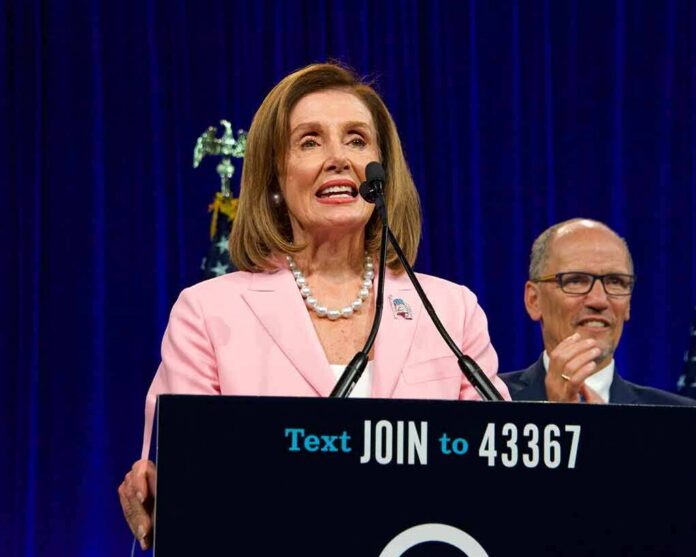
The real story here is not a single quotable contradiction; it is how quickly campaign critique hardens into an accusation of concealment, and how a veteran operator like Nancy Pelosi can say two things at once: that she was worried about Joe Biden’s political viability, and that her later praise of Gavin Newsom was not, in the moment, an endorsement.
Key Points
- Pelosi’s public account draws a line between concerns about Biden’s campaign and concerns about Biden’s capacity, but that line is narrower than her critics want to admit.
- Her remarks after the debate show she treated the question as legitimate before she later described the post-debate moment as when “we learned” how bad things were.
- The strongest evidence against the “I didn’t know” framing is not a smoking gun of secret knowledge; it is the accumulated record of polling worries, a suggested cognitive test, and pressure around his exit.
- Her praise of Newsom reads less like a spontaneous compliment than like the familiar language of a party elder managing a succession conversation.
Pelosi’s Core Claim: Campaign Weakness, Not Diagnostic Certainty
Pelosi’s defense rests on a distinction that matters in politics, even when it annoys commentators: being alarmed by a campaign’s trajectory is not the same as concluding the candidate is cognitively impaired. In the post-debate coverage, she said it was “a legitimate question” whether Biden’s performance was “an episode” or “a condition,” and she framed the matter as one deserving scrutiny from both candidates. That is not the language of someone pretending the debate never happened. It is the language of an insider trying to keep the diagnosis separate from the tactical problem.
That distinction also appears in later remarks in which Pelosi said her concerns were “around the campaign, not about the candidate,” and that Biden’s legacy remained “substantial”. In other words, she publicly maintained a separation between political performance and personal fitness. Critics are right to note that this is a convenient separation, because campaign collapse and decline are often intertwined in real life. But convenience is not proof of deceit. The available record supports the narrower proposition that Pelosi was worried about electability before she was willing to describe the problem in blunt medical terms.
Why the “We Learned” Line Sounds So Bad
Pelosi’s most vulnerable formulation is the one that suggests the post-debate moment was when “we learned” how serious the problem was. That phrasing invites ridicule because it compresses a longer arc of concern into a single dramatic reveal. Yet the compression is political, not necessarily fraudulent. In elite political speech, “we learned” often means the moment a private worry becomes publicly undeniable. That is a very different claim from “nobody had suspicions before.”
The difficulty for Pelosi is that her own record makes the line easy to attack. She had already acknowledged that the debate raised a “legitimate question” about whether Biden’s performance signaled a broader condition. She also later said she had spoken with Biden about polls and campaign organization, and one account says she urged him to publicize cognitive testing. Those details do not prove she knew he had dementia or a comparable condition. They do show that she was not passively surprised by the issue. The honest reading is that she saw a political problem early and, like many insiders, moved cautiously around the sharper implication until the public debate made caution impossible.
The Evidence Against Complete Innocence Is Real, But It Stops Short of Proof of Prior Knowledge
The strongest counter-case is inferential, not documentary. Pelosi reportedly told Biden that she questioned his polling and asked whether there could be a better campaign to win the White House. She was also described as advising him to publicize a cognitive test, which suggests enough concern to raise a diagnostic issue before the collapse became unavoidable. On top of that, reporting indicated she was a sounding board for Democrats anxious about Biden’s viability and spoke to him the day before he dropped out. That is substantial evidence that she was inside the pressure environment around his exit.
But substantial does not mean dispositive. None of the material in the record gives the public contemporaneous emails, internal medical readouts, or sworn testimony showing that Pelosi had direct knowledge of cognitive decline before the debate. The evidence shows concern, signal reading, and political maneuvering. It does not show settled knowledge of a hidden incapacity. That is why the attack line works rhetorically while remaining evidentiary weak. It is an accusation built from pattern recognition, not from a document that closes the case.
Newsom Praise Is Best Read as Power-Political Language, Not a Clean Endorsement
Pelosi’s comments about Gavin Newsom fit a very old congressional pattern: the elder strategist praises the rising figure, declines to lock in an endorsement, and leaves the door open just wide enough to be useful. In the available reporting, she called Newsom “extraordinarily talented,” while also saying, “Let’s let them make their announcements,” and stressing that no one yet knew who would run. Another account described her as calling him “hardworking” and “responsible,” with the suggestion that a White House bid was only a matter of time. That combination is classic strategic ambiguity.
Ambiguity is not the same thing as coordination. Nothing in the record proves a formal plan to boost Newsom or position him as Pelosi’s chosen successor. But in Washington, intent often reveals itself through posture rather than declaration. A full-throated endorsement would have been news. A politely noncommittal shower of adjectives, offered by one of the Democratic Party’s most experienced operators, is signal enough. It tells allies that Newsom is acceptable, formidable, and worth keeping in the frame. It tells rivals that Pelosi is not trying to bury him. And it keeps her inside the room where future power is negotiated.
What This Episode Says About Biden Politics and Democratic Succession
This dispute lands where two familiar political dynamics overlap: retrospective blame and succession signaling. After any public failure of this magnitude, insiders are accused of having known more than they admitted, because voters naturally assume that private alarm must have been stronger than public language. Sometimes that is true. Sometimes it is only the ordinary mismatch between private concern and public loyalty. Pelosi’s record sits uncomfortably in the middle. She was clearly worried. She clearly wanted Biden to confront the campaign problem. And she later helped define the terms under which the party processed his exit.
The Newsom angle is part of the same ecosystem. Once a sitting Democrat becomes a plausible national heir, every compliment becomes a potential signal. That does not mean the compliment is fake; it means the audience has learned to read power as performance. Pelosi knows that better than almost anyone. Her praise of Newsom, then, should be understood as the language of succession politics: careful, flattering, and deliberately deniable. The more interesting question is not whether she was “gushing,” but why seasoned observers immediately heard the sound of a party grooming its next standard-bearer.
What the Record Supports, and What It Does Not
The record supports three conclusions. First, Pelosi was not blind to Biden’s troubles; she had real concerns about polls, campaign organization, and post-debate viability. Second, the evidence does not prove she had direct, earlier knowledge of cognitive decline in the clinical sense. Third, her praise of Newsom was politically functional even if it was sincere in tone. What the record does not support is the more extravagant claim that she has been caught in a flat lie. The better judgment is sharper and more mundane: she managed a difficult transition in the way experienced political leaders often do, by narrowing her language, protecting relationships when possible, and leaving future possibilities open.
In the end, her pushing Biden out actually hurts Newsom in the end. No way is he going to be able to side step that when the time comes.
Nice going Pelosi! 🤣— Dicapito (@dicapito) August 11, 2026
Sources:
redstate.com, politico.com, sacbee.com, nytimes.com, theguardian.com, nypost.com, foxnews.com
© fixthisnation.com 2026. All rights reserved.