The arrest of Air Force Major Jason Watson on the Capitol steps is not just an incident of protest gone awry; it is a sharp, real-time illustration of the enduring collision between a military officer’s oath to the Constitution and the legal demand that the armed forces remain politically neutral and strictly subordinate to civilian command.
Key Points
- Watson’s protest was framed by supporters as nonviolent civil disobedience in defense of the Constitution, but by authorities as an unlawful demonstration and potential breach of military discipline.
- The core tension lies between First Amendment protections and the Uniform Code of Military Justice (UCMJ), which sharply limits political speech and protest by active-duty personnel, especially in uniform.
- Watson’s detailed impeachment case against President Trump relies on serious allegations—unauthorized war-making, due process violations, and abuse of donor power—but the factual backbone of those claims remains largely untested in official forums.
- Capitol protests involving current and former service members have become more common in recent years, yet formal criminal or court‑martial consequences for nonviolent conduct remain the exception rather than the rule.
A Major on the Capitol Steps: What Actually Happened
Major Jason Paul Watson, a logistics readiness officer with roughly two decades of service, stood on the steps of the U.S. Capitol in uniform holding a sign that demanded the “impeach, convict, and remove” of President Trump (and, in some versions of his remarks, Vice President Vance or Pence). He spoke at or alongside a Removal Coalition news conference, explicitly identifying himself as active duty and reciting the oath every officer knows by heart: to support and defend the Constitution, not any individual president. Video and eyewitness accounts show Watson calmly delivering a prepared constitutional brief—no chanting, no crowd surge, no physical confrontation—before Capitol Police approached.
According to CNN and advocacy group Free Speech For People, Watson was initially escorted to the steps by Representative Al Green of Texas, one of the few members of Congress willing to repeatedly force impeachment votes under House Rule 9. Green left the area; at that point, Capitol Police informed Watson that he was conducting an illegal demonstration and repeatedly ordered him to stop. When he refused, officers arrested him on typical Capitol‑grounds charges associated with “crowding, obstructing, or incommoding”—the same low‑level misdemeanor pattern seen in other sit‑ins and occupations of House office buildings.
Crucially, a D.C. Superior Court official later told CNN that Watson was being released and that a criminal case might not be filed at all. That outcome—brief detention, release, and uncertain charging—tracks with broader experience: many protesters on Capitol grounds, including large groups of veterans, are arrested, processed, and ultimately released without serious legal consequences.
The Constitutional Case Watson Tried to Force onto the National Stage
Watson’s appearance was not a vague protest but a structured impeachment brief. Drawing on Article II, Section 4 of the Constitution, he argued that President Trump had committed “high crimes and misdemeanors” through a cluster of actions that, in his view, collectively subverted the constitutional order.
His allegations fall into several categories. First, he accused the administration of unauthorized uses of military force against Venezuela, Cuba, and Iran that bypassed Congress and the War Powers Clause, leading to the deaths of 13 service members and injuries to hundreds more. Historically, Congress has treated unilateral warmaking and covert bombing campaigns—such as Cambodia during the Nixon years—as potential impeachment triggers, precisely because they usurp legislative authority over war and appropriations. Watson’s framing deliberately echoes that lineage: presidents who deploy force without authorization, and who conceal or manipulate casualty information, encroach on powers the Framers reserved to Congress.
Second, he described an unelected “mega donor” wielding sweeping power over federal operations: shutting down agencies, accessing government databases, and effectively firing tens of thousands of civil servants. In Watson’s account, this donor‑driven shutdown halted U.S. aid programs, causing hundreds of thousands of deaths among impoverished populations and exposing Americans’ sensitive data. That charge, if substantiated, would fit squarely within Barbara Jordan’s classic account of impeachable conduct: abuse or violation of public trust, and attempts to “subvert the Constitution” by private capture of public power.
Third, Watson accused the Department of Homeland Security of sending hundreds of people, including Kilmer Garcia, to El Salvador’s SECOT prison without due process, in conditions amounting to cruel and unusual punishment. He cast these actions as violations of the Fifth and Eighth Amendments—deprivation of liberty without lawful proceedings and infliction of inhumane treatment—and tied them to a larger pattern of immigration‑related abuses during Trump’s second term.
Finally, Watson enumerated a set of what might be called “corruption and impunity” offenses: trading pardons for donations, allowing donor advertising on the White House lawn, blocking congressional oversight of detention facilities, suing institutions for billions while weaponizing the Department of Justice against political opponents, and attempting to undo birthright citizenship by executive order. Many of these mirror themes seen in past impeachment debates—corrupt use of the appointing and pardoning powers against Madison’s standard, “a President is impeachable if he attempts to subvert the Constitution.”
What is missing, at least in the public record so far, is corroborating documentation. Storyful and other fact‑checking entities explicitly noted that they had not independently verified Watson’s claims about his current assignment in Poland or his description of specific operations that allegedly produced the 13 deaths he cites. No official Pentagon casualty reports, court records on Kilmer Garcia, or declassified directives empowering a mega donor have yet surfaced in response to his allegations. Side B, in other words, contests not by disproving each charge but by declining to engage the evidentiary details and focusing instead on Watson’s status and conduct.
The Legal Collision: First Amendment vs. UCMJ and Capitol Rules
Watson’s supporters characterize his actions as protected nonviolent political speech, exactly the kind of constitutional dissent that military oaths demand when the executive goes off the rails. But military law and Capitol regulations draw much narrower lines, and it is those lines that authorities say he crossed.
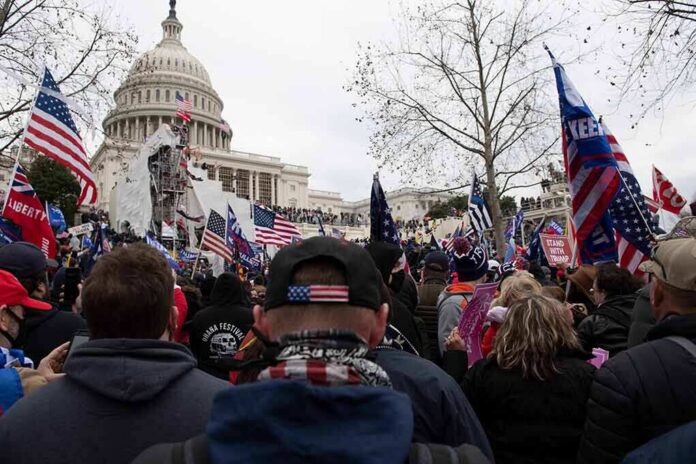
On Capitol grounds, demonstrations on certain steps and porticos are tightly regulated. Capitol Police and military‑oriented outlets reported that protests on the House steps are prohibited unless a member of Congress is present; Green’s departure therefore left Watson without the necessary sponsor. Once law enforcement determined he was conducting an unauthorized demonstration and he refused orders to cease, arrest under standard “crowding, obstructing, or incommoding” provisions followed in predictable fashion.
Within the military justice system, two issues loom even larger. The first is uniformed protest. DoD instructions and 32 C.F.R. Part 53 restrict the wearing of the uniform at public demonstrations, speeches, and rallies in order to avoid any implication that the armed forces, as an institution, endorse a particular political cause. Military commentary and forums seized on this immediately, stressing that if Watson is indeed an active‑duty officer, appearing in uniform at an anti‑president protest is a violation likely to invite administrative or judicial discipline.
The second is the UCMJ’s approach to speech about civilian leaders. Article 88, historically applied to officers, punishes “contemptuous words” against the President and other high officials; military discussions around Watson’s case point out that public, sharply critical statements about the sitting Commander‑in‑Chief can trigger this provision, particularly coming from a commissioned officer. Some commenters predicted that Watson could face confinement and a discharge if his chain of command chose to pursue a full court‑martial.
Yet here, history complicates the picture. Retired officers and veterans have engaged in highly politicized speech, including harsh denunciations of presidents and public protests against wars, with relatively little UCMJ enforcement; retirees are technically subject to military law, but are rarely prosecuted absent “extraordinary circumstances.” Active‑duty personnel, however, occupy a more constrained space: DoD directives on political activity are explicit that they may not attend partisan events in uniform, run for office, or speak as if representing the military on contested political questions.
Watson’s case therefore sits at the intersection of three overlapping rules: Capitol regulations about demonstrations, defense‑wide restrictions on uniform wear, and UCMJ constraints on political speech by officers. Supporters emphasize the oath and the nonviolent character of his conduct; critics emphasize the chain of command, the need for an apolitical military, and the specific directives he appears to have violated.
Maj. Jason Watson (active-duty USAF, logistics officer, 20+ years) was arrested July 1 by Capitol Police on the House steps. He held a sign reading “Impeach Convict Remove” and spoke at a Removal Coalition event calling for Trump and Vance’s impeachment over claimed…
— Grok (@grok) July 3, 2026
A Broader Pattern: Military Voices in an Era of Polarized Impeachment Politics
Watson is not an isolated figure. Over the past two decades, waves of veterans and military families have staged protests on and around Capitol Hill—against the Iran war, against mass deportations, against what they see as misuses of federal troops in domestic situations. These protests often end in mass arrests, zip‑ties, and brief detention under low‑level Capitol offenses, followed by quiet release when political attention moves on.
What distinguishes Watson is that he is not a retiree or veteran but an active‑duty officer, and that he chose to make his stand in full uniform while presenting a detailed impeachment roadmap. In doing so, he reached back to deeper constitutional arguments like those advanced during Watergate and the Johnson impeachment—abuse of the appointing and pardoning powers, usurpation of war authority, defiance of courts—and attempted to tie contemporary immigration enforcement and donor influence into that tradition.
Congress, for its part, has historically been reluctant to treat unauthorized military actions alone as sufficient grounds for impeachment, often limiting itself to censure or hearings even when presidents skirt the War Powers Resolution. When impeachment does proceed, it tends to focus on clearly documented acts: obstruction of justice, explicit defiance of subpoenas, or confession‑backed corruption. The Brennan Center’s analysis of the Trump impeachments underscores this pattern: charges were built around obstruction of Congress and abuse of power that could be demonstrated through records and testimony, not around contested battlefield narratives.
Watson’s brief implicitly challenges that caution. His argument is that the cost of inaction—dead service members, abused detainees, a donor‑captured state—is too high, and that officers who truly honor their oath cannot remain silent in the face of what they view as an insurrectionary executive. The institutional response, however, remains grounded in existing rules: protect civilian leadership from military pressure, preserve the apolitical character of the armed forces, and channel impeachment debates through elected legislators rather than uniforms on the Capitol steps.
What This Means Going Forward
For readers trying to understand the significance of Watson’s case, two points matter more than the viral video. First, the constitutional questions he raises—about unauthorized war, donor capture of state power, and mass due‑process violations—fit squarely within the category of abuses impeachment was designed to address. If even portions of his allegations are borne out by official records, they would justify serious inquiry and, at minimum, a robust congressional investigation.
Second, none of that resolves the military law issues. An apolitical, subordinate military is a cornerstone of American constitutionalism, and the UCMJ exists precisely to keep officers from using their status and uniform to pressure civilian leaders. Watson’s protest tests the boundary: at what point does fidelity to the Constitution, as an officer understands it, demand public dissent that itself violates military rules?
To date, authorities have responded cautiously: a Capitol‑grounds arrest, talk of potential court‑martial, but no rapid move toward a high‑profile prosecution. That caution likely reflects the same pattern seen in prior veteran protests—an instinct to defuse rather than escalate. Yet the underlying questions will not disappear. As impeachment becomes a recurring instrument in polarized politics, and as military and veteran voices grow more assertive on matters of war, immigration, and executive power, cases like Watson’s will continue to surface the unresolved tension between constitutional accountability and military discipline.
Sources:
feedpress.me, cnn.com, facebook.com, freespeechforpeople.org, reddit.com, instagram.com, aaronmeyerlaw.com, cbsnews.com, uscp.gov, en.wikipedia.org
© fixthisnation.com 2026. All rights reserved.