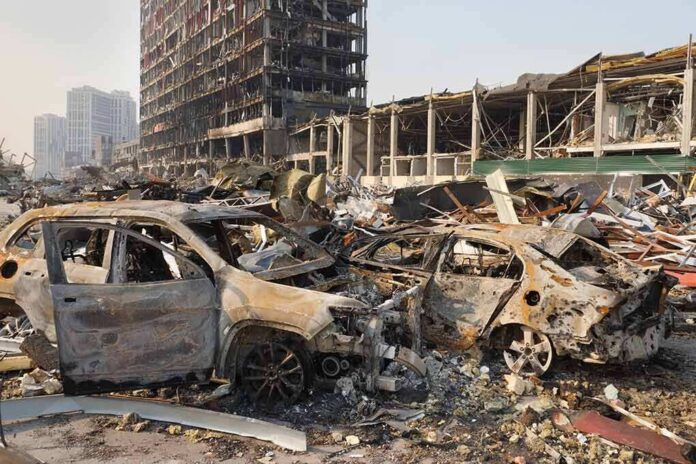
A Russian ballistic missile just turned a supposedly “secure” defense showcase near Kyiv into a mass-casualty crime scene, raising hard questions about how this war is being fought—and who is really being protected.
Story Snapshot
- A Russian missile hit a defense-industry arms event near Kyiv, killing about 10 and injuring up to 100, according to Ukrainian officials.
- Ukraine says the gathering was a weapons exhibition at a private training ground; Russia claims it was striking a drone demonstration used to plan attacks inside Russia.
- The blast damaged nearby homes and cars, showing again how military and civilian life are now dangerously mixed.
- Both Moscow and Kyiv had recently warned of more “systematic” strikes on each other’s defense industries, feeding fears of a wider tit-for-tat spiral.
What Russia Says It Hit Near Kyiv
Russian defense officials admit they struck the site and say it was not a random hit but a planned attack on a military target. Moscow claims it used “high-precision long-range weapons” against a demonstration of unmanned aerial vehicles, including new drones from Ukraine and foreign partners. Russian statements say top Ukrainian defense industry figures and military officers were present and accuse them of directly planning and carrying out drone and missile attacks on Russian cities. This fits months of Russian warnings that it would launch “systematic strikes” on defense sites in and around Kyiv.
Russian leaders also frame the strike as payback. In recent weeks, Ukraine has hit Russian defense plants and logistics hubs linked to drone production, causing fires and reported deaths. Russian officials say attacks like the arms expo strike are retaliation for those cross-border hits and for Ukrainian drone raids on Russian oil and warehouse targets. For many Americans, this looks like yet another example of both sides escalating while ordinary people—on either side of the line—get very little say in how far things go.
How Ukraine Describes the Arms Exhibition
Ukrainian officials and defense-industry leaders confirm the missile hit an event they describe as a weapons or defense exhibition in Kyiv region. The founder of a Ukrainian defense company said the strike hit a military training ground where an arms exhibition was underway and that “people have been killed.” The Ukrainian Council of Defence Industry later said a missile hit a site in Kyiv Oblast where defense-industry representatives had gathered, and that the location had not been publicly advertised, likely for security reasons.
Local and international outlets report that the event took place at a privately run training ground in the Bucha district, roughly 20–30 kilometers from central Kyiv. Reports describe an exhibition of unmanned systems branded “Armada,” suggesting companies were showcasing drones and related military tech. Ukraine’s prosecutor general says at least 10 people were killed and about 100 wounded, and that criminal cases are open both for violation of the laws of war and for possible failures in how the event was organized and secured. Those charges show Kyiv’s own authorities see this not only as an act of Russian aggression but also as a preventable security failure.
Damage on the Ground and Civilian Risk
The missile did not only hit people in the defense sector. Ukrainian reports say the blast in Bucha district damaged 27 houses and 44 vehicles in the surrounding area. Earlier updates spoke of at least six dead and dozens injured; later counts rose to around 10 killed and close to 100 hurt as rescue teams searched the debris. That pattern—rising casualty numbers and damage spreading into nearby neighborhoods—matches what many Ukrainians have suffered since the full-scale invasion began.
For Americans watching from far away, this is another example of how modern war erases the line between “front line” and “civilian life.” A “private training ground” looks like a military site on paper, but when it sits near homes and roads, any strike risks killing regular people, not just defense insiders. This is exactly the kind of dual-use targeting problem that worries people who feel global conflicts are run by elites while ordinary families pay the price.
Why This Strike Feeds Distrust of Global Elites
This attack did not happen in a vacuum. Russian officials had already warned foreigners to leave Kyiv and said they would target defense industry locations and “decision-making centers” in the capital. At the same time, Ukraine has been open about striking deep inside Russia at facilities tied to weapons and drones. Both sides justify bigger and riskier operations as “defense,” while the larger war grinds on with no clear end and growing costs for taxpayers around the world.
Anton Gerashchenko
This video speaks volumes abut us Ukrainians. It was filmed in Lukianivka district in Kyiv that is under Russian attacks often.
Just a few hours after last night's Russian strike, the market and people there resumed working.
My heart breaks from what our… pic.twitter.com/m5TMXUKZr9
— Gianl1974 (@Gianl1974) July 21, 2026
Coverage of the strike also highlights who was in the room. Reports say the event brought together defense-industry representatives and possibly senior figures tied to weapons production for the war effort. In other words, this was not a gathering of front-line soldiers but of the people and companies who build and sell the tools of war. For Americans who already believe a global security class profits while everyone else struggles with high prices and shaky services at home, this only deepens the sense that powerful players make the decisions and regular citizens bear the risk.
The Bigger Picture: War, Secrecy, and Accountability
Both Moscow and Kyiv are running intense information campaigns. Each side pushes its story first, often before independent investigators can reach the scene. In this case, Russian officials stress that the target was a drone expo used to plan attacks on Russian civilians, while Ukraine stresses the illegality of striking such an event and the civilian damage nearby. Outside experts say this pattern—one side calling a site “military,” the other stressing civilian harm—is now standard in this war.
For citizens in the United States, whatever their politics, the lesson is grim but important. When war planners on any side decide that a “defense event” inside a country’s own territory is fair game for ballistic missiles, it shows how far the rules have shifted. It also raises a question Americans increasingly ask about their own government and its allies: who is making these choices, who benefits from them, and who is left picking up the pieces when the smoke clears?
Sources:
bbc.com, aljazeera.com, bloomberg.com, reuters.com, nytimes.com
© fixthisnation.com 2026. All rights reserved.