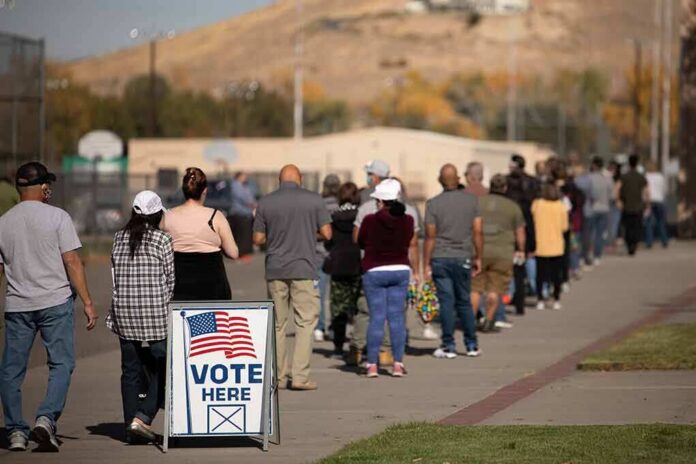
fixthisnation.com — A 20-year Republican congressman just got wiped out in a primary, and the age breakdown of who voted tells a story about the future of the MAGA coalition that nobody in the party wants to discuss out loud.
Story Snapshot
- Trump-backed challenger Ed Galin defeated incumbent Thomas Massie 54.4% to 45.6%, carrying 19 of 21 counties in Kentucky’s 4th Congressional District.
- Exit polling showed Massie winning voters under 55 but losing heavily among older voters, who dominated primary turnout and delivered the decisive margin.
- The race became the most expensive House primary in American history, with over $32 million spent on advertising.
- The result raises a legitimate question that neither side wants to answer with actual data: what happens to MAGA’s electoral math when the older, highly motivated base eventually shrinks?
How a 20-Year Incumbent Gets Erased in One Night
Thomas Massie was not a weak candidate by any conventional measure. He had won his Kentucky district repeatedly, built a national profile as a libertarian-leaning fiscal hawk, and cultivated a genuine grassroots following. What he did not have was Donald Trump’s blessing. Trump called Massie a “pathetic loser,” a “moron,” and “the worst congressman in the long and storied history of the Republican Party.” That was apparently enough. Galin swept the district in a race NBC News called quickly on election night. [1]
The county map tells the story with unusual clarity. Galin carried 19 of 21 counties, losing only two, one of which was Massie’s home county. That kind of geographic sweep in a Republican primary does not happen by accident or by candidate quality alone. It reflects a highly organized, well-funded, and deeply motivated electorate that showed up with a single purpose. The question worth asking is exactly who that electorate was, because the answer shapes everything downstream. [1]
The Age Split That Should Worry Republican Strategists
Exit polling from the race reportedly showed Massie winning among voters under 55 while losing heavily among older voters. Older voters form the structural core of Republican primary participation, which is precisely why that split matters so much. If the candidate who appealed to younger Republicans lost because older voters overwhelmed the count, that is not a story about Massie’s weaknesses. That is a story about who actually controls the primary process right now, and what happens when that demographic cohort ages out of the electorate over the next decade. [1]
To be fair, the exit poll data here is reported in summary form without published crosstabs, field methodology, or sample sizes. That is a real limitation. The age-split claim is plausible given what political scientists have documented about primary electorates for decades, but it deserves verification rather than assumption. What is not in dispute is that $32 million in outside advertising flooded a single House primary, with significant funding traced to pro-Israel political action committees and aligned donors. Record spending in a single House district does not organically produce a grassroots result. It produces a turnout operation targeting the most reliable voters, who in Republican primaries skew older and more ideologically consistent. [1] [2]
Loyalty as the Only Organizing Principle
The Massie race crystallized something that has been building inside Republican primaries for several cycles. Policy positioning, constituent service, and ideological consistency no longer function as sufficient protection for an incumbent. Massie opposed Trump-backed legislation, raised questions about Epstein file releases, and criticized foreign aid flows. Those positions may resonate with a younger, more skeptical Republican voter who came of age during the Ron Paul era or during the early MAGA years when economic nationalism and anti-interventionism were the animating themes. They did not resonate with the primary electorate that actually showed up. [1] [3]
MAGA boomers vote in a turncoat AIPAC shill because Thomas Massie actually did something against the oligarchs and they sent a message with horrific bullshit ads and 20 million dollars.
The youth loathe you and this bullshit Republican Party
— Kessler🇺🇸 (@RK92CLE) May 21, 2026
The danger in reading this result as pure coalition strength is that it conflates intensity with breadth. A primary electorate that punishes dissent with extreme efficiency is not the same thing as a coalition that is growing. Trump’s personal endorsement moved 19 counties. That is impressive. It is also a data point from a single off-year primary in one Kentucky district, not a national demographic survey. Generalizing from this result to the health of the broader Republican coalition requires more evidence than one expensive, loyalty-driven contest can provide. [2] [4]
What the Record Does and Does Not Prove
The honest accounting here is that the Massie defeat confirms Trump’s dominance over Republican primary voters who show up, particularly older, highly motivated, Trump-aligned voters. It does not confirm, by itself, that younger Republicans are structurally disengaging from the party, that Hispanic Republican participation is declining, or that the coalition faces a demographic cliff. Those are serious questions that deserve actual voter file analysis, precinct-level turnout modeling, and validated survey research. None of that data has been released publicly from this race. What exists is a striking margin, a dramatic age split in preliminary exit data, and a record-breaking spending figure that suggests someone was very motivated to make sure a specific kind of voter got to the polls. [1] [3]
The MAGA coalition remains formidable in Republican primaries precisely because its most loyal members vote with unusual consistency and intensity. That is a genuine strength. But political coalitions that rely on the most reliable segment of an aging demographic without demonstrating parallel growth among younger voters are running a clock they cannot reset. Whether that clock is ticking fast or slow is the question this race raised without fully answering. The Republican Party would be wise to find out before the answer arrives uninvited. [2] [4]
Sources:
[1] YouTube – Rep. Thomas Massie LOSES PRIMARY to Trump-backed candidate
© fixthisnation.com 2026. All rights reserved.