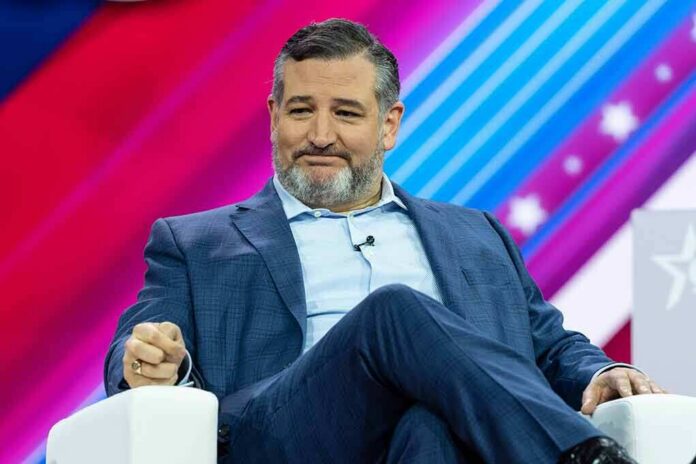
The clearest tell that a politician is running for president is rarely the word “yes.” It is the refusal to say “no” — repeated, on cue, across a dozen interviews, until the ambiguity itself becomes the campaign. Ted Cruz has been performing that refusal for more than a year, and on August 26, 2026, he finally said the quiet part out loud: “it’s no secret that I want to be president.”
Key Points
- On Lt. Gov. Dan Patrick’s podcast, Cruz confirmed his presidential ambition directly, calling it “a bug that history has proved is rarely ended.”
- Days earlier, Cruz told MS NOW the Republican Party has not settled on Vice President JD Vance as Trump’s political heir, arguing the GOP still has “to decide who we are.”
- Cruz’s positioning has been building for over a year — through a public feud with Tucker Carlson, breaks with Trump on key primary endorsements, and leaked recordings criticizing Vance and Trump’s tariff policy.
- President Trump has responded to the speculation with studied neutrality, noting it is “a little early” but not dismissing the idea.
- The pattern — ambiguous non-denials sustaining months of coverage — is a recurring feature of early presidential positioning, not unique to Cruz.
What Cruz Actually Said, and When
The August 26 podcast appearance was not a slip. Asked point-blank by Dan Patrick whether he would run again, Cruz did not say yes, but he did not say no either: “Time will tell,” he offered, adding that “there will be time to figure that out. I’ll certainly be part of the discussion, because I care deeply.” That phrasing — deliberate, rehearsed, leaving every door open — followed closely on the heels of a sharper claim just days prior. In an MS NOW interview, Cruz argued explicitly that the GOP has not coalesced around Vance as Trump’s successor, framing 2028 as an open contest rather than a coronation.
The New York Post’s account of the same period captured the throughline: Cruz “admitted… that he still harbors aspirations of becoming president,” a statement that landed as confirmation rather than speculation precisely because it followed his public challenge to Vance’s heir-apparent status. Read together, the two moments form a single message: Cruz wants the door open, and he wants everyone to know he thinks it should be.
Why “Not Ruling It Out” Works as a Strategy
Cruz’s phrasing — “it’s no secret,” “time will tell,” a “bug that history has proved is rarely ended” — is not evasive by accident. It is evasive by design, and it is a design with a long pedigree in American politics. A candidate who declares outright invites immediate scrutiny of infrastructure, fundraising, and staff — resources most potential candidates do not yet have locked down three years before a general election. A candidate who denies outright forecloses the option and looks weak if circumstances change. The middle path — acknowledged ambition without commitment — lets a politician bank the attention of a campaign while paying none of its costs.
This is not merely armchair theorizing. Research on political rumor coverage finds that news organizations do not simply report uncertainty neutrally; they amplify it, framing ambiguous statements in ways that heighten a politician’s perceived strengths or vulnerabilities relative to rivals. A remark as thin as “time will tell” can function simultaneously as genuine non-commitment and as a durable news hook — which is exactly why it recurs, cycle after cycle, among politicians positioning for a future they have not yet committed to seeking. Cruz is not inventing this playbook; he is executing a well-worn one with unusual candor about the fact that he’s executing it.
The Vance Problem, and Cruz’s Year of Positioning
What makes Cruz’s 2026 remarks more consequential than routine speculation is the target he chose: not a generic 2028 field, but Vance specifically, the sitting vice president and the figure most commentators had assumed would inherit Trump’s coalition by default. Cruz’s claim that the party “hasn’t decided” undercuts that assumption directly, and it did not arrive in isolation. Axios reported in mid-2026 that Cruz had begun breaking with Trump on key primary endorsements, backing rivals to Trump-endorsed candidates in high-profile Republican races — a move read widely as staking out independence ahead of a possible run. Months earlier, Axios had also documented Cruz intensifying a public feud with Tucker Carlson, a Vance ally, in a maneuver several outlets interpreted as an early positioning tactic against the Vance wing of the party. Tucker Carlson himself dismissed the effort as “hilarious” when asked about it.
Perhaps the most striking data point came in leaked recordings reported by Axios in January 2026: in private donor meetings, Cruz reportedly criticized both Vance and Trump’s tariff policy, a sharper and more candid line than anything he has said publicly. Taken together — the endorsement breaks, the Carlson feud, the donor-room criticism, and now the on-record acknowledgment of ambition — the record shows a methodical, sustained campaign of positioning rather than a single offhand remark.
How Trump and the Party Have Responded
President Trump’s own reaction has been notably unbothered. Asked about Cruz’s potential bid in the Oval Office, Trump called it “a little early,” noting that “three and a quarter years” is “a long time” — a response that neither endorsed Cruz nor moved to shut him down. That restraint is itself informative: a president fiercely protective of succession politics would ordinarily foreclose talk of rivals to his own vice president. Trump’s shrug suggests he sees the 2028 field as genuinely unsettled, or at least sees no cost in letting it look that way for now. CNN reported that Cruz’s ambitions have drawn Vance’s attention and irritated some Trump allies, even as Cruz has publicly insisted, in other settings, that he remains “fully committed” to midterm House and Senate races rather than his own campaign.
What This Means Going Forward
Nothing about Cruz’s statements constitutes a declared candidacy, and nothing in the record suggests one is imminent — filings, fundraising infrastructure, and formal campaign staff remain the actual thresholds that separate positioning from running. But the throughline across eighteen months of reporting is consistent enough to take seriously: a senator with 2016 national-campaign experience, actively distancing himself from Trump-aligned endorsements, sparring publicly with a Vance ally, and now saying plainly that he wants the job. Whatever happens between now and 2028, Cruz has made one thing unambiguous: the assumption that Vance inherits the movement uncontested is no longer safe to make.
@realDonaldTrump Senator Cruz will be the reason for Republicans losing Texas, Campaigning on promises of Congressional Term Limits? If he runs again in 2028, I’m an Independent voter who would not vote for Lying Ted!
— Jerry Bland (@JerryBland84317) August 27, 2026
Sources:
nypost.com, texastribune.org, nj.com, x.com, axios.com, fox26houston.com, usatoday.com, abc7amarillo.com, thehill.com
© fixthisnation.com 2026. All rights reserved.