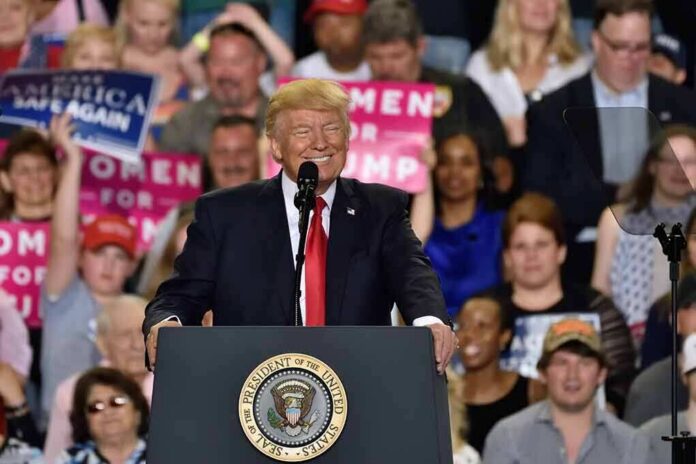
When a president publicly vows to “spend whatever amount of money necessary” to shape a midterm map, he is not just telegraphing a tactic; he is asserting command over the party’s resource engine and the narrative gravity of an election. President Trump’s pledge to deploy a vast war chest behind Republican candidates fits a broader transformation of American campaign finance in which a few colossal accounts can set the tempo—and the terms—of an entire cycle.
The Short Version
- Trump has said he will spend heavily to back Republicans in the 2026 midterms, citing control of a massive political war chest.
- He’s publicly floated figures in the hundreds of millions and described an $850 million total across his political operation.
- MAGA Inc. and affiliated entities give him multiple levers: independent expenditures, coordinated party spending, and direct political travel and messaging.
- In a super PAC era, signaling capacity can be as consequential as actual outlays—fundraising, leverage, and candidate discipline all respond to perceived firepower.
What Trump Pledged, and Why It Matters
Trump has repeatedly said he intends to spend substantially to help Republicans in the 2026 midterms, including tapping funds he controls and, if needed, his own money. In late summer remarks, he said he would direct “a lot” of his MAGA Inc. resources toward “good, Republican candidates” and placed the scope of his broader political operation at roughly $850 million—a headline number that underscores the scale of the apparatus around him. Such statements accomplish more than donor messaging. They influence candidate recruitment, primary negotiations, and the strategic posture of allied outside groups that typically calibrate their buys to avoid duplication and to exploit presumed presidential air cover.
The potency of the pledge rests on a real foundation. Across cycles, Trump-aligned organizations have assembled some of the largest balances in modern politics, and reporting shows MAGA Inc. and affiliated vehicles entering midterm periods with cash positions measured in the hundreds of millions. Public commitments to spend—especially when paired with eye-catching totals—shape both expectations and the opportunity cost calculations of down-ballot campaigns that must decide now whether to build their own infrastructure or bank on late infusions.
The Mechanics: How the Money Moves
Trump’s promise operates through distinct legal and strategic channels. Super PACs such as MAGA Inc. can raise and spend unlimited sums on independent expenditures—ads, voter contact, and mobilization—so long as they do not coordinate with specific campaigns. Leadership PACs and joint fundraising committees serve as intake valves and political relationship engines, while the Republican National Committee can deploy coordinated expenditures under party rules and within the contours of current court rulings. The effect is a web of accounts that, together, can fund early air cover in marquee Senate states, flood late-breaking House districts with turnout operations, or underwrite national message architecture that lifts the entire ticket.
This structure makes the pledge both flexible and protean. A super PAC can sit on cash when rates are inefficient and then saturate late when GRPs are cheapest for persuasion or turnout. It can also target areas where party committees face legal caps. The cost of that flexibility is opacity in real time: FEC independent expenditure filings and periodic reports tell us what has been spent, not what will be. Analysts can observe intent mainly through public statements, vendor activity, and the cadence of ad reservations.
The Historical Through-Line: From Capacity to Control
Over the last decade, the center of gravity in federal elections has shifted from traditional party committees to a handful of mega-funded outside groups. The Brennan Center’s work chronicling the surge of super PAC capital—and its concentration among a small donor class—illustrates the macro trend that makes a single pledge from a single node so consequential. Pro-Trump entities have been quintessential beneficiaries of that system, posting record hauls between presidential cycles and carrying forward balances that rival national party committees in their prime.
In that environment, a president’s public commitment functions as both strategy and signaling. It reassures vulnerable incumbents, disciplines would-be freelancing by allied groups, and pressures major donors to match the tempo. The mere expectation that $50–$100 million could appear in the final six weeks can move candidate behavior months earlier—on message, on opposition research investments, and on field capacity.
Where the Uncertainty Lives: Timing, Targeting, and Tradeoffs
If the big picture is settled—Trump says he will spend substantially and has accounts with the capacity to do so—the tactical questions are unresolved by design: when to deploy, how to split between persuasion and turnout, and whether to prioritize Senate control, House expansion, or governor’s mansions with redistricting implications. Reporting across outlets has, in past cycles, captured the push-pull inside Trump-world between stockpiling cash and unleashing it; moments of cautious pacing have coexisted with public vows to “open the purse strings” for midterms. Those internal debates are not contradictory to the pledge; they are how large operations avoid wasting marginal dollars when rates are poor or messages are unsettled.
Two structural frictions recur. First, independent spending works best when aligned with campaign strategy but must, by law, remain uncoordinated—creating a lag that sophisticated adversaries can exploit. Second, nationalized branding can be double-edged: presidential branding lifts base turnout but may complicate persuasion in crossover suburbs. The solution most winning committees have found is portfolio logic—diversify tactics, tailor tones by district, and stage capital so that late money buys incremental points rather than vanity impressions.
The Scale Question: From Headline Numbers to Deployable Dollars
Trump’s own description of his political operation’s size—about $850 million—reflects a networked reality: multiple accounts, different restrictions, and cash at varying stages of pledges, transfers, and liquidity. Journalistic tallies from prior midterm windows have repeatedly pegged MAGA Inc. and its peers in the $300–$400 million cash range heading into the heart of a cycle, a staggering sum even by modern standards. The right way to read those figures is not as a single checkbook balance but as capacity: the ability to command media markets at scale, sustain simultaneous Senate-state programs, and underwrite national messaging frames that force the opposition to play defense.
Capacity, not just cash on hand, is what worries opponents. When a presidential super PAC has the reserves to escalate across multiple DMA clusters for weeks, the other side must hold dry powder—money that otherwise might have been spent earlier building name ID or inoculating against attacks. The opportunity cost compounds across dozens of competitive seats.
Trump says he will spend up to $500 million of 'my money' to help Republicans in midterms – Trump's pledge would dramatically increase MAGA Inc.’s spending after the Trump-aligned PAC kept most of its $403 million war chest on the sidelines. Via @CNBC:https://t.co/Kl9l0hKhfb
— 🌊💙 Viking Resistance 💙🌊 (@BlueCrewViking) September 4, 2026
Implications for 2026: What to Watch
Four indicators will determine how far Trump’s pledge reshapes the 2026 map. First, reservation footprints: large, cancellable ad blocks in Senate and top-tier House races are the earliest tell of strategic prioritization. Second, purpose-built creative: if the buys carry race-specific contrasts rather than generic national branding, the intent is net-new persuasion, not merely base activation. Third, timing of cash surges: an early September wave suggests shaping the battlefield; an October deluge signals a momentum bet. Fourth, party coordination bandwidth: the RNC’s coordinated spend—newly unconstrained in some respects by evolving legal doctrine—can complement the super PAC’s independent buys in ways that maximize reach without crossing lines.
Bottom Line
Trump’s midterm vow is best understood as a statement of capacity and intent within a campaign finance system that rewards bigness and speed. The accounts exist, the sums are large, and the levers are well understood. Whether those dollars arrive early to mold the chessboard or late to tip close endgames, a presidentially controlled war chest of this magnitude is itself a strategic asset—one that shapes decisions up and down the ballot long before the first ad hits the air.
Sources:
youtube.com, thericotv.com, bloomberg.com, newsmax.com, thehill.com, cbsnews.com, ap.org, washingtonpost.com
© fixthisnation.com 2026. All rights reserved.