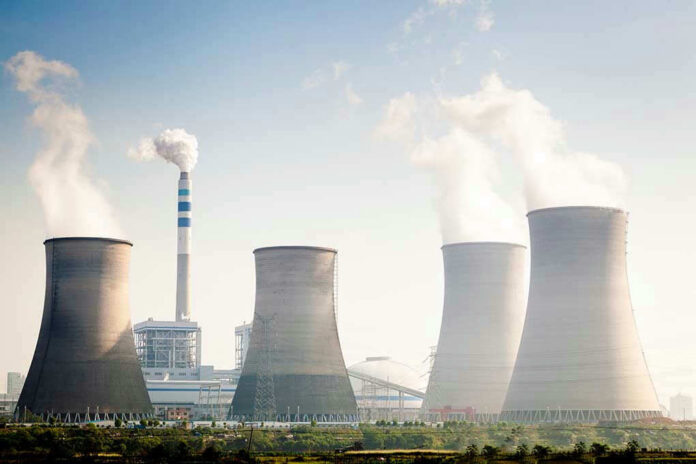
The most consequential shift in global energy geopolitics over the next decade will not be driven by solar panels or wind turbines — it will be measured in gigawatts of nuclear capacity, and China is about to rewrite the rankings.
Key Points
- BloombergNEF projects global nuclear capacity will reach 535 GW by 2036, a 44% increase from 372 GW in 2025 — driven overwhelmingly by China and India.
- China’s nuclear capacity is expected to nearly double from 59 GW to 102 GW, displacing the United States as the world’s largest nuclear power holder.
- The IAEA has raised its nuclear growth projections for five consecutive years, with its high-case scenario now reaching 992 GW by 2050 — lending broad institutional credibility to the expansion narrative.
- The projection rests on aggressive construction pipelines that carry real execution risk: nuclear megaprojects have a long history of cost overruns and schedule slippage, particularly outside China.
- The global operating fleet already stands at roughly 401 GW across 421 reactors, meaning the 535 GW target requires net additions — not just new builds, but successful additions above retirements.
The Numbers Behind the Shift
BloombergNEF’s July 2026 report frames the coming decade in stark arithmetic: from a 2025 baseline of 372 GW, the world’s nuclear fleet is projected to reach 535 GW by 2036. That 163 GW of net new capacity — the equivalent of adding more than 150 large conventional reactors — would represent the most sustained period of nuclear expansion since the post-oil-shock building boom of the 1970s and 1980s. The driver is not a diffuse global enthusiasm but a highly concentrated construction program in two countries.
China alone had 59 GW of reactors under construction at the end of 2025, a pipeline with no parallel anywhere in the world. By 2036, BloombergNEF expects that figure to translate into a total installed base of approximately 102 GW — nearly doubling China’s current capacity and, critically, surpassing the United States, which has long held the top position. India, meanwhile, is pouring billions into new reactor projects explicitly framed around energy security: reducing dependence on imported fossil fuels for a rapidly industrializing economy whose electricity demand is climbing faster than almost any other major nation.
Why China Builds Where Others Stall
Understanding China’s construction velocity requires understanding what makes nuclear projects fail elsewhere. In the West, the post-Fukushima regulatory tightening, combined with decades of dormant supply chains and a workforce that had largely lost the institutional knowledge of large-scale reactor construction, produced disasters like Vogtle Units 3 and 4 in Georgia — years late and billions over budget. The UK’s Hinkley Point C tells a similar story. These are not isolated failures; they reflect a structural atrophy that set in after construction largely stopped in the 1990s.
China never stopped building. Its state-owned nuclear enterprises — China National Nuclear Corporation and China General Nuclear Power Group — have maintained continuous construction programs, standardized reactor designs, and a vertically integrated supply chain that keeps costs and schedules far more predictable than Western equivalents. The result is a learning-curve advantage that compounds: each successive reactor benefits from the engineering and project management lessons of the last. China’s current fleet of operational reactors sits at roughly 59 GW, and the under-construction pipeline is essentially a second fleet waiting to come online.
The IAEA’s Upward Revisions Add Institutional Weight
BloombergNEF’s projection does not stand alone. The IAEA has revised its nuclear capacity forecasts upward for five consecutive years running, with its high-case scenario now projecting 992 GW of nuclear electrical generating capacity by 2050 — approximately 2.6 times the 2024 level. Its low-case scenario reaches 514 GW by 2050. The World Nuclear Association’s outlook is even more bullish, suggesting capacity could reach 1,446 GWe by 2050 if national targets are met. Across these institutions, the directional consensus is unusually consistent: nuclear is expanding, and the pace is accelerating.
What drives the repeated upward revisions? Three forces converging simultaneously. First, electricity demand is growing faster than most mid-decade models anticipated — driven by data center proliferation, electric vehicle adoption, and industrial electrification. Second, the intermittency constraints of solar and wind are pushing grid planners toward dispatchable, firm-capacity sources; nuclear is the only low-carbon option that operates at high capacity factors around the clock. Third, the political economy of energy security — sharpened by the gas supply disruptions that followed Russia’s invasion of Ukraine — has made energy independence a first-order national priority in ways that favor domestic nuclear over imported fossil fuels.
Where the Execution Risk Lives
The honest caveat to all of this is that nuclear projections have a complicated history of optimism that outruns reality. The BloombergNEF report, as reported, provides aggregate capacity figures without granular data on individual reactor commissioning schedules, financing terms, or risk-adjusted scenarios. That methodological opacity matters: a projection built on 59 GW of Chinese under-construction capacity is only as good as China’s ability to bring those reactors online on schedule, which — to be fair — China’s recent track record largely supports. The same confidence cannot be extended uniformly to every project in every jurisdiction.
Retirements compound the picture. The Global Energy Monitor’s Global Nuclear Power Tracker records the world’s operating fleet at approximately 401 GW across 421 reactors as of 2026 — already higher than BloombergNEF’s 372 GW 2025 baseline, a discrepancy that reflects different counting methodologies and timing. What matters is that aging reactors in the United States, Western Europe, and Japan will continue to retire over the coming decade, and the net capacity gain depends on new builds outpacing those retirements by a sufficient margin. The United States has extended the operating licenses of several plants — and the Biden and Trump administrations alike have provided policy support for nuclear — but the US construction pipeline remains thin compared to China’s.
What the Leadership Change Actually Means
The projected displacement of the United States by China as the world’s largest nuclear capacity holder is more than a statistical milestone. It signals a fundamental reordering of where nuclear expertise, supply chain capability, and reactor export influence will reside. China’s state-owned nuclear enterprises are already exporting reactor technology to Pakistan and pursuing contracts in several emerging markets; a 102 GW domestic fleet by 2036 would give them the scale and credibility to compete globally in ways that Western vendors — hobbled by cost overruns and project failures — currently cannot.
India’s expansion trajectory adds a second major vector. Unlike China’s centrally directed program, India’s nuclear build-out involves a mix of domestic pressured heavy-water reactors and imported light-water technology, with partnerships spanning Russia, France, and the United States. The strategic logic is straightforward: India cannot meet its development trajectory on coal alone without compounding its air quality crisis, and solar and wind — however aggressively deployed — cannot provide the baseload density a rapidly urbanizing industrial economy requires. Nuclear is not a romantic choice for India; it is an arithmetic one.
A BloombergNEF report predicts that world nuclear capacity will increase by 44% (from 372 GW to 535 GW) over the next 10 years. Much of the growth will be in China and India. Article link in reply. pic.twitter.com/AATA2E9gGz
— James Hopf (@HopfJames) July 8, 2026
The Broader Energy Context
Nuclear’s resurgence does not occur in a vacuum. The global nuclear power market, valued at over $37 billion in 2025, is projected to reach approximately $52 billion by 2035 — growth that reflects not just new capacity but the economics of life extension, fuel supply chains, and waste management infrastructure. The technology landscape is also shifting: small modular reactors (SMRs) remain largely pre-commercial but are advancing in the United States, Canada, and the United Kingdom, and the IAEA projects they could represent 6% of all added capacity in its low-case scenario by 2050.
The 44% capacity increase BloombergNEF projects by 2036 is, in the longer arc of nuclear history, a recovery from a prolonged trough rather than an unprecedented surge. Global nuclear capacity peaked in the early 2000s, stalled after Fukushima in 2011, and is now climbing again on the back of Asian construction programs and Western policy reversals. Whether 535 GW is achieved precisely on schedule matters less than the structural direction: nuclear is back in the energy planning calculus of every major economy, and China’s construction machine is the primary reason the numbers are moving as fast as they are.
Sources:
zerohedge.com, oilprice.com, energyconnects.com, facebook.com, accf.org, iaea.org, about.bnef.com, nei.org
© fixthisnation.com 2026. All rights reserved.