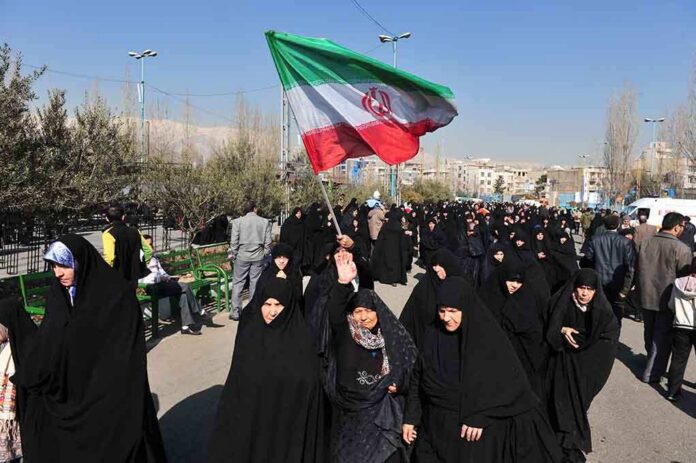
When a leader’s funeral turns into an open stage for naming, shaming, and threatening a foreign president by name, you are looking not at a spontaneous outburst but at a ritualized intersection of grief, geopolitics, and coercive messaging.
Key Points
- Khamenei’s funeral in Tehran featured explicit, on‑record calls for Donald Trump’s death — from the emcee on the loudspeakers to named mourners speaking to reporters.
- Visuals such as “Kill Trump” banners and the stoning of Trump’s portrait turned standard “Death to America” sloganeering into personalized assassination symbolism.
- Iranian authorities framed Khamenei’s killing as a U.S.–Israeli strike, using the funeral to fuse private loss with a public revenge narrative, even as back‑channel diplomacy with Washington continued.
- Western media and U.S. security agencies treat these threats as part of a sustained pattern of Iranian hostility toward Trump and his circle, not merely theatrical rhetoric.
A Funeral as a Political Weapon, Not Just a Farewell
The funeral ceremonies for Ayatollah Ali Khamenei followed a long-established Iranian pattern in which state-orchestrated mourning doubles as mass political theater. Since the 1980s, major funerals for senior regime figures have routinely featured “Death to America” and “Death to Israel” slogans, functioning as a ritualized denunciation of U.S. and Israeli policy rather than a literal call to slaughter ordinary citizens. What distinguishes Khamenei’s farewell is the degree of personalization and specificity: not only were foreign states condemned in the abstract, but Donald Trump and Benjamin Netanyahu were named, targeted, and woven directly into a revenge narrative tied to the leader’s death.
This personalization matters. A slogan like “Death to America” is diffuse; its meaning shifts with context and audience. By contrast, “Kill Trump” on a banner or shouted into a camera by a mourner collapses that ambiguity; it points to a single, identifiable person. At Khamenei’s funeral, that shift from diffuse outrage to targeted hostility was not incidental but central to the spectacle.
What Was Actually Said and Shown: From Slogans to Explicit Threats
Multiple independent and semi-independent outlets converge on a core set of facts about the rhetoric at the funeral. A poet, Mohammad Rasouli, serving effectively as master of ceremonies, used the loudspeakers to ask why “the biggest bastard in the world” — referring to Trump — was “still alive,” adding that “the world is no longer a good place for Trump.” This is not generic anti-Americanism; it is a direct verbal cue that the continued existence of a named leader is itself the problem. The line was met with cheers and followed by the now-familiar chants of “Death to America” and “Death to Israel,” giving the crowd a liturgical frame that tied the personalized insult back into the broader anti-Western repertoire.
Beyond the emcee’s words, named mourners echoed and sharpened the message. One attendee, Gholamreza Sabooni, told reporters, “They killed our imam; we should kill their leader, Trump,” explicitly linking Khamenei’s killing to the perceived need for violent reciprocity. That kind of statement is important because it demonstrates that the assassination rhetoric was not confined to a single performer or stray fringe element; it had diffused into the emotional vocabulary of ordinary regime supporters willing to speak on the record.
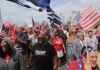
Visual evidence reinforces this pattern. Footage and stills from Tasnim and other outlets show banners reading “Kill Trump” and “Kill Bibi,” held aloft in the funeral procession as Khamenei’s coffin passed through Tehran. Other segments captured mourners throwing stones at a large portrait of Trump, a symbolic adaptation of the Hajj ritual of stoning the pillars that represent Satan. In the Iranian religious context, that act marks Trump not simply as an adversary but as a personification of evil to be ritually attacked. Such imagery pushes the rhetoric beyond metaphor toward a performative invocation of harm.
The Regime’s Narrative: Grief, Airstrikes, and Revenge
These threats did not appear in a vacuum. Iranian officials and sympathetic media framed Khamenei’s death as the result of a joint U.S.–Israeli strike on February 28, 2024, which allegedly also killed his wife, mother, and granddaughter Zahra Mohammadi Golpayegani. The smallest coffin at the ceremony — that of Zahra — was repeatedly highlighted in coverage as a symbol of the personal cost of the conflict, visually inviting mourners to connect familial grief with a desire for vengeance.
This framing serves at least three purposes. First, it casts the strike as a violation of Iran’s sovereignty and as a moral outrage that justifies anger at U.S. leaders specifically, not just U.S. policy. Second, it personalizes Khamenei’s death, inviting empathy for him as a family man rather than merely as a stern religious figure; that emotional reframing makes assassination rhetoric feel, to sympathizers, like a defense of innocence rather than a naked call for murder. Third, by insisting that the strike was clearly attributable to the United States and Israel, the narrative supplies a causal chain: foreign leaders ordered Khamenei’s killing, therefore those leaders are legitimate targets for revenge.
It is important, however, to note a gap in the evidentiary record. Outside Iranian state media and aligned outlets, there is no independently verified forensic or international confirmation of the precise circumstances of Khamenei’s death as described. That does not by itself falsify the claim, but it means that the revenge rhetoric rests on a contested account of how and by whom the leader was killed. The chants and banners treat that account as settled fact; the broader international record does not.
Is This State-Sanctioned Threat or Spontaneous Fury?
One of the key analytical questions is whether the “Kill Trump” language was orchestrated from above or emerged organically from below. Funeral coverage shows a highly choreographed event: coffins arrayed in symbolic formation, microphones controlled by vetted speakers, and the presence of senior officials like Parliament Speaker Mohammad Bagher Ghalibaf and Judiciary Chief Gholam-Hossein Mohseni-Eje’i. In such an environment, it is reasonable to infer that nothing broadcast over the main loudspeakers happens without at least tacit approval. Rasouli’s role as emcee, and his ability to deliver assassination-tinged lines without interruption, suggests that his rhetoric sat comfortably within the bounds of what organizers considered acceptable, even if no formal directive ordering him to utter those precise words has surfaced.
At the same time, the record does not contain a leaked decree from Iran’s Supreme National Security Council or Ministry of Culture explicitly instructing mourners to carry “Kill Trump” banners or to shout for his death. The regime’s broader narrative — of legitimate resistance and revenge — creates a permissive environment where such expressions are welcomed and amplified, but the specific wording and imagery appear to have been contributed by aligned civil society actors, media arms like Tasnim, and individual mourners. This hybrid of top-down framing and bottom-up expression is typical of Iranian political rituals: the state sets the emotional script, and supporters improvise within its parameters.
How Washington and Western Media Read the Threats
Outside Iran, the funeral’s rhetoric has largely been framed through the lens of security and hate speech rather than cultural ritual. U.S.-based outlets and commentators emphasize the explicitness of the threats, highlighting both Rasouli’s comments and Sabooni’s “we should kill their leader” remark as evidence of a dangerous escalation in Iranian hostility toward Trump personally. The convergence of televised chants, repeated “Kill Trump” imagery, and named individuals publicly advocating assassination leads many observers to treat the funeral as more than mere venting.
This reaction is amplified by the existing background of documented Iranian threats against Trump and other officials dating back to the 2020 killing of General Qassem Soleimani. U.S. federal agencies have monitored plots and rhetoric targeting former administration figures for years, treating them as part of a persistent pattern rather than isolated incidents. Against that backdrop, the funeral’s imagery looks less like theatrical exaggeration and more like the latest manifestation of an entrenched hostility with operational implications.
Western media, especially outlets critical of Iranian policy, tend to label the chants as “hate speech” and “death threats,” reinforcing a narrative in which the regime and its supporters are not only anti-American in the abstract but actively calling for political murder. This framing influences public opinion and can shape policy debates about Iran’s intentions and reliability as a negotiating partner. It also feeds social-media moderation decisions: platforms enforcing rules against incitement to violence are more likely to remove or down-rank content that prominently features “Kill Trump” banners or explicit assassination calls.
The Tension Between Funeral Fury and Ongoing Diplomacy
One of the more striking aspects of the funeral is how its maximalist rhetoric coexists with ongoing, albeit fragile, diplomatic engagement between Tehran and Washington. Even as mourners shouted for Trump’s death and vowed revenge, indirect talks mediated by Qatar and Pakistan about navigation rights in the Strait of Hormuz and the unfreezing of Iranian assets were reported to have made “positive progress.” U.S. and Iranian officials spoke cautiously about potential steps toward limiting Iran’s nuclear program, while Israel remained vocally skeptical.
This dual track — public denunciation and private negotiation — is not unusual in Iranian foreign policy. The regime has long used harsh anti-American slogans to signal resolve to domestic audiences while simultaneously engaging in pragmatic bargaining behind closed doors. Yet the personal nature of the threats against Trump complicates this dance. It makes it harder for U.S. policymakers to treat the rhetoric as purely symbolic, especially when domestic political actors highlight the funeral footage to argue against engagement.
Trump’s own response at a Mount Rushmore speech, boasting that “We knocked the hell out of Iran. They’re dying to settle,” only intensified the reciprocal hostility. To Iranian supporters, his words validate their depiction of him as a swaggering adversary. To external observers, the mutual taunting underscores how funerals and rallies have become arenas for leaders and their enemies to exchange threats by proxy, even as diplomats attempt to manage crises quietly elsewhere.
USrael's Death Spiral 26-07-06:
Iran buries its Leader while flexing military muscle across three chokepoints, Israel keeps demolishing homes it isn't supposed to be near, and Washington quietly pulls its refueling planes out of a region it just bombed.
🔻 Millions gridlocked…
— 🔻agitprop + absurdity🔻 (@agtprpnabsrdty) July 6, 2026
How Mourning Rituals Amplify, and Sometimes Resist, State Narratives
To understand why Khamenei’s funeral became such a potent platform for anti-Trump messaging, it helps to situate it within the broader psychology of mourning in Iranian culture. Researchers who study these rituals emphasize how funerals, commemorations, and the “chehelom” — the 40th-day post-burial gathering — can serve as spaces where grief, identity, and political meaning blur. In some cases, families defy state scripts, playing wedding music and dancing at graves to reclaim their dead from official narratives. In others, as with Khamenei’s farewell, the state’s narrative and the mourners’ emotions align, allowing the regime to harness genuine sorrow for political ends.
Mourning rituals, especially for martyrs or leaders framed as victims of foreign aggression, create what psychologists describe as an “affective bridge” between private loss and collective cause. When a coffin is draped in a national flag and accompanied by slogans about foreign enemies, the deceased becomes more than a person; he becomes an embodiment of the nation’s injury. Under those conditions, calls for revenge — including targeting foreign leaders — can feel, to participants, like an extension of the grieving process rather than a separate political act.
That dynamic carries risks. It blurs moral boundaries, making it easier to justify violence in the name of healing or justice. It also means that events like Khamenei’s funeral will continue to be contested in global discourse: for Iranian regime supporters, they are legitimate expressions of resistance and grief; for many outside observers, they are chilling displays of state-linked incitement to political murder.
Sources:
redstate.com, youtube.com, ndtv.com, facebook.com, newsweek.com, washingtonexaminer.com, foxnews.com
© fixthisnation.com 2026. All rights reserved.