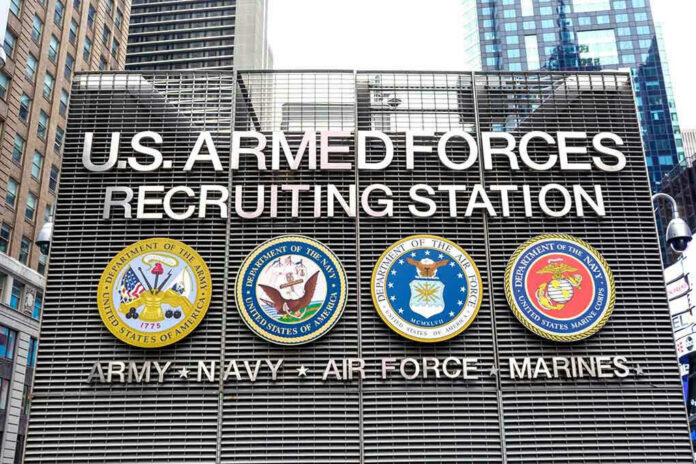
The U.S. military’s recruiting rebound is real, it is documented to the decimal point, and understanding how it happened — and what it actually means for force readiness — requires looking well beyond the headline numbers.
At a Glance
- All five active-duty services met or exceeded their FY2025 recruiting goals, collectively achieving 103% of mission — the strongest performance in 15 years.
- The Army hit 62,050 recruits against a goal of 61,000; the Navy surpassed its target by more than 8%, bringing in 44,096 sailors.
- The rebound built on momentum that began in early 2024, driven by sustained pay raises, lowered entry standards, and preparatory programs that brought borderline candidates up to qualification.
- The Army has already met its FY2026 active-duty goal four months before fiscal year’s end — suggesting the momentum is holding.
- Structural headwinds remain: declining birth rates, a shrinking veteran population, and a pool of eligible youth that the Pentagon estimates at just 23% of 17-to-24-year-olds without waivers.
The Numbers, Precisely
The data from the Pentagon’s own press release leaves little room for interpretation. The Army signed contracts with 62,050 recruits against a goal of 61,000 — 101.72% attainment. The Navy brought in 44,096 sailors, clearing its target of 40,600 by more than 8%. The Air Force reached 30,166 airmen on a goal of 30,100; the Space Force delivered 819 Guardians against a target of 796; and the Marine Corps hit its goal of 26,600 exactly. Across all five active-duty components, the collective attainment rate was 103%. Chief Pentagon Spokesman Sean Parnell stated that since November 2024, the military had seen its highest recruiting percentage of mission achieved in more than 15 years — a claim the branch-level figures corroborate without ambiguity.
The momentum has not stalled. The Army announced it met its FY2026 active-duty recruiting goal — more than 61,500 contracts signed — four months before the fiscal year closes. That kind of early attainment is operationally significant: it gives recruiters time to focus on quality screening and delayed-entry program management rather than scrambling to fill shortfalls in the final quarter. One asterisk worth noting: the Army Reserve reached only 75% of its FY2025 goal, and Army Recruiting Command’s own data shows Special Operations recruiting at 69% of mission. The reserve component gap is a persistent structural issue, not a new one, but it tempers the all-services-thriving narrative at the margins.
How the Crisis Developed — and Why the Rebound Matters More in Context
To appreciate the scale of the turnaround, you have to understand how badly things deteriorated. The Army missed its FY2022 recruiting goal by 25% and its FY2023 goal by 10%. The Air Force and Navy suffered comparable shortfalls. The causes were layered: COVID-19 closed high schools and effectively shut down in-person recruiting pipelines from 2020 onward, producing a 36% drop in high school enlistments between 2020 and 2024. The veteran population — historically the single strongest social influence on enlistment decisions — shrank from roughly 18% of American adults in 1980 to 6% by 2022, gutting the informal recruitment network that once operated through families and communities. And the economy tightened: in a labor market where civilian employers were aggressively competing for the same young workers with signing bonuses and flexible schedules, military service lost some of its economic appeal.
The recovery did not arrive suddenly. It was engineered. The Department of Defense authorized three consecutive annual pay raises of 4.5% or more, plus a 10% raise specifically for junior enlisted personnel effective April 2025. Enlistment bonuses were expanded. Entry standards were selectively relaxed — tattoo policies loosened, medical waivers broadened, and felony waivers quadrupled from 98 in FY2022 to 401 in FY2024. To offset the risk that lower standards might degrade force quality, the Army stood up the Future Soldier Preparatory Course at Fort Jackson, South Carolina, a 90-day program that brings borderline candidates up to physical and academic requirements before they formally enlist. It carries a roughly 90% success rate and accounted for approximately 25% of Army recruits in 2024. The Navy followed with its own Future Sailor Preparatory Course in 2023. These are structural interventions, not cosmetic ones, and they explain why the rebound has proven durable rather than a single-year anomaly.
The Question of Credit — and Its Limits
Political figures have been quick to claim the recruiting surge as a leadership dividend. Defense Secretary Pete Hegseth attributed the numbers to young Americans wanting to serve under Trump’s “America First” leadership, and President Trump himself suggested the gains had materialized since election night 2024. The timeline does not support that framing as the complete picture. Army Recruiting Command’s Major General Johnny Davis stated in October 2024 that recruiting momentum “really started in February 2024, after about a year of putting many of these initiatives together” — well before any change in administration. The 12.5% jump in total DoD recruitment from FY2023 to FY2024 occurred during the final year of the Biden administration. The FY2025 result is the culmination of a multi-year institutional effort, not a single election cycle’s effect. Crediting any one political moment exclusively misreads the data.
What is fair to say is that the current administration has maintained — and in some cases accelerated — the incentive structures that drove the rebound, and that the cultural messaging around military service has shifted in ways that may resonate with a segment of potential recruits. But the underlying machinery: the preparatory courses, the pay raises, the modernized recruitment pitches emphasizing cyber, AI, drone warfare, and space operations to appeal to a generation raised on technology — that machinery was built across administrations and represents a genuine institutional response to a genuine institutional crisis.
From Accession to Readiness: The Gap That Numbers Don’t Capture
Recruiting success and force readiness are related but distinct metrics, and conflating them overstates what the headline numbers mean for operational capability. Military Times investigated how quickly FY2025’s recruits would become fully mission capable and found no standardized, publicly available department-wide metric for that timeline. The answer, as Navy officials explained, is that readiness is measured through demonstrated proficiency rather than elapsed time: “It’s not really time-based. Can you do the mission?” Training pipelines vary enormously by specialty — administrative and support roles can produce qualified personnel in months, while special operations and highly technical fields like nuclear engineering or cyber operations can require several years of sequential qualification courses. The 62,000 soldiers the Army signed in FY2025 are not 62,000 combat-ready soldiers on day one of their contracts. They are the beginning of a multi-year pipeline, and the health of that pipeline matters as much as the accession numbers.
The Structural Horizon
The recruiting surge is genuine and consequential. It is also a rebound from an unusually severe trough, not evidence that the long-term structural pressures have been resolved. The Pentagon’s own estimate — that only 23% of Americans aged 17 to 24 qualify for service without a waiver, due to obesity, mental health conditions, educational deficits, and criminal records — has not changed. The U.S. birth rate has been declining for years, which will mechanically shrink the eligible pool in the decade ahead. The veteran population, which functions as the military’s most effective informal recruiting network, continues to contract as a share of the adult population. And the Army Reserve’s persistent underperformance — 75% of goal in FY2025, following years of similar shortfalls — signals that part-time service remains a harder sell than full-time enlistment, even in a strong recruiting environment.
The military currently maintains approximately 1.3 million active-duty personnel and 760,000 reservists, and requires somewhere between 150,000 and 200,000 new recruits annually simply to replace attrition and sustain force levels. FY2025’s results demonstrate that the services can meet those annual accession targets when incentives are strong, pipelines are maintained, and institutional energy is directed at the problem. Whether the current conditions — competitive pay, modernized messaging, preparatory programs — can be sustained against demographic headwinds is the question that the next decade will answer. The 15-year high is a real achievement. It is also, viewed against the full arc of American military manpower, a floor to defend rather than a ceiling to celebrate.
Sources:
facebook.com, washingtontimes.com, militarytimes.com, war.gov, instagram.com, pmc.ncbi.nlm.nih.gov, youtube.com, usafacts.org
© fixthisnation.com 2026. All rights reserved.