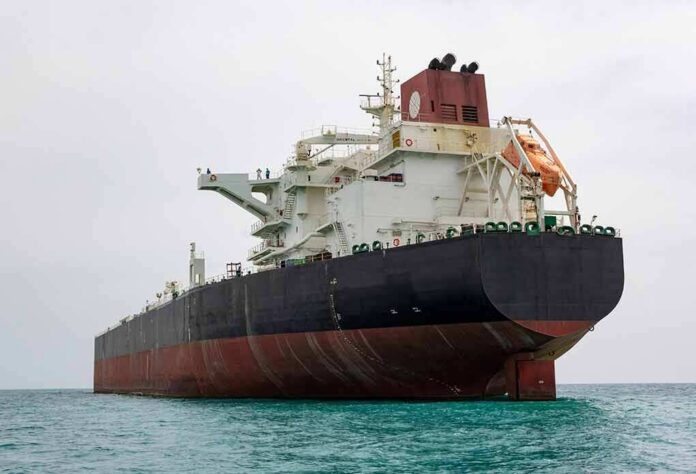
Tankers in and around the Strait of Hormuz were hit in a fast-moving wave of attacks that quickly turned a shipping lane into a battlefield.
Quick Take
- Reuters reported that Iranian Revolutionary Guards fired missiles at commercial ships in the Strait of Hormuz, and U.S.-aligned maritime bodies raised the threat level to severe.
- Multiple reports described tankers, fuel ships, and other vessels damaged across the Gulf, the Gulf of Oman, and the Strait of Hormuz in a short span.
- Public reporting tied some incidents to Iranian or Iran-backed forces, while other accounts used cautious terms like “unknown projectile” or “explosions.”
- The record supports a broad pattern of hostile maritime pressure, but the public evidence shown here is uneven from incident to incident.
How the Attacks Changed the Sea Lanes
The Strait of Hormuz matters because a small stretch of water carries huge energy traffic. When ships start burning there, markets do not wait for perfect certainty. Reuters reported that Iranian Revolutionary Guards fired at least two missiles at commercial ships, and CNBC said a U.S.-led maritime coalition warned that deliberate hostile action by Iran was likely.
That is the core of the story: not one isolated blast, but repeated hits that made commercial crews treat the route as hostile ground. Reuters, BBC, and Lloyd’s List all described a cluster of vessels struck or damaged in compressed time windows, which is why the attacks were read as part of a wider campaign rather than random mishaps.
What the Public Record Says About Attribution
The public record does not look the same in every case. Some reports were blunt. Reuters quoted officials saying Iranian boats laden with explosives assaulted two oil tankers in Iraqi waters, and CNBC said Qatar held Iran responsible for an LNG tanker attack near Hormuz. Those are direct attributions, not vague hints.
Other reports were more cautious. BBC coverage of earlier Gulf of Oman incidents described tankers damaged by explosions, and later reports referred to explosions on foreign vessels or a ship hit by an unknown projectile. That matters because it shows how fast maritime reporting can move before a full forensic file is public.
Why the Pattern Matters More Than One Incident
One attack can raise alarms. A string of attacks changes behavior. BBC reported six vessels assaulted in less than two days, while CNBC later said dozens of commercial ships had been attacked across the wider region since March 1. Even without a perfect evidence trail for every single case, the repetition tells shipowners, insurers, and naval planners that the threat is not theoretical.
That is also why the language of official warnings carries weight. The Joint Maritime Information Center said the threat to ships crossing Hormuz had risen to severe and warned that deliberate hostile action by Iran was likely. In plain terms, that is a shipping authority telling mariners to assume the worst until proven otherwise.
The Middle East Shipping Crisis Did Not Start Here
The deeper background is a familiar one. Reuters and BBC both place the attacks inside a larger cycle of Iran-West escalation, while the historical record of the tanker war shows that merchant ships have long been used as pressure points in Gulf conflict. That history helps explain why each new attack gets interpreted through a security lens almost immediately.
Post 1.
Hormuz, Capacity and the Collapse of Energy Fiction
1st August 2026
The Strait of Hormuz is not a metaphor. It is a narrow waterway through which roughly one-fifth of the world’s seaborne oil and a significant share of LNG have historically moved. In the summer of…
— Barry Sharp (@BarryESharp) August 1, 2026
The public tension in this case is not whether ships were hit. They were. The sharper question is how much of the technical proof is available outside government channels. The provided record relies heavily on maritime warnings, official statements, and major news reports. That is enough to support the hostile-act narrative, but not enough to show a full forensic chain for every vessel.
What a Skeptical Reader Should Notice
The strongest part of the case is the pattern. The weakest part is the uneven public evidence behind each attribution. Reuters, BBC, CNBC, and other outlets repeatedly describe attacks, damage, fires, and warnings tied to Iran or Iran-backed forces. But the public material here does not include the kind of released forensic package that would settle every disputed detail ship by ship.
That gap does not erase the event. It only defines its limits. The record shows a serious maritime campaign, a sharp rise in danger for crews, and a region where one tanker hit can ripple through oil prices, insurance costs, and naval posture. The sea lanes were not just threatened. They were being tested in real time.
Sources:
feedpress.me, reuters.com, bbc.com, trtworld.com, lloydslist.com, cnbc.com, en.wikipedia.org, wsj.com, youtube.com
© fixthisnation.com 2026. All rights reserved.