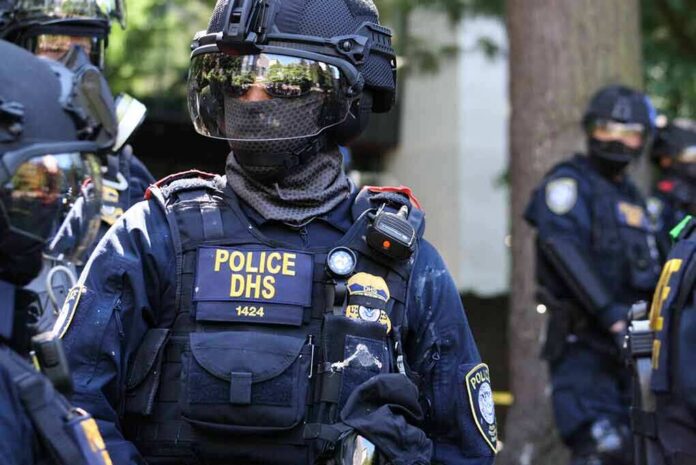
The real significance of ICE’s glove purchase is not the gimmick of hidden electronics; it is the normalization of a new, direct-contact coercive tool that sits somewhere between a patrol glove and a pain-compliance device. Once an agency starts buying equipment designed to produce immediate discomfort on touch, the debate shifts from branding to force policy, medical risk, and oversight.
Key Points
- ICE plans to spend up to $20 million on thousands of gloves that can deliver electric shocks, according to reporting on a DHS procurement notice.
- The product is marketed as a “conductive distraction and de-escalation device,” with the manufacturer claiming it can produce compliance in seconds.
- The gloves are described as operating like ordinary patrol gloves until activated by a switch, which makes them easy to carry and hard to read at a glance.
- The strongest unresolved issue is not whether the gloves exist, but whether their real-world use will be tightly limited, independently evaluated, and transparent enough to justify deployment.
What the Gloves Are, and Why the Purchase Matters
ICE’s reported plan is unusually concrete: up to $20 million for thousands of gloves, with delivery by March, for officers and agents. The devices are identified as the G.L.O.V.E., short for Generated Low Output Voltage Emitter, and the manufacturer says they are intended to work within the force continuum as a compliance tool. That matters because the purchase is not a speculative prototype story or a trade-show curiosity. It is an institutional acquisition, which means the question is no longer whether such a device can be made, but what kind of force doctrine an agency is willing to build around it.
Supporters will hear the company’s language and see a less-lethal rationale: a tool that can be deployed close-up, quickly, and without the blunt trauma of batons or the distance-and-impact profile of other devices. Compliant Technologies says the gloves function as normal patrol gloves until a switch is pressed, and that the device can produce compliance rapidly while leaving no burns, marks, or scars. In the abstract, that is the pitch of many police technologies: less visible injury, more control, less need for prolonged physical struggle. In practice, the real test is whether those claims survive contact with training, field use, and human variability.
How the Device Works in Practice
The core appeal is concealment through familiarity. A glove is a mundane item of police gear; if the electrical function is dormant until activated, officers can carry the device without advertising it the way a baton or taser signals force. That design is what makes the product distinct from more familiar conducted-energy devices. It is not meant to look like a weapon until it is used. The manufacturer describes a direct-contact mechanism: the glove must touch skin to deliver a pain stimulus, and the promotional language emphasizes speed, with compliance often claimed within seconds.
The technical material published by Compliant Technologies is more detailed than the general reporting. It lists different glove models, activation by switch, voltage ranges, pulse characteristics, and operating temperatures. On paper, that gives the product an air of engineering precision. But engineering specifications are not the same as operational validation. Numbers on a product page tell you what the device is designed to do; they do not tell you how it behaves on a sweaty, moving, resisting human being, in poor lighting, under stress, or against someone with a medical vulnerability. That distinction is the heart of less-lethal weapons policy, and it is where early reporting tends to be thinnest.
The Claims for Safety Are Narrower Than They Sound
The manufacturer’s strongest claim is also its most politically useful: the gloves are presented as a means of gaining compliance without visible injury. That is an attractive proposition for any agency that wants a tool perceived as cleaner than a firearm, less injurious than a baton strike, and more controlled than a prolonged physical takedown. But “no burns, marks or scars” is not the same as “no harm.” It says nothing about pain intensity, psychological distress, escalation risk, or the possibility that a shock could worsen resistance rather than end it.
That is where the evidence base remains thin. The materials in the record include the manufacturer’s statements and news reporting, but no independent biomedical testing, no comparative use-of-force study, no medical review, and no incident-level data showing how the gloves perform under ICE conditions. The available record also does not show training manuals, deployment rules, or after-action reviews demonstrating that the devices are being limited to narrow scenarios. In other words, the public is being asked to evaluate a coercive tool largely on the seller’s description of its kindness.
The Real Policy Question Is Not Branding, It Is Restraint
This is where the broader less-lethal debate becomes instructive. Devices of this sort are rarely judged only by their advertised function; they are judged by the institutional habits surrounding them. Who may use them, against whom, at what threshold, and with what medical follow-up? Those questions matter more than the product name. The reporting says supporters see the gloves as tools for specific jail and transport situations, not broad street patrol use, and that the manufacturer warns against using them as punishment or against people who are merely verbally defiant. That is the right conceptual boundary. The problem is that the public record provided here does not show whether ICE has codified that boundary with enough force to matter.
There is also an obvious accountability issue. A glove that looks ordinary until switched on is harder to monitor than a device that is visibly recognized as a control instrument. That does not make it illegitimate; it does make oversight more important. If an agency adopts a concealed shock-capable glove, then the decisive safeguards are not cosmetic. They are written use-of-force limits, recertification rules, medical checks, incident logging, and independent review. The manufacturer says officers must complete a course and be recertified every two years. That is useful, but training requirements alone do not answer whether the device will be deployed with discipline or drift into routine coercion.
Why the Public Reaction Is So Instantly Intense
The phrase “bee sting” captures why this story lands the way it does. It is vivid, almost flippant, and it reduces a coercive device to a familiar childhood sensation even though the underlying purpose is to induce pain. That rhetorical contrast is doing a lot of work. To critics, the story is proof that ICE is broadening its coercive repertoire. To defenders, it is a less-lethal alternative that may reduce wrestling injuries and control volatile encounters more quickly. Both reactions are understandable; neither is sufficient.
The deeper truth is that public judgment will be shaped less by the abstract existence of the gloves than by the first real records of use. If the devices are restricted, documented, and used sparingly in genuinely high-risk custodial situations, the controversy will narrow. If they are used casually, hidden from meaningful review, or applied against vulnerable people, the criticism will harden fast. The Omega Research Foundation’s broader warning about direct-contact electric shock weapons is categorical, arguing that such tools facilitate abuse and should not be used by law enforcement. That is an advocacy position, not a field study, but it captures the central fear: once pain becomes easily portable, misuse becomes easier to normalize.
ICE is spending $20 Million to provide its fascist agents with 𝐞𝐥𝐞𝐜𝐭𝐫𝐢𝐜 𝐬𝐡𝐨𝐜𝐤 𝐠𝐥𝐨𝐯𝐞𝐬. This is barbaric. Abolish ICE. pic.twitter.com/UCBzOEvTAE
— Power to the People ☭🕊 (@ProudSocialist) August 12, 2026
What Still Needs to Be Proven Before Anyone Can Judge the Program
The missing documents are the ones that would convert this from a controversial procurement story into a properly assessable policy choice: the DHS solicitation, the ICE justification memo, the training bulletin, the force-policy classification, and any internal testing or pilot results. Without those, the public is left with a manufacturer’s description on one side and alarmed headlines on the other. That is not enough to settle whether the glove is a narrowly tailored control device or a new instrument of avoidable pain. It is enough, however, to say that ICE is not just buying equipment; it is buying a doctrine of use.
Sources:
cbsnews.com, theguardian.com, powerpak.net, grainger.com, amazon.com
© fixthisnation.com 2026. All rights reserved.