When politics collides with the realities of life at sea, anecdotes become stress tests of credibility; the durable question isn’t who told the story first, but whether the claim fits the known mechanics of long deployments and whether the evidence around it supports or undercuts the core facts.
The Short Version
- Mark Kelly’s “grandmother and 21-year-old grandson on the USS Abraham Lincoln” anecdote is specific, on record, and embedded in a broader call for an inquiry into carrier conditions.
- Independent reporting and Navy-facing commentary document sustained strain on sailors during an unusually long deployment, making the complaint plausible in pattern if not yet verified in every detail.
- Direct disavowals from leadership allies dispute the severity narrative but do not rebut the particular grandmother call with named, sourced counter-evidence.
- The evidentiary gap is narrow and knowable: the story would be settled by firsthand corroboration from the grandmother or sailor, or by routine records.
What Kelly actually claimed — and why its specificity matters
In a recorded appearance, Mark Kelly said he had spoken with a grandmother concerned about her 21-year-old grandson serving aboard the USS Abraham Lincoln; he relayed that the sailor had lost 20–25 pounds and was struggling with depression. That is not vague political atmospherics. It includes three concrete anchors: a particular kin relationship, a precise age, and a quantifiable physical change. Kelly also positioned the anecdote in service of a defined policy demand — an investigation into conditions aboard the carrier — rather than as a standalone emotive flourish. In public disputes over military readiness and habitability, granularity is the line between rhetoric and a fact pattern one can attempt to verify. The line here is bright because the claim identifies a checkable chain: a constituent contact, a sailor, a weight change of a stated magnitude, and a ship.
That chain is not fully corroborated in the public record. There is no released phone log, affidavit from the grandmother, medical record, or direct statement from the sailor attaching a name to the account. But absence of documentary attachments does not erase the specificity of the original on-record claim; it simply defines the remaining proof problem and locates it in places that are mundane to confirm if the parties choose to surface them. The detail is the point, and the detail is testable.
How the larger record of the Lincoln’s deployment frames plausibility
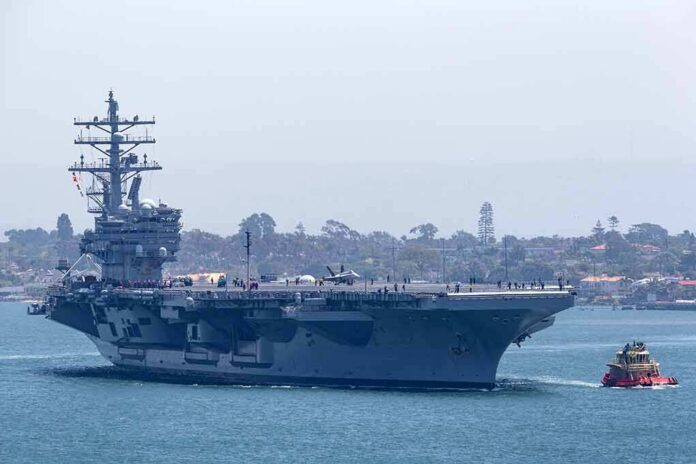
The USS Abraham Lincoln’s cruise has been characterized in independent reporting and family accounts as exceptionally long and operationally grinding, with consequences that predictably erode morale and health: scarce port relief, degraded habitability, and basic-life-support frictions that compound fatigue. Descriptions that surfaced include nonfunctional heads, mold in showers, intermittent hot water, laundry breakdowns, spot food shortages, and long shifts on high-risk decks — a profile entirely consistent with increased stress loads and weight fluctuation in younger enlisted sailors, who are the population most vulnerable to deployment-related psychological strain. Multiple Navy-focused studies and evidence maps have found shipboard sailors exhibit behavioral health risks comparable to those seen after ground combat rotations, with chronic sleep restriction, noise, and resource gaps acting as multipliers. In other words, the environment alleged by families is aligned with what peer-reviewed literature predicts will happen to a crew under sustained tempo.
The specifics of the grandmother’s report — a 20–25 pound loss and depressive symptoms — sit squarely within that plausible range. A weight drop of that scale across months of 12–14 hour days, broken sleep, variable chow quality, and elevated cortisol is not physiologically exotic; it is a classic signal of prolonged stress and reduced intake. Separately, qualitative studies of sailors underway repeatedly document the same pattern: constrained opportunities to recover, diminished mental health resources when most needed, and a tendency for family members to become the first reporters of warning signs because they hear the private admissions a young service member won’t give his chain of command. That is precisely the transmission path Kelly described.
Where the real evidentiary dispute lies
The counter-narrative does not, at this point, offer a named, sourced contradiction to the grandmother call itself; rather, it disputes the larger premise that conditions aboard the Lincoln were as dire as critics described. Defense leadership and allies have cast the reporting as misrepresentation or misinformation. This is a broad-frame rebuttal — a contest over adjectives and emphasis — not a document-based refutation of the concrete anecdote Kelly placed on the record. The difference matters. If the debate is about whether a carrier at sea for hundreds of days faced “deplorable” versus “challenging but adequate” conditions, that is a policy and leadership argument. If the debate is about whether a specifically described grandmother ever called and relayed a specifically described weight change, the standard is documentary: call records, testimony, or sailor confirmation. The former rebuttal does not settle the latter question.
That is why the grandmother story is both sticky and fragile. Sticky, because it is emblematic: one sailor’s struggle symbolizes the human cost of extended deployments. Fragile, because it depends on a single thread of secondhand reporting. The shortest path to resolution is straightforward. If Kelly’s office releases constituent casework notes or a redacted log confirming the contact, and the family chooses to identify themselves, the anecdote graduates from plausible to substantiated. If, conversely, named parties deny the call took place or records fail to align, the claim collapses. Until one of those things happens, weighing the larger corpus of shipboard research and family testimony is the rational way to judge plausibility rather than certainty.
Mechanics: why long deployments bend sailors toward these outcomes
To evaluate an anecdote responsibly, you need the mechanism. Shipboard life concentrates stressors: confined quarters, constant noise and vibration, circadian disruption, heat, chemical smells, and ever-present risk on the flight deck. Work-rest cycles skew; chow lines and watch bills leave little room for consistent nutrition; laundry and sanitation backlogs chip away at dignity. When maintenance lags stack with mission extensions and unclear end states, control and predictability — two pillars of resilience — evaporate. Younger, unmarried, lower-ranked sailors are most exposed to these effects, a finding replicated across Navy and maritime mental health literature. The result is a known symptom cluster: sleep fragmentation, weight change, irritability, anxiety and depressive symptoms, and reduced help-seeking despite need. On carriers, this plays out under the eyes of peers and supervisors, which can suppress self-reporting; families often hear it first.
Against that mechanistic backdrop, the grandmother’s relayed description reads as textbook: an early-twenties sailor dropping significant weight over months while mood deteriorates. That does not prove that this sailor exists or that the call occurred as described. It does establish that the claim matches not only broader reporting about this specific cruise but also the predictable outputs of the environment in question. When anecdotes rhyme with the mechanism, the burden shifts to either verify or falsify the particular instance, not to litigate whether the pattern is possible.
What would settle it: the narrow, fixable evidence gap
This is not an unsolvable mystery. Four classes of routine material would answer it cleanly. First, constituent-service records from Kelly’s office — call logs, case notes, or staff emails — would timestamp the contact and record who said what. Second, family testimony — a sworn or recorded statement from the grandmother and, ideally, from the sailor — would fix identities and circumstances. Third, fitness or medical documentation — periodic weigh-ins, medical visits, or command fitness records — would confirm the claimed 20–25 pound delta and date its onset. Fourth, command climate or ombudsman communications from the Lincoln’s deployment window would contextualize whether similar reports were common. These are standard artifacts in congressional casework and Navy administration; their existence is normal, their disclosure is the variable.
Until then, the prudent reading is this: the anecdote is uncorroborated in its particulars but strongly consonant with a well-documented operational stress picture. Treat it as a plausible signal rather than a proven indictment, and direct scrutiny toward the underlying deployment conditions that would either make such a story ordinary or anomalous.
Sen. Mark Kelly (D-AZ) on conditions aboard USS Abraham Lincoln:
"What's worse is the Sec. of Defense's response dismissing it like it's no concern at all. I think a fundamental part of leadership is trying to improve the lives of the people you're leading, and he doesn't want…
— Scott MacFarlane (@MacFarlaneNews) August 14, 2026
Why the politics obscure more than they reveal — and how to keep the focus
High-profile disputes over military habitability often degrade into reputational combat — was a senator embellishing, is a secretary minimizing — because the political payoff sits in those verdicts. But the sailors’ reality doesn’t move with the talking points. Long underway periods, limited port breaks, chronic maintenance debt, and manpower gaps produce predictable human consequences regardless of which party narrates them. When a leader relays a family’s distress to force an inquiry, the proper response is to test the claim against records and to measure it against the deployment’s operational facts, not to collapse the question into team sport. On this record, leadership allies have offered rhetorical pushback on the severity narrative; they have not produced named, document-based counter-evidence that the grandmother call did not occur or that the described symptoms were fabricated. That is a substantive asymmetry.
There is a responsible way forward that honors both truth-testing and the crew. First, verify the anecdote with the narrow materials that can do so decisively. Second, publish a frank accounting of habitability and tempo on the Lincoln during the deployment window, including corrective actions taken and remaining gaps. Third, stop treating family intermediaries as political pawns; they are often the earliest, and only, reliable witnesses to a sailor’s downward slide. Finally, regardless of the anecdote’s eventual status, treat the common mechanism it exemplifies — cumulative operational stress on young sailors — as the problem to solve. That, more than any viral clip, is what determines readiness and retention in the fleet.
Sources:
twitchy.com, youtube.com, instagram.com, facebook.com, washingtonexaminer.com, mercercountyoutlook.net
© fixthisnation.com 2026. All rights reserved.