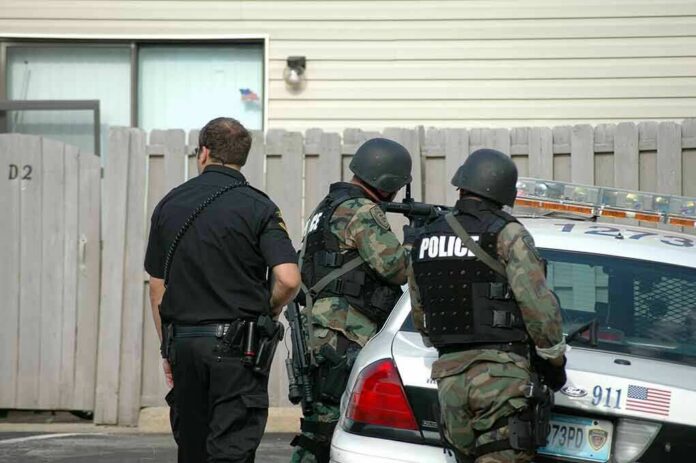
In Atlantic City, a routine act of policing that plays out thousands of times a year—serving a search warrant—collapsed in seconds into a point-blank gunfight at a front door. The clearest lesson is also the oldest: the threshold is the most dangerous place in American law enforcement.
At a Glance
- State investigators say Donald Gardner opened fire as SWAT officers opened his front door during a June 2, 2026 warrant service in Atlantic City.
- Two officers were struck—one in the leg, another in the helmet—and Officer Robert Reynolds returned fire, fatally wounding Gardner, according to the Attorney General’s account.
- Body-worn camera footage and radio traffic released by New Jersey authorities depict officers announcing a search warrant and the immediate eruption of gunfire.
- The case illustrates how fast warrant service can turn lethal, even in close quarters and against an occupant with limited mobility.
What the official record shows about the shooting
On June 2, 2026, Atlantic City Police Department SWAT and the Atlantic County Prosecutor’s Office SWAT moved to execute a search warrant at a residence on the 100 block of North Florida Avenue. As the team opened the door to the residence, the occupant, identified as 52-year-old Donald Gardner, fired multiple gunshots at the officers, striking two of them. Officer Robert Reynolds, an Atlantic City officer who was not hit, returned fire multiple times, striking Gardner, who was later pronounced dead, according to the New Jersey Attorney General’s Division of Criminal Justice, which is investigating the incident. The Attorney General subsequently released a package of body-worn camera footage and radio transmissions from the operation, providing time-synced audio and video of the approach and the burst of gunfire at the threshold.
Contemporaneous local coverage is consistent with the state’s account: two officers were wounded in the exchange and Gardner died after being struck by police gunfire. Reports describe one officer hit in the leg and another saved by his ballistic helmet—injuries echoed in television segments that reviewed the body-camera release. While those reports do not function as medical confirmation, they track with the visual and audio cues in the clips and with the Attorney General’s narrative of a brief, close-range firefight at the doorway.
How a door becomes a danger zone
The mechanism of risk in a warrant service is simple physics and human reaction time. A team approaches a known location and announces authority; the occupant—who controls the interior angles—can decide instantly to comply, flee deeper into the structure, or fire from cover. Open a door and you create a funnel: officers are silhouetted, often within a narrow field of fire, while the person inside can shoot from darkness or concealment. This geometry is why even well-trained teams emphasize speed, clear commands, and layered protection, and why even a fraction of a second can determine whether an officer or an occupant survives a first volley. The Atlantic City footage shows this dynamic with painful clarity; the verbal announcement and the opening of the door are immediately followed by gunfire, leaving little window for de-escalation once the first round is discharged.
In popular imagination, SWAT deployments are exotic and rare; in practice, they are a staple of modern policing. A Council on Criminal Justice review notes that the most common use of SWAT teams is executing search warrants—roughly nine in ten deployments—often involving forcible entry. Most such entries do not end in gunfire, but the door phase is where the outliers cluster: fast, violent, and largely dictated by the person on the inside.
The sequence on camera and on the radio
The state-released compilation includes the moments just before the breach, the shouted notice—“Police Department search warrant”—and then the eruption of shots as the door opens. Radio traffic captures the chaos and the immediate shift to casualty care and command: calls that officers are hit, requests for medics, and updates as the team regains control of the threshold. This is exactly the mix of sensory information investigators rely on to reconstruct who did what, when: time-stamped audio, muzzle flashes synced to frames, and shouted identifiers that anchor positions and actions. The Attorney General’s update uses that material to underpin its preliminary narrative: Gardner fired first; Officer Reynolds returned fire and struck him; two officers were wounded in the initial exchange.
Independent outlets who reviewed the same release describe the sequence in virtually identical terms: announcement, door opens, gunfire from inside, officers hit, return fire, and Gardner down. The emphasis varies—some foreground the fact that one officer’s helmet absorbed a round; others anchor on the suspect’s mobility limitations—but the core arc is stable across the coverage.
Why mobility status doesn’t neutralize threat
One detail in the public framing that invites misinterpretation is Gardner’s mobility impairment and reported use of a wheelchair. From a tactical perspective, mobility affects movement but not necessarily lethality at contact distance. A seated shooter can command the fatal angles of a short hallway or doorway as decisively as someone on two feet. Ballistics care about distance, line of sight, and the presence of a firearm; they are indifferent to gait. The Atlantic City case is a textbook example: the first seconds at the entrance, not a chase or standoff, defined the outcome. The body-camera record shows a rapid, close-quarters exchange where any occupant—ambulatory or not—retains the capacity to initiate gunfire at arm’s-length range.
Where this incident sits in the broader pattern of raids
Across jurisdictions, the overwhelming share of SWAT missions are search or arrest warrant executions, with a majority involving some form of forced entry. That prevalence shapes risk profiles: most raids are resolved without shots fired, yet the small fraction that do involve gunfire tend to occur at the moment of entry, exactly as in Atlantic City. The policy conversation nationally has focused on how teams announce, whether and when no-knock authority is appropriate, and how to stage personnel to minimize crossfire and silhouette—issues that matter regardless of local crime patterns or agency size. The Council on Criminal Justice’s synthesis is instructive: SWAT is primarily a warrant service tool, and the methods chosen at the door carry disproportionate consequence if the person inside is armed and determined to resist.
New Jersey’s posture on officer-involved shootings aligns with best practice by assigning the criminal investigation to the Attorney General’s office; that externalization is meant to insulate the core fact-finding from the home agency’s internal loyalties, and it brings the resources needed to analyze body-camera metadata, ballistics, and autopsy results at scale. The office’s October release is framed as a preliminary account while the full investigation proceeds, but it anchors its claims in contemporaneous audio-visual evidence—a higher-grade substrate than narrative-only recaps.
On June 2, 2026, Atlantic City Police SWAT and the Atlantic County Prosecutor's Office SWAT team went to serve a search warrant at a house on North Florida Avenue in Atlantic City, New Jersey. When they pulled up the front door was open, but someone inside closed it. The team… pic.twitter.com/nbOOTGzWmA
— Spec Ops Magazine (@specopsmag) October 15, 2026
The takeaways for policy and practice
Three conclusions follow. First, the center of gravity in a warrant service is the threshold; if an occupant chooses to fire from inside as the door opens, officers must survive the opening salvo before any other tactic—de-escalation, dialogue, containment—can be brought to bear. Second, body-worn camera and synchronized radio traffic are not decorations; they are the evidentiary backbone that stabilizes public understanding when an operation goes lethal at conversational distance. Third, the arithmetic of SWAT work is unforgiving: because most deployments are for warrants, and most warrants involve doorways, the rare catastrophes accrue where the procedure is most common.
Sources:
nbcphiladelphia.com, courierpostonline.com, newjersey.news12.com, fox29.com
© fixthisnation.com 2026. All rights reserved.