When small boats fail far offshore, survival hinges on minutes, coordination, and physics: the geometry of a search grid, the drift of currents, and the range of aircraft matter as much as bravery. A predawn mayday off Baja California proved the point—16 people were pulled alive from open ocean, and a multinational search pressed on for others believed missing.
At a Glance
- Coast Guard aircrews rescued 16 people after a sinking was reported roughly 140 miles west of Ensenada; survivors were flown to San Diego for treatment.
- The rescue launched off a 1:00 a.m.-hour distress call; responders found debris and people in the water, not a floating vessel.
- Authorities continued searching for additional people believed missing, employing multiple aircraft and ships from the U.S. and Mexico.
- Medical care included treatment for cold exposure and at least one suspected shark-bite injury.
A predawn mayday, a long-range rescue, and a continuing search
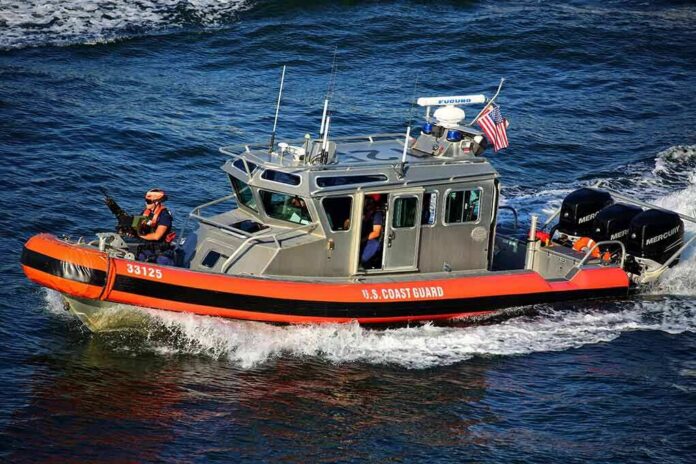
Shortly after 1 a.m. local time, U.S. Coast Guard watchstanders received a distress transmission reporting a boat taking on water in the Pacific west of Ensenada. Sector San Diego treated the call as a sinking at sea—time critical and unforgiving—and launched a layered response: helicopters and fixed-wing aircraft to localize survivors, and surface assets to sustain the search and recover people from the water. Aircrews reached the reported area, approximately 140 miles offshore, and hoisted 16 survivors; all were transported to San Diego for medical care. Responders encountered debris and floating seats but no intact hull, consistent with a rapid foundering event in open water.
Accounts from survivors suggested more people had been aboard, prompting the Coast Guard to continue searching beyond the initial rescue. U.S. assets included multiple aircraft and a cutter, while the U.S. Navy contributed a surface combatant to extend endurance and sensor coverage. Mexico’s Navy (SEMAR) launched its own operation out of Ensenada, coordinating across the international boundary line that bisects the search box. At the public-briefing stage, authorities described the total number aboard as unconfirmed—a common position until interviews, hospital intakes, and cross-border notifications are reconciled.
How responders find people in a vast ocean
Open-ocean searches are races against two clocks: human survivability and the dispersion of the search area. From a last-known-position (LKP), planners model drift using wind, swell, and current data; the error ellipse grows with time, so aircraft establish visual and sensor search patterns that maximize probability of detection and rapidly revise as new clues appear. Helicopters deliver speed to the datum and precise recovery; fixed-wing aircraft cover broad areas and vector surface ships. The offshore distance—roughly 140 nautical miles—dictates refuel cycles and crew swaps, which is why Coast Guard and Navy assets share the load and why Mexican naval participation matters along the southern arcs of the search.
Survivability improves markedly with flotation, signaling devices, and relatively warm water; it degrades with night exposure, fatigue, and injury. In this case, at least one patient was treated for injuries consistent with a shark bite, and others for hypothermia and exhaustion—predictable complications after nighttime immersion without a platform. The clinical priority sequence ashore reflects that reality: airway and bleeding control, rewarming, then evaluation for trauma masked by cold stress.
What we know—and don’t—about the boat and the casualty sequence
When rescuers arrive to find only debris fields and people in the water, cause analysis begins later and is often inconclusive. Without a recovered hull, investigators rely on survivor interviews, photographs of debris, and any serial numbers or distinctive components to infer vessel type, maintenance condition, and possible overloading. Weather, sea state, and dark-of-night navigation errors are frequent contributors; collisions and sudden flooding from hull breaches or failed through-hulls are less common but catastrophic when far from shore with minimal safety gear. In this incident, public reporting has not identified the boat’s class or ownership, and officials have not ascribed a definitive cause based on the available record.
The location is a corridor where commercial, recreational, and illicit maritime traffic overlap. Authorities and local reporting have documented a multiyear rise in maritime smuggling attempts along the Southern California–Baja coast, with fatal outcomes when lightly built boats meet rough water or heavy loads. That pattern is relevant background—risk concentrates on poorly equipped craft—yet, as investigators often underscore, pattern is not proof about a specific casualty unless and until a case file, charges, or documentary links are established.
Medical realities: cold stress, saltwater trauma, and shark-bite assessment
Nighttime immersion strips heat faster than most first-timers imagine. Even in relatively warm Pacific water, core temperature drifts downward, impairing cognition, swimming endurance, and clotting. Rescue swimmers and flight medics triage in the sling: patients with altered mental status, advanced hypothermia, or significant bleeding are prioritized for immediate hoist. Back on land, emergency teams manage rewarming carefully to avoid afterdrop (continued cooling from peripheral cold blood returning to the core). Distinguishing shark bites from propeller or debris lacerations is not trivial; clinicians look for semicircular arc patterns, tissue avulsion, and serrated margins that track with dentition, though definitive identification can remain cautious in the absence of bite-mark forensics. In the Baja rescue, at least one patient was treated for injuries described by authorities as consistent with shark bites.
Why the count of “missing” is hard in the first 24–48 hours
Initial headcounts at sea are imperfect by design: there is no passenger manifest, survivors are exhausted, and language barriers complicate interviews. Coast Guard practice is to treat survivor estimates seriously but label them preliminary until corroborated. That is why statements referenced “people believed to be missing” even as the search surged. Confirmation typically comes from a triangulation of hospital admissions, consular notifications, family reports, and, when possible, identification of the vessel’s operator and owner. Until then, search planners bracket the highest plausible number; it is operationally safer to over-search than to risk leaving someone behind.
Multiple survivors were treated for suspected shark bites after a boat, departing from Mexico, capsized off the coast of Baja California, according to the U.S. Coast Guard. 16 Mexican nationals had already been rescued on Friday, and authorities continue the search for 11 people… pic.twitter.com/rq0RKLc0oF
— The Manila Times (@TheManilaTimes) October 18, 2026
The broader risk landscape on the California–Baja maritime border
The incident aligns with a sustained increase in illicit maritime traffic along the region’s coastline, which has brought more underpowered, overloaded boats into open water at night. Public reporting catalogues both the surge in attempts and the resulting fatalities over recent years. Tragedies tied to smuggling operations—such as the 2021 Point Loma case that killed three and led to an 18-year sentence for the captain after a multiagency investigation—illustrate how quickly an overloaded panga can become a mass-casualty event when surf, rocks, or swells intervene. The operational consequence is straightforward: Coast Guard and Mexican naval forces must maintain persistent offshore detection, rapid-response aviation, and cross-border coordination to convert thin leads—like a lone mayday—into lives saved.
Sources:
military.com, nbcsandiego.com, yahoo.com, mdjonline.com
© fixthisnation.com 2026. All rights reserved.