Every presidential cycle produces at least one insurgent candidacy that promises to upend the two-party order, and almost every one of them ends up doing far less than its backers promised — the leverage is real even when the vote share isn’t. That is the frame worth holding onto as reports circulate that Libertarian activists and anti-war conservatives want Thomas Massie to be their 2028 standard-bearer: the organizing is documented, the candidate’s own commitment is not, and history gives strong reason to discount the more dramatic forecasts.
Key Points
- Thomas Massie lost his Kentucky Republican primary in May 2026 to a Trump-backed challenger after the most expensive House primary in U.S. history, then filed FEC paperwork for 2028 without specifying which office he intends to seek.
- A coalition of Libertarian Party activists, including Mises Caucus founder Michael Heise and commentator Bret Weinstein, is actively recruiting Massie to run as the nominee of a rebranded Libertarian Party, built around a new American Liberty Party and a “Draft Massie” push.
- Massie himself has repeatedly declined to confirm interest, telling reporters, “I will not rule out anything, and right now I’m not going to rule in anything”.
- Organizers argue an anti-war, anti-foreign-aid campaign could pull 5 to 15 percent of the vote from a major party, but that figure is a stated goal, not demonstrated support.
- Historical third-party runs — Perot, Nader, Johnson — show occasional large protest votes but generally modest performance, undercutting the “guaranteed spoiler” framing.
What Actually Happened
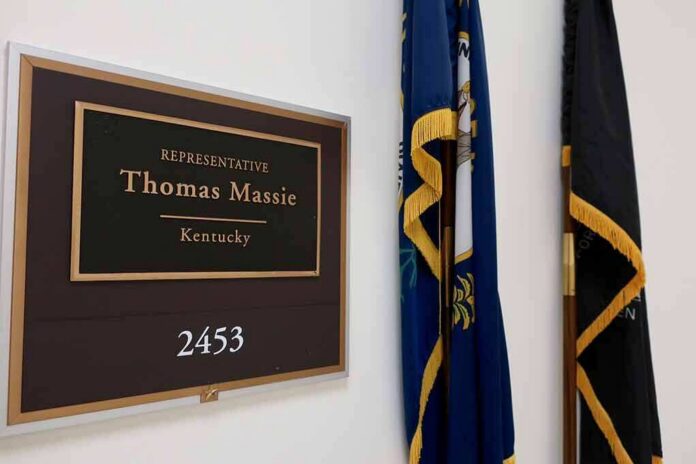
Massie’s 2028 story begins not with a presidential announcement but with a defeat. In May 2026, he lost the Republican primary in Kentucky’s 4th Congressional District to a Trump-endorsed challenger, in a race that drew roughly $30 million in spending and became, by multiple accounts, the costliest House primary in American history. Much of that money came from pro-Israel donors and groups — AIPAC, the Republican Jewish Coalition, and individual megadonors — responding to Massie’s long record of voting against foreign aid to Israel, Egypt, Syria, and Ukraine alike, a record he has defended on the air rather than softened.
Less than a week after that loss, Massie filed a statement of candidacy with the Federal Election Commission for the 2028 election. Coverage at the time, and his own public statements, described this narrowly: it kept open the option of running for his old House seat and preserved his ability to raise money as “a potential candidate for federal office”. He was explicit that no decision had been made. That filing is a legal and financial maneuver common among ambitious politicians weighing multiple paths — not a declaration of any particular campaign, presidential or otherwise.
The Draft-Massie Effort
Separately, and later in the year, a different kind of story emerged. Reporting in November 2026 described a coalition of Libertarian Party operatives and anti-war conservatives who had broken from President Trump attempting to recruit Massie as the nominee of a reconstituted Libertarian Party. The effort has real organizational infrastructure behind it: Michael Heise, founder of the Libertarian Party’s Mises Caucus, is involved, as is a newly launched American Liberty Party and a formal “Draft Massie” project. Bret Weinstein has been the most visible public advocate, framing the project as a “friendly takeover” of a minor party that could then serve as a vehicle for anti-interventionist politics broadly.
Weinstein’s stated theory is explicit: a campaign that siphons even 5 to 10 percent of the national vote from a major party forces that party “to listen and cave to interest of the people.” That is a coherent strategic logic — third parties have historically functioned more as pressure valves than as governing vehicles — but it is an organizer’s aspiration, not a polling result or a commitment from Massie himself. No public reporting shows Massie accepting a nomination, authorizing the project, or even confirming he is engaging with it.
Massie’s Own Position
What is on the record is Massie’s ideological material, which makes him a plausible recruit regardless of whether he ever says yes. He has been unambiguous about opposing foreign aid “to Egypt, to Syria, to Israel, or to Ukraine” and has framed his primary loss explicitly as retaliation by what he calls the Israeli lobby for that position. After his defeat, he posted that congressional Republicans “let Trump start a war, increase spending, arm a genocide, betray MAHA, and cover up for Epstein’s coconspirators” — language aimed squarely at the same anti-interventionist, anti-establishment constituency the Libertarian recruiters are courting. That overlap explains why organizers see him as a natural fit. It does not establish that he intends to run under their banner, and every direct quote attributed to him since his primary loss has been carefully non-committal: he has left the door open without walking through it.
Why Third-Party Math Rarely Delivers
The base rate on insurgent presidential candidacies argues for skepticism toward the more sweeping claims attached to this story. Ross Perot, running with far greater name recognition, personal wealth, and a ballot-access operation unmatched by any third-party effort before or since, won 18.9 percent of the popular vote in 1992 and still just 8.4 percent in 1996. Ralph Nader, despite real traction among disaffected progressives, managed 2.7 percent in 2000. Gary Johnson, the most credentialed Libertarian nominee in that party’s history, took 3.3 percent in 2016. Large protest candidacies happen occasionally; durable third-party electorates do not. A Massie campaign would also face the Federal Election Commission’s public funding rules for minor and new parties, which tie general-election funding to prior electoral performance or a current showing sufficient to qualify after the fact — a bar built specifically to keep speculative candidacies from drawing taxpayer money before they prove themselves at the ballot box.
Marjorie, I hope you are Vice-Presidential nominee and Thomas Massie is Presidential nominee so you two can run together as the 2028 Libertarian Party candidates! @mtgreenee
— Leslie (Bob) Yarbrough (@BigBobArm71) November 9, 2026
What It Means Going Forward
The realistic reading is that this is a recruitment campaign testing whether an anti-war, anti-interventionist coalition can be organized around a sitting member of Congress with genuine credibility on those issues — not evidence that such a campaign exists yet. Massie’s ambiguity is itself strategically useful to him: it lets him raise money, keep his national profile alive, and extract maximum leverage from Republicans nervous about losing anti-war and MAHA-aligned voters, without committing to a third-party run whose historical odds are poor. Whether that ambiguity hardens into an actual Libertarian campaign depends on factors well beyond the recruiters’ control — ballot access in dozens of states, fundraising infrastructure, and whether Massie concludes a long-shot presidential bid serves his interests better than a House comeback or another role entirely.
Sources:
wlky.com, rawstory.com, wlwt.com, docquery.fec.gov, yahoo.com, ibtimes.co.uk
© fixthisnation.com 2026. All rights reserved.