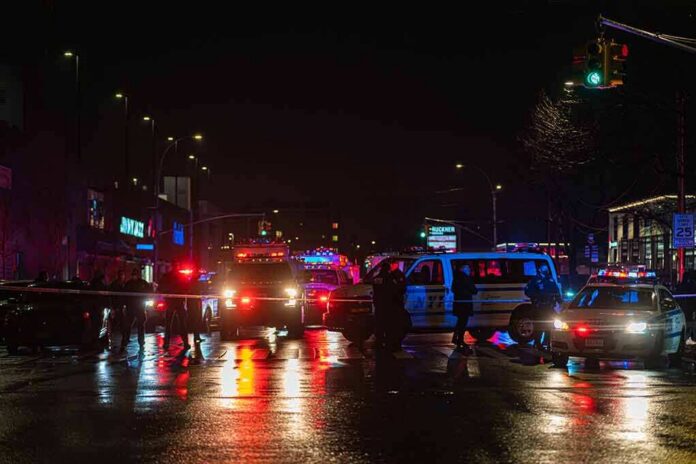
A bloody Juneteenth weekend left more than 20 people shot in Chicago, even as President Trump again offers federal help that city leaders still resist.
Story Snapshot
- A Juneteenth drive-by on Chicago’s South Side left at least 12 to 13 people wounded in one attack.
- Across the extended weekend, local reports counted dozens shot and several killed in separate incidents citywide.
- Chicago officials point to a “decades-low” May homicide count, even while shootings run ahead of last year’s pace.
- Trump has offered federal help, renewing the clash between law-and-order backers and leaders who blame budget cuts and call for “root causes” spending.
Drive-by Mass Shooting Shatters Juneteenth Celebration
Late Friday night, a red sport utility vehicle rolled up on a large Juneteenth gathering near West 95th Street and South Princeton Avenue on Chicago’s South Side, and two people inside opened fire into the crowd before speeding away.[2] Police said at least twelve people, ages seventeen to forty-seven, were shot, with one teen and a twenty-six-year-old man among the most seriously hurt.[2] A local television report described the scene as a classic drive-by attack, with officers arriving around 11 p.m. and finding multiple victims down in the street.[4]
Reporters on the scene said some wounded victims collapsed nearby, while at least ten others drove themselves to several different hospitals across the city, overwhelming emergency rooms already used to weekend gunshot cases.[2] A national outlet later confirmed the basic details: a mass shooting, a red sport utility vehicle, two shooters, and at least twelve wounded with no arrests announced as detectives worked overnight.[1] Online tracking of mass shootings has already logged the Princeton Park attack as a 2026 incident with twelve injured and zero killed, underscoring how common such events have become.[5]
Dozens Shot Citywide Despite “Decades-Low” May Homicides
The drive-by at the Juneteenth party was only the worst single burst of violence in a wider weekend of bloodshed that stretched from Thursday through Sunday across multiple Chicago neighborhoods.[3] A city crime rundown counted at least eight people killed and thirty-eight wounded by gunfire over the extended Juneteenth weekend, with victims as young as fourteen and as old as seventy.[3] In case after case, the pattern repeated: unknown attackers in vehicles, multiple rounds fired, and no suspects in custody when the dust settled.[3]
This latest carnage comes just weeks after a local public television report noted that Chicago recorded the fewest May homicides in decades, with thirty-six killings, but also warned that nonfatal shootings were already running ahead of last year’s pace.[4] Chicago Police Department public safety reports show that gun crime remains a major and constant focus, with weekly tallies of shootings and murders citywide.[7] That mix of talking points lets city leaders highlight the “decades-low” line while families on the South and West Sides still live with regular gunfire, stray bullets, and the fear that comes with both.[4]
Trump Offers Federal Help as City Leaders Blame Budgets and “Root Causes”
The fresh wave of shootings has renewed a now-familiar fight over who is responsible for Chicago’s violence and what kind of help is needed. President Trump and his allies have again offered federal law enforcement support, arguing that repeated mass shootings and every-weekend casualty counts show that current city approaches are failing. They point to long-running crime data, open cases, and mass-shooting lists as proof that local leaders have not brought basic order back to many streets.[5][7]
Chicago’s Democrat mayor and other officials respond by talking about “root causes” and community spending, calling for more youth jobs, mental health services, and housing support as their preferred violence reduction tools.[6] The same leadership also blames past federal budget choices and claims that national cuts to violence-prevention money have tied the city’s hands, while not producing documents that clearly show the exact amounts or local program results.[6] Meanwhile, police detectives still process scenes like the Juneteenth drive-by and work case files in a city that remains one of the most studied examples of concentrated, repeat gun violence in America.[7][10]
Families Want Safety, Not Politics, as Shootings Keep Hitting the Same Neighborhoods
For families living near 95th and Princeton, and in other long-suffering Chicago blocks, the debate in television studios and city hall chambers feels far away from the sidewalk where shell casings land. National crime labs and university researchers have shown that Chicago’s gun violence is highly concentrated among certain people and places, and that focused strategies can cut shootings when leaders back them and keep them funded.[10][18] Yet those same neighborhoods keep seeing the same headlines about holiday weekend shootings, even as city hall talks up long-term trends and technical progress.
Chicago saw multiple shootings over the weekend; the AP reported that at least seven people were killed and dozens were injured. This has once again sparked debate in the United States over public safety, gun control, and whether to deploy federal forces
— Lina (@Linapyi) June 21, 2026
The clash now is not over whether Chicago has a gun violence problem; it is over whether the answer is more federal agents, tougher prosecution, and support for police, or more social programs and speeches about “systems” and “underlying issues.” City data and weekend body counts show that, despite some improvement in homicide numbers, everyday people still pay the price when leaders treat crime as a political talking point instead of a basic duty to protect life, liberty, and the right to safely gather in their own neighborhoods.[3][4][7]
Sources:
[1] Web – More Than 20 Shot in Chicago Over Weekend As Trump Offers Help
[2] Web – 7 wounded, 2 fatally, in mass shooting on South Side
[3] YouTube – Drive-by shooters fire into crowd, injuring at least 12 …
[4] Web – Chicago police say at least 12 people were shot when an SUV …
[5] Web – Chicago Sees Fewest May Homicides in Decades, But Shootings …
[6] Web – List of mass shootings in the United States in 2026 – Wikipedia
[7] Web – Chicago leaders are optimistic that violence in the city could be …
[10] Web – News – Chicago Police Department
[18] Web – Predicting and Preventing Gun Violence – PMC – NIH
© fixthisnation.com 2026. All rights reserved.