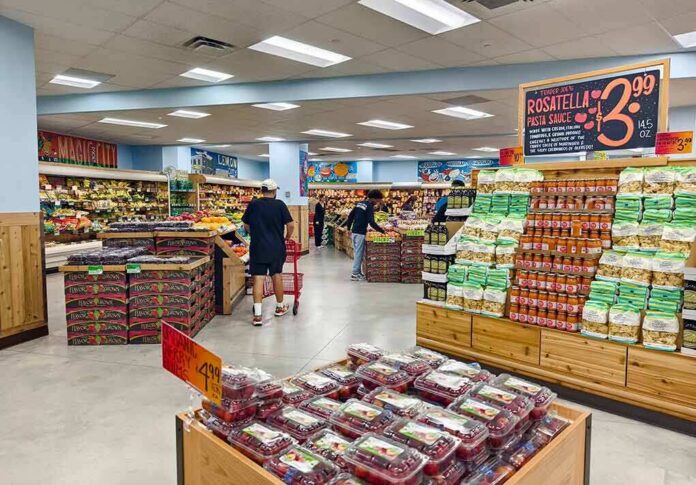
Americans are quietly rebuilding their grocery routines from the ground up after a food price shock we have not seen in fifty years.
Story Snapshot
- Grocery prices for food at home are up about one-third since 2019, the biggest jump in decades.
- Surveys show a large majority of Americans say they have changed how they shop for food because of prices.
- Families are trading down to store brands, using more coupons, cutting meat and snacks, and even relying on food banks.
- These changes are not just about shopping; they touch dignity, family life, and the political debate over affordability.
Grocery prices jump and families feel the strain
Government data show that buying food to eat at home now costs about 33% more than it did in early 2019, the sharpest grocery price jump in about half a century. That number sounds abstract until you picture it as one out of every three dollars added to the same cart. For a typical family of four, some estimates say monthly grocery bills are now well over $1,000. That kind of pressure does not just change menus; it changes how people live.
In interviews across several cities, shoppers describe the same uneasy routine. They walk into a store they have known for years and feel like strangers in it. They skip steaks and grab store-brand chicken thighs. They count items as they place them in the cart. They put back small treats for the kids. Some say they now shop with a calculator always open on their phone, tracking every dollar. This is not luxury dieting; it is survival math.
Americans rewire everyday shopping habits
Survey after survey shows most Americans are not just noticing higher prices; they are changing behavior to fight them. A LendingTree study found that 88% of Americans say they have changed their grocery habits because of inflation, including choosing generic brands and cutting impulse buys. Purdue University’s Consumer Food Insights work reports that about 82% of adults changed their food purchasing in 2025, and more than half say higher food prices were the main reason.
These numbers line up with what shoppers and researchers both describe as “trade-down” behavior. People hunt for coupons, split shopping between multiple stores, and stock up when something is on sale. They buy more store brands and bulk packages and fewer convenience items. They make simple swaps that add up: frozen vegetables instead of fresh, beans instead of some meat, tap water instead of soda. Industry analyses say price has now passed taste and brand loyalty as the top driver of grocery choices.
When coping turns into a new normal
At first, many families treated these changes like a short-term plan, the way people did during the pandemic. They expected prices to jump, then slide back. Instead, the higher price level has stuck around, even as headlines talk about inflation “cooling.” So habits that started as coping tricks are hardening into a new normal. Shoppers tell reporters they now think in terms of “value” every time they buy food, not just during tough months.
Researchers see that in the data. McKinsey’s grocery report says consumers are shopping more often while shrinking basket size, comparing prices more, and making deliberate tradeoffs across brands and pack sizes. A consumer insights firm found that more than 90% of shoppers say they have changed how they buy food in response to higher prices. The pattern is clear: people are not eating much less overall, but they are eating differently, and often less joyfully, to stay within tight budgets.
The human and political weight of grocery decisions
There is a deeper emotional layer under all this number crunching. For many Americans, feeding a family is tied to dignity, love, and basic competence. When parents have to say “no” to favorite foods week after week, it hits more than the wallet. Some households are now leaning on food banks or the Supplemental Nutrition Assistance Program to fill the gap between paychecks and pantry shelves. That carries its own quiet shame, even when the need is driven by broad price trends rather than personal choices.
Living through the biggest jump in grocery prices in a half-century has many Americans changing their eating and food shopping habits. https://t.co/0gcifP1YIP
— NBC Los Angeles (@NBCLA) July 26, 2026
These everyday struggles also feed into politics. You do not need a pollster to know that a $6 carton of eggs or a $7 gallon of milk sticks in people’s minds longer than a monthly inflation report. Policy groups on the left point to corporate pricing and call for more intervention. Many conservatives see years of loose monetary policy, regulatory overreach, and supply-side neglect behind the spike, and they argue that any serious affordability agenda must start with disciplined policy and a respect for markets.
What this grocery shift reveals about American priorities
The most telling change is not that people buy more store brands. It is that they now plan every food dollar with the same care they once reserved for big-ticket items. That planning says something about what Americans value. Families are cutting back on restaurant meals to protect home cooking. They drop sodas and snacks before they drop eggs and rice. They move meat from the center of the plate to the side before they give up family dinners altogether.
From a conservative common-sense view, these choices show both resilience and a demand for accountability. Households are doing their part: trimming waste, trading down, and living within tighter limits. The open question is whether leaders will treat grocery inflation as a real test of policy, not a talking point. After all, when a nation has to rewrite its grocery routines just to stay afloat, it is not only the menu that is on the table; it is the kind of country people want to live in.
Sources:
fmi.org, foodandwine.com, seattletimes.com, pro.morningconsult.com, boston.com, miamiherald.com, scrippsnews.com, ag.purdue.edu, finance.yahoo.com, usertesting.com
© fixthisnation.com 2026. All rights reserved.