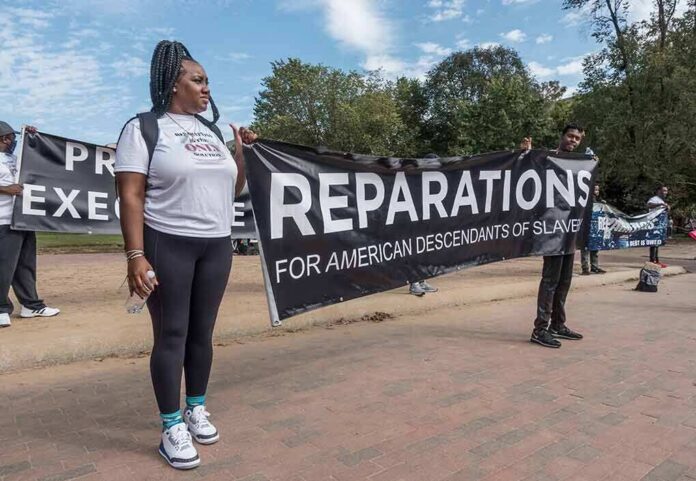
Debates over “reparations” only make sense when we separate four questions that routinely get collapsed into one: what the government did, what harms endure and can be proven, how a lawful remedy must be designed, and which level of government should pay. Chicago’s latest clash with the White House sits precisely at that junction; the core dispute is not whether history matters, but whether race-classified cash benefits are a lawful and effective way to address it.
At a Glance
- Chicago’s mayor framed unmet demands of Black descendants in terms of federal economic choices and announced a city task force and listening initiative to build a reparations record.
- The White House answered categorically: programs that distribute money based on race are illegal and divisive; it urged Chicago to prioritize homicides over race-based payouts.
- Evanston’s nearby housing-focused reparations program is the live test case; a federal judge let a constitutional challenge proceed, and the Justice Department moved to intervene.
- The legal hinge is design, not intent: race-exclusive eligibility invites strict scrutiny; ancestry-, place-, time-, and injury-based designs are a different—and still developing—terrain.
What Chicago is actually doing—and what it is not (yet)
Chicago’s mayor put federal distributional choices and the demands of descendants of enslaved people in the same frame, arguing that national policy has shifted wealth upward while leaving long-identified needs in housing, education, health care, transportation, and wages unmet. He paired that rhetoric with municipal steps: an executive order creating a 40-member reparations task force and a “Repair Chicago” initiative to gather lived-experience testimony from Black residents as pre-policy evidence building. Those moves matter because they convert slogans into process—charters, membership, minutes, datasets, interviews—materials that can later support or sink any remedy proposal. They do not, however, constitute findings, a costed plan, or a legal theory; Chicago has not published eligibility criteria or a compensable-harm standard.
That gap—between institution-building and completed record—is where many reparations efforts stall. The evidentiary lift is significant: tying specific government actions (zoning, redlining, contract steering, school boundary lines, policing practices) to measurable intergenerational effects today requires archival work, credible econometrics, and a public record that survives scrutiny. Chicago has started that machinery; its conclusions will stand or fall on the quality of that record, not the passion of the premise.
The White House’s position: categorical on race classification, narrow on history
The Trump administration’s response is unambiguous on design: government programs that “dole out money based on race are illegal,” full stop. It couples that with an equal-treatment frame—no racial distinctions in public benefits—and a political redirect to violent crime in Chicago. That is a constitutional, not historical, argument: it does not contest whether Chicago can document harm; it declares that race-exclusive eligibility is the wrong—and unlawful—tool no matter the record. The same position underwrites federal efforts to halt Evanston’s program, presenting a coherent through-line: even as localities experiment, the federal government will challenge any remedy that conditions benefits on being Black.
Critically, this is where precision matters. Equal protection doctrine scrutinizes racial classifications intensely, but it does not erase all remedial tools. Governments do remediate historic harms lawfully when they identify a specific wrong traceable to official action and craft a remedy closely fitted to that wrong. Whether a reparations program is race-restricted, lineage-based, time-and-place limited, or requires proof of individual harm is not a cosmetic choice; it is the design variable that determines the level of constitutional risk.
Evanston as the proving ground: what the court fight is actually about
Evanston’s Restorative Housing Program offers a concrete template under fire. The city ties $25,000 housing benefits to Black residents and certain descendants linked to the 1919–1969 period of documented municipal housing discrimination; challengers argue that making race a gateway violates the Fourteenth Amendment’s Equal Protection Clause. A federal judge declined to dismiss the suit, allowing plaintiffs to proceed—an early procedural signal that the legal questions are substantial and not easily waved away. The Justice Department moved to intervene and opened a parallel investigation, elevating the stakes and ensuring the program will be tested against federal equal-protection standards.
Two things follow. First, Evanston’s litigation will shape, de facto, what is legally safe for nearby jurisdictions, Chicago included. Second, the challenge targets the eligibility architecture, not the historical narrative. Even a robust evidentiary chronicle of city-driven racial steering can founder if the remedy is keyed primarily to the race of the applicant rather than to lineage, residence during a defined period, or documented injury tied to named policies.
The design space: from race to lineage, place, time, and proof
Jurisdictions contemplating reparative policy have four main levers. They can anchor eligibility in lineage (descendants of those harmed), in geography and time (residents of redlined tracts during specified years), in individualized injury (people who can document discriminatory acts by municipal agents), or in race. Race triggers the highest constitutional scrutiny. The other three can still be contentious but are more plausibly defended as neutral mechanisms calibrated to a government-verified wrong. That is why some state-level task forces have explored ancestry- and residence-based formulations and why Evanston’s inclusion criteria have become the flashpoint—if the same historical record could support a lineage-plus-period design, the city’s litigation risk profile might look very different.
Design also drives purpose-fit. Housing remedies address home equity foregone through discriminatory zoning, lending, and contract practices; education remedies address interrupted accumulation of human capital; business-credit interventions address the compounded effect of historic exclusion from capital markets. The closer the instrument tracks the harm, the stronger the causal and legal case.
What strong evidence looks like—and why it matters here
When courts or skeptical publics ask for proof, they want more than narratives. They look for archival ordinances, HOLC and FHA maps, assessor files, bank underwriting rules, arrest and clearance data, and longitudinal wealth or mobility estimates that connect specific public acts to present gaps. They examine whether a jurisdiction’s program measures both scope (how many were harmed) and scale (what the harm cost), and whether the remedy’s cost is proportional. Peer-reviewed economic work can illuminate why blunt transfers may not generate long-run wealth convergence without complementary structural reforms—risk preferences, credit constraints, and local market dynamics matter to outcomes as much as the transfer size. That kind of analysis does not argue against repair; it argues for careful program architecture and credible expectations.
The Chicago effort, if it matures, will need exactly that: a documented causal chain and quantified damages, not for rhetorical flourish but to satisfy the two audiences that decide its fate—judges applying constitutional tests and taxpayers deciding whether to fund the remedy.
Where the real disagreement lies—and what comes next
The immediate conflict is not over whether historic discrimination occurred; it is over whether race-exclusive cash benefits are lawful. The White House’s position is categorical and, for now, controlling at the federal-enforcement level. Chicago has launched the front-end work—the task force and listening process—but has not published a design capable of being legally evaluated. Evanston’s case is the bellwether: if courts reject race-gated eligibility but leave room for time-place-lineage remedies fitted to documented municipal harms, local governments will have a map to proceed within the Constitution’s constraints. If courts go further, narrowing even lineage or place designs as proxies for race, experimentation will shift toward individually proven injury and sector-specific remedies.
Practical guidance for policymakers and citizens
For city leaders: build the record first—charter clear research questions, publish your archives, quantify harms, and test eligibility designs against current equal-protection doctrine before you legislate. For federal actors: if the goal is equal treatment under law, articulate the permissible zone for redressing government-caused harms to avoid chilling lawful repair. For residents and taxpayers: watch the eligibility lever and the evidence. If a proposal explains precisely who was harmed, how the government caused it, what the remedy fixes, and why the design survives strict scrutiny, you are in the presence of serious policy—not a slogan.
Sources:
judicialwatch.org, noticias.foxnews.com, youtube.com, foxnews.com, independent.co.uk
© fixthisnation.com 2026. All rights reserved.