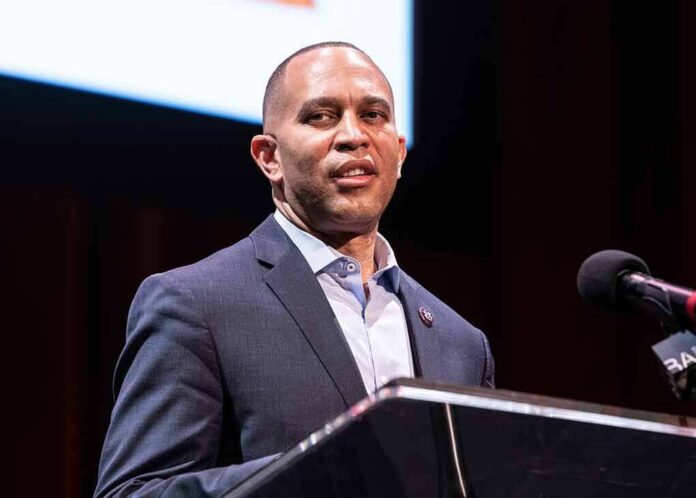
The fight over Hakeem Jeffries’ speakership is not a personality contest; it is a clash between two theories of how Democrats should wield power—one that prizes a broad affordability mandate and coalition discipline, and another that demands sharper breaks with corporate influence, a different posture on Israel, and more overt confrontation with President Trump.
At a Glance
- Progressive skeptics have built visible, if fluid, opposition to Jeffries tied to Medicare for All, corporate money, Israel policy, and the pace of accountability for Trump.
- Jeffries grounds his leadership case in a tightly defined affordability-and-accountability agenda—rolling back tariffs, restoring health supports, and ending the Iran war—framed as the electorate’s mandate.
- Grassroots mobilization is real, but petition metrics are unverifiable as voter signals and do not yet translate into a decisive House bloc.
- The dispute reprises a century-old pattern: ideological factions use speakership leverage for programmatic change, while leadership organizes for governing capacity.
The real fault line: mandate vs. movement
Jeffries’ allies argue the electorate handed Democrats a mandate narrowly focused on affordability: lower household costs first; combine that with targeted accountability where corruption and overreach demand it. In official statements and national interviews, Jeffries has been explicit: reverse Medicaid cuts, restore SNAP funding, extend Affordable Care Act tax credits, roll back tariffs he says have raised prices “by thousands of dollars per year,” and end what he calls a costly “war of choice” in Iran—framed not as posture but as the most direct path to cheaper gas, fertilizer, and groceries. This is a leadership case built on legible economic interventions, not a grab bag of factional priorities.
Progressive critics see that same selectivity as an abdication. They want Medicare for All on the table, a more aggressive stance against corporate power, restrictions on military assistance to Israel, and a clearer willingness to deploy hard oversight against Trump—up to and including impeachment if investigations warrant it. Their case has surfaced through reporting on activist and candidate statements and digital mobilization; it is not vague discontent but a policy-linked critique of the party’s center of gravity.
What the evidence establishes—and what it doesn’t
The opposition exists in the institution, not just online. Newsweek and Reuters both identified progressive members-elect who had not committed to Jeffries, with at least one named as offering explicit resistance; that matters because the speakership is a headcount exercise, and even a handful of defections can be decisive in a closely divided House. But the available record stops short of a whip list. Much of the language from undecided members is conditional rather than categorical; nothing in public documents shows a bloc capable of denying Jeffries the gavel on its own.
Outside the chamber, activists have converted frustration into measurable mobilization. Common Dreams reported a petition opposing Jeffries’ speakership surpassing one million signatures, and Axios described Democratic offices “inundated” with calls and emails urging a vote against him. As political signals, those inputs are loud; as voter proxies, they are soft. There is no disclosed deduplication, verification, or constituent matching for the petition, and calls-to-office tallies rarely distinguish organized advocacy from district sentiment. The activity demonstrates energy and organizing capacity; it does not prove a majority of Democratic voters share the view.
Jeffries’ governing theory, on its own terms
Jeffries has not pitched passivity. His documents and interviews outline an opposition program packaged for caucus-wide adoption: attack price drivers linked to the administration’s policy mix; restore health and nutrition supports; pursue accountability for wrongdoing while avoiding a politics of retribution for its own sake. He insists animus toward Trump should not displace the kitchen-table agenda and that bipartisan deals are acceptable when they lower costs. Tariffs are his keystone example—he repeatedly ties them to higher prices and pledges to push votes to roll them back—paired with a through-line asserting that ending the Iran war would ease supply shocks that spill into grocery aisles.
To critics, this still leaves out big pillars: single-payer health care, structural fights with corporate donors, and a different posture on Israel. But on the evidentiary record, Jeffries’ program is coherent and specific in the lanes he chooses to occupy; whether those lanes are sufficient is a political judgment, not a factual dispute.
Why this intraparty clash is familiar—and hard to resolve quickly
Speaker fights routinely become vehicles for reform because they offer leverage at the only moment when leadership absolutely needs every vote. The House speakership concentrates agenda power; factions with procedural or policy demands have long extracted commitments at this juncture. The Progressive Republican revolts of 1910 and 1923 weakened Speaker Joseph Cannon and forced rules concessions before Frederick Gillett secured the gavel; more recently, both parties have seen organized flanks threaten or unseat speakers to reset terms of power sharing. The job itself—simultaneously presiding officer, party leader, and administrative head—builds structural friction into every Congress.
That history clarifies the present: progressive Democrats are testing whether their priorities can be encoded in leadership commitments now, not promised later. Jeffries, reading the same balance of forces, is arguing that a cross-caucus affordability push is the most governable and electorally resonant path, with accountability proceeding through institutional channels rather than a maximalist public pledge. Those are not rhetorical differences; they are rival operating systems for the next session’s agenda.
Points of genuine disagreement, weighed on the record
On Trump oversight, the line of contention is tone and timing, not denial of authority. Jeffries’ comments about not getting “even” were heard by activists as caution bordering on retreat, but his own materials pair affordability with “hold the crooks accountable,” signaling oversight as a parallel track rather than the organizing principle. On health care, progressives want a categorical commitment to Medicare for All, whereas Jeffries has framed near-term health policy around restoring ACA subsidies and reversing Medicaid cuts—arguably faster-moving levers but not a system overhaul. On Israel, activists demand conditioning or halting arms transfers; the supplied record does not contain Jeffries’ detailed counterposition, which is precisely why it animates this fight in progressive circles. And on corporate influence, critics point to funding streams and policy posture; the research here flags the need for an empirical link audit between receipts and roll calls, which, if conducted, would sharpen this argument considerably.
These are contestable questions with real stakes. But the strongest available documentation aligns with Jeffries’ stated affordability program and with the existence—less so the size—of a progressive push to force broader commitments.
What it means for governing
Three outcomes are plausible. First, opposition consolidates around concrete, negotiable asks—committee process, floor access for specific bills, or targeted policy planks—and Jeffries trades for votes without abandoning his affordability frame. This is the most historically common resolution of speakership standoffs. Second, critics fail to unify, leadership rallies undecideds, and the episode becomes a cautionary tale about petition politics versus vote counts. Third, a narrower but durable faction sustains pressure into the session, using motions, discharge petitions, and public scoring to force roll calls—turning the speakership vote into the first, not the last, round of bargaining.
In all scenarios, the center of gravity Jeffries has articulated—lower costs first; accountability as a constant but not a crusade—remains the baseline against which critics must measure their leverage. The evidence supports two confident statements: he has a clear, specific governing thesis, and he faces an organized, policy-driven leftward challenge that is energetic but not yet dispositive in the House. What happens next turns less on rhetoric than on math, rules, and whether either side can translate movement energy or message discipline into binding commitments at the only table that counts.
Sources:
pjmedia.com, newsweek.com, fox5atlanta.com, cnn.com, commondreams.org, english.elpais.com, axios.com, washingtonsun.com, democraticleader.house.gov, jeffries.house.gov
© fixthisnation.com 2026. All rights reserved.