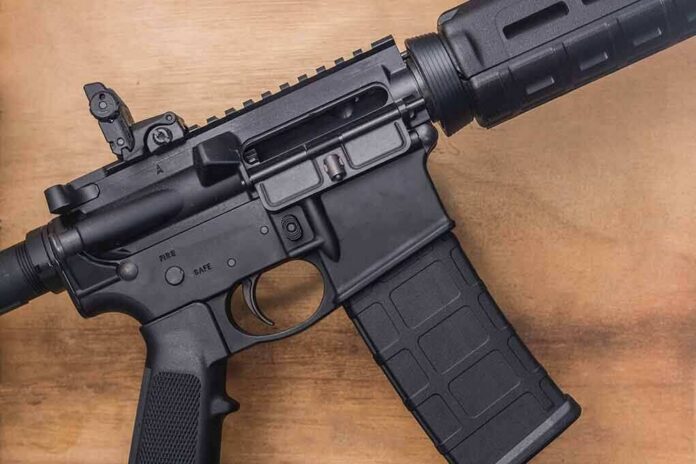
The core fight over AR-15s at the Supreme Court is not about aesthetics or politics; it is about classification under controlling doctrine—whether these semiautomatic rifles are “arms” in common lawful use and thus protected, or whether they instead fit the historically unprotected category of “dangerous and unusual” weapons. Only one of those frames is durable under the Court’s modern text-and-history approach, and the record now before the Court heavily favors the common-use frame.
The Short Version
- The Commonwealth of Virginia has urged the Supreme Court to treat AR-15s like machineguns—outside the Second Amendment—despite conceding they are semiautomatic by design.
- Opposing filings, including from the United States, argue AR-15s are commonly owned by law-abiding Americans for lawful purposes and therefore fall within protected “arms”.
- Recent Supreme Court guidance underscores that weapons commonly possessed for lawful purposes are presumptively protected; AR-15s fit that description, undermining the “dangerous and unusual” label.
- The machinegun analogy hinges on speculative ease-of-conversion claims, not a demonstrated engineering or historical record, which weakens that path under the Court’s doctrine.
What the case is really about: classification under Heller and Bruen
Since District of Columbia v. Heller, the Court has separated protected “arms” in common lawful use from weapons deemed “dangerous and unusual,” which may be restricted. New York State Rifle & Pistol Association v. Bruen reinforced that the government must justify limits with text and historical tradition, not generalized interest balancing. In live litigation over AR-15-platform rifles, that framework narrows the decisive question to a threshold classification: do these rifles, owned by millions, sit within the commonly used category, or can governments reclassify them as akin to machineguns and thus outside protection? Congressional research summaries and the Court’s own language frame the inquiry this way, and that is where the parties are focused.
On that threshold, several briefs—including one filed on behalf of the United States—contend the AR-15 is in widespread lawful use for self-defense, target shooting, and related purposes, which under existing precedent places it inside the constitutional boundary of protected “arms.” Those submissions tie their argument to the Court’s own common-use line, emphasizing that bans on arms commonly possessed by law-abiding citizens cannot stand.
The Virginia brief’s machinegun analogy, and why it struggles doctrinally
Virginia’s amicus takes a different tack: it asserts that AR-15s are “machineguns, except that they—at least to start—have semiautomatic fire,” and argues users can take “simple steps” to achieve automatic fire; thus, the Commonwealth concludes AR-15s share “nearly all the same features” that remove machineguns from Second Amendment coverage. As a matter of mechanics, however, Virginia’s own phrasing acknowledges the dispositive distinction: a machinegun fires more than one round per trigger function, while a semiautomatic fires one. Bridging that gap with an ease-of-conversion theory is not just an engineering claim; it is a legal one that must survive the Court’s categorical structure. The record excerpts offered by critics of the Virginia brief highlight the absence, in that filing, of test data, expert declarations, or a reliable conversion protocol demonstrating that ordinary AR-15s lawfully and readily become automatic weapons in a way that should control constitutional status.
The analogy also runs into the Court’s recent articulation of “common use.” A Supreme Court opinion has already recognized that “millions of Americans own AR–15s” and that “a significant majority of the States allow possession,” which gives petitioners “a strong argument” that AR-15s are commonly used by law-abiding citizens and thus protected under Heller. That guidance undercuts attempts to relocate AR-15s into the dangerous-and-unusual silo simply by gesturing at theoretical convertibility or asserted equivalence to M16s.
Common use, not speculative convertibility, carries the constitutional weight
Under Heller and Bruen, what matters at step one is whether the arm is of the sort the people commonly keep for lawful purposes. On that score, multiple filings—government, law-enforcement–aligned amici, and gun-rights organizations—converge: AR-15-platform rifles are bearable arms, are owned in large numbers by law-abiding citizens, and are used for ordinary lawful ends such as self-defense and sport. The common-use test has never turned on whether a platform shares some design DNA with a regulated military arm; nor has it rested on the claim that a semiautomatic device might be illicitly modified into a different category. To the contrary, the Court’s approach protects the arm as it is commonly possessed and used by the law-abiding.
Virginia’s fallback—pointing to modern legislative practice as proof that AR-15 restrictions are not anomalous—faces the same doctrinal headwind. Bruen does not treat the number of contemporary jurisdictions enacting a ban as self-justifying; the inquiry looks backward to the Nation’s historical tradition. A tally of jurisdictions today tells the Court little unless those laws are analogs of longstanding historical regulations on arms that were not in common lawful use, which is not what the opposing briefs describe here.
Written on November 11th, 2026:
I already prayed all of these prayers this morning:
PRAYERS FOR THE VULNERABLE IN OUR SOCIETY
Let us pray for all those who are victims of Satanic Cult Abuse, those who are victims of organized crime groups, pedophile cults, and Satanic cults,…
— Snuffy McBriggs (@SMcbriggs) November 11, 2026
Mechanics versus law: what the record does and does not show
Precision matters in this domain. A semiautomatic firing cycle—one round per trigger press, energy from the prior discharge cycling the action—differs categorically from the definition of a machinegun. To collapse that line constitutionally, a party must do more than speculate about “simple steps.” The available record around Virginia’s filing, as summarized by critics, identifies no empirical demonstration of routine, lawful, reliable conversion of off-the-shelf AR-15s into automatic weapons without materially changing the firearm or violating existing law—gaps that undermine the weight of the analogy at the classification stage. Meanwhile, the opposing side anchors its case in the doctrine the Court itself has articulated and in the prevalence of lawful civilian ownership and use.
Where the real disagreement lies—and what will likely decide it
The genuine dispute is not whether AR-15s are mechanically distinct from M16s; both sides, in different ways, concede they are. The fight is over which difference the Constitution recognizes. If the Court continues to treat “in common use by law-abiding citizens for lawful purposes” as the lodestar, then the pro-ban strategy of relabeling semiautomatics as near-machineguns will remain a doctrinal cul-de-sac. The Court’s own recent language signaling that AR-15s are widely owned and presumptively within the common-use category further narrows the path for governments seeking to sustain bans under a dangerous-and-unusual theory.
Sources:
twitchy.com, supremecourt.gov, nraila.org, shootingnewsweekly.com, justice.gov, congress.gov
© fixthisnation.com 2026. All rights reserved.