Security at large-scale political rallies is designed to neutralize disruptions fast; when a heckler in Myrtle Beach wore a shirt urging violence and interrupted President Trump mid-speech, the removal was swift because that is how these events stay orderly and safe.
At a Glance
- A Trump rally in Myrtle Beach was briefly interrupted when a man wearing a “Kill Your Local Pedophile” shirt heckled during the speech and was escorted out.
- Multiple outlets and local reporting describe security physically removing at least one protester; Trump acknowledged the disruption from the stage.
- In campaign-rally settings, organizers and security have broad latitude to remove disruptive attendees, especially when messages invoke violence.
- Courts distinguish between removing people for conduct and safety versus suppressing a viewpoint; that line is fact-dependent and context-driven.
What Happened: A Disruption, A Provocative Shirt, A Routine Ejection
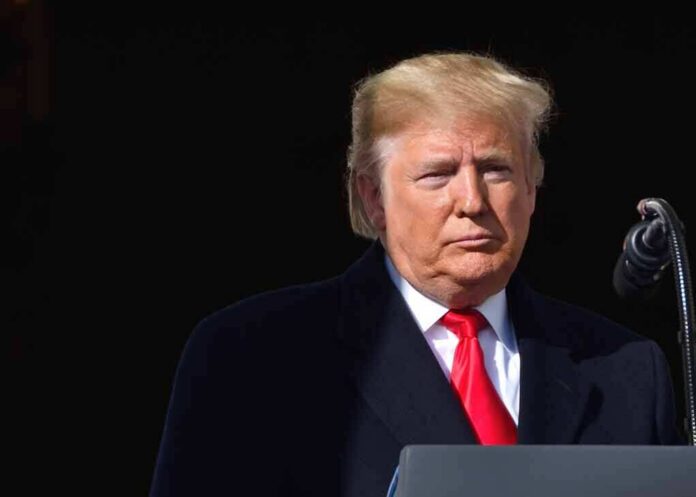
During President Trump’s rally in Myrtle Beach, South Carolina, a man in the audience wearing a shirt reading “Kill Your Local Pedophile” interrupted the speech and was removed by security. Contemporary write-ups captured the sequence as it unfolded: the interruption, a brief pause from the stage, and a quick escort out of the venue. Descriptions are consistent across outlets that monitored the event, with one local account noting that two protesters were ultimately escorted out as Trump made a quip and resumed his remarks.
The mechanics were standard: spot the disruption, move promptly, and keep the program moving. That cadence is neither new nor unique to Trump rallies; it is the baseline for modern campaign events where security must balance access with control in rooms full of cameras and tightly timed speeches. The Myrtle Beach incident fit that template—brief noise, an intervention, and a return to business.
Why Security Acts Fast: How Rally Control Works
Rallies operate as limited-access environments with layered security: magnetometers at entry, roving staff inside, and a clear chain of command linking campaign advance teams, venue security, and law enforcement. Inside the room, the trigger for removal is conduct, not opinion—interrupting the principal, refusing to comply with staff instructions, or creating a focal point that draws crowd energy away from the stage. A shirt that explicitly advocates violence is the kind of provocation that accelerates decisions; even absent a physical threat, it heightens agitation and complicates the crowd’s mood, which is exactly what security doctrine aims to prevent.
In practice, the threshold is low: if you are actively disrupting the program, you will be moved. Most removals are uneventful—hands on elbows, an aisle walk, the doors—and the speech continues. That is what happened here, and the contemporaneous reporting shows the system functioned as designed: isolate the disturbance, minimize the spectacle, and restore the run-of-show.
The Legal Frame: Conduct Versus Viewpoint
The First Amendment questions that hover around rally ejections are well-trod. Courts draw a line between suppressing a message and managing safety and order. The Supreme Court in Wood v. Moss held that security can reposition or remove protesters when there is a legitimate protective rationale tied to the president’s proximity; the inquiry turns on whether agents acted because of viewpoint or because of risk and logistics. Lower courts, meanwhile, have allowed claims to proceed where plaintiffs plausibly allege selective, viewpoint-based treatment in comparable circumstances—an admonition that neutrality in enforcement matters as much as the rules themselves.
Campaign rallies typically function as limited public or nonpublic forums—legally, spaces where organizers can set content-neutral rules and exclude disruptions without running afoul of the First Amendment. The decisive factor is motive and application: ejecting someone for shouting down a speaker or refusing directions sits on one side of the line; targeting someone solely for holding a dissenting sign, while allowing equally expressive supporters to remain, can cross into unconstitutional viewpoint discrimination. The Myrtle Beach accounts point to a conduct-based ejection amid a speech disruption, consistent with the permissible side of that divide.
Pattern and Precedent at Trump Events
Trump-era rallies have produced a library of ejection moments—some sparked by chants, some by silent signs or conspicuous placement on camera. Linguists have even cataloged the onstage instructions that cue removals, noting the imperative “Get them out” as a reliable indicator that staff will move quickly to defuse conflict. As a descriptive matter, the campaign’s operational norm has been fast extraction over prolonged negotiation; it compresses risk and denies the heckler oxygen.
That pattern is not proof of viewpoint discrimination; it is evidence of a security culture optimized for momentum and message control. The law does not require campaigns to tolerate disruptions. It requires that rules be enforced even-handedly and for legitimate reasons. When a protest includes language advocating violence and coincides with an audible interruption, security’s task is straightforward: remove, reset, resume. The Myrtle Beach incident, short and orderly, tracked that playbook.
A protester wearing a shirt that said "kill your local pedophile" was escorted out of a Trump rally supporting Sen. Darline Graham on Friday in Myrtle Beach, South Carolina.
President Trump addressed the outburst as the protester was still leaving the room, saying, "That's all… pic.twitter.com/nK4S5LjQXp
— CBS News (@CBSNews) August 22, 2026
Why This Matters Going Forward
Rallies are choreographed; campaigns are judged in part on their ability to execute under pressure. Quick, clean removals preserve not just safety but also the narrative the campaign came to deliver. For attendees who want to register dissent inside the room, the durable lesson is tactical: remain non-disruptive and avoid messages that can be read as incitement; outside the venue, traditional protest zones offer far more expressive latitude with far less risk of ejection.
Sources:
mediaite.com, washingtontimes.com, independent.co.uk, britanniadaily.com, nbcnews.com, myrtlebeachonline.com, youtube.com
© fixthisnation.com 2026. All rights reserved.