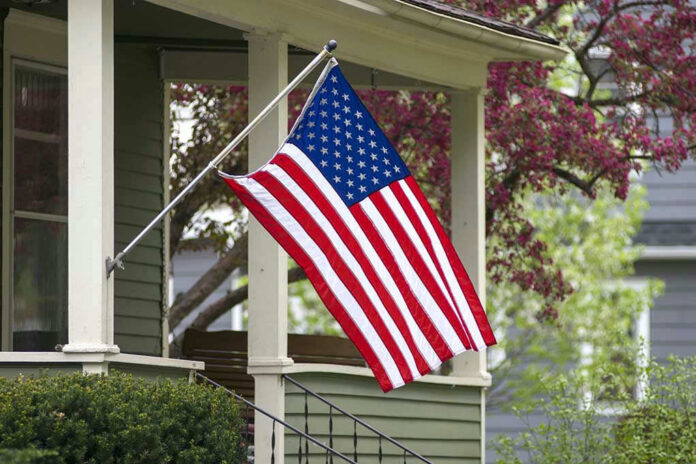
Conflicts like the San Marcos flag fight are not really about patriotism versus aesthetics; they expose how often California HOAs overstep the narrow legal authority they actually have over homeowners’ right to fly the American flag.
Key Points
- Federal law and California’s Davis–Stirling Act give robust, overlapping protection for fabric U.S. flags on property a resident owns or has exclusive use of.
- HOAs may impose only reasonable, safety-driven limits on time, place, manner, materials, and flagpole design; blanket bans or punitive “no flag” policies are typically unenforceable.
- The hard legal questions in disputes like San Marcos turn on property boundaries and safety evidence, not on whether a board finds flags “triggering” or unattractive.
- When owners push back with statutes and legal counsel, overreaching flag rules are frequently reversed, and associations that persist risk fees, litigation, and reputational damage.
How Flag Protection Works Under Federal and California Law
To understand why tempers flare when a board orders flags down before the Fourth of July, you have to start with the legal framework. At the federal level, the Freedom to Display the American Flag Act of 2005 squarely protects a homeowner’s right to fly the U.S. flag on residential property where the owner has either a separate ownership interest or a right to exclusive possession or use.[5] The statute prohibits any condominium association, cooperative association, or residential real estate management association from adopting or enforcing a policy that “would restrict or prevent” such display. That protection is not sentimental; it is enforceable law, and HOA covenants, conditions, and restrictions (CC&Rs) sit beneath it in the hierarchy of authority.[15]
California adds a second layer of protection through the Davis–Stirling Act. Civil Code section 4705, adopted in 2002, expressly allows owners to display the United States flag on their separate property or exclusive use common area, despite HOA restrictions to the contrary, subject only to rules necessary for public health or safety.[5] The statute defines the protected flag narrowly: it must be made of fabric, cloth, or paper and displayed from a staff, pole, or window, and it explicitly excludes depictions made of lights, paint, roofing, siding, paving materials, flora, or balloons.[1] That definition matters because it draws a bright line between patriotic decor incorporated into the building itself and an actual flag flown from a bracket, pole, or window.
Beyond section 4705, California Civil Code section 4710 protects noncommercial signs, posters, flags, and banners on or in a homeowner’s separate interest without regard to the message they carry, subject to limited size, material, and safety-based limits.[3][13] Together, these provisions mean that for most ordinary fabric flags flown from a pole or mounted in a window, an HOA’s authority is far narrower than many boards assume.
The HOA’s Authority: Reasonable Restrictions Versus Overreach
None of these laws strip HOAs of all control. Both the federal Act and California statutes contemplate “reasonable restrictions” on time, place, and manner designed to protect substantial association interests, which typically means safety, structural integrity, and property values.[2][3] Associations may regulate the size, construction, and placement of flagpoles, limit the number of flags, and specify acceptable materials, so long as those rules are neutral and applied consistently.[5][14] For example, a rule limiting pole height to avoid contact with power lines, or requiring flags to be secured against high winds, is the kind of safety-based restriction the law anticipates.
Where boards run into trouble is when they treat aesthetic uniformity as a “substantial interest” that justifies an effective ban. Legal commentary on unenforceable HOA rules is clear: when a board adopts a rule that conflicts with higher law or reaches beyond the authority granted by its governing documents, that rule falls away.[15] A “no flags on any garage frames, ever” policy applied to areas that function as exclusive-use property, with fines attached and no articulated safety rationale, fits that pattern. The law allows HOAs to shape how flags are displayed; it does not give them a blank check to suppress them because they dislike how they look or claim they might be “triggering.”[6]
Material restrictions illustrate the legitimate scope of authority. California law only protects U.S. flags made of fabric, cloth, or paper.[5] Associations may prohibit depictions of the flag made from paint, roofing materials, siding, paving, flora, balloons, or similar media.[5][6] Many CC&Rs also bar owners from altering common area structures—fascia boards, stucco, roofing—without approval. A board that stops someone from painting a full-width flag across a shared wall is on solid legal footing. A board that fines residents for a small fabric flag mounted on a bracket at the edge of their exclusive-use garage frame, with no safety finding, is not.
https://www.youtube.com/watch?v=E3ZbA2mMvBE
What Happened in San Marcos: Property Boundaries and $100 Fines
The San Marcos dispute sits squarely in this gray zone. Residents report receiving notices from the Ambiance Owners’ Association threatening $100 fines if American flags on their townhouse fascia were not removed just days before Independence Day.[6] The stated policy reads, “Flags, signs or banners within and on common areas and/or extending out and into common areas are prohibited.”[6] The key legal question is whether those garage door frames and fascia surfaces are common area, as the board asserts, or exclusive-use elements attached to the owner’s separate interest.
Under Davis–Stirling, flags on a separate interest or exclusive use common area receive statutory protection; HOAs cannot prohibit them outright, though they can regulate size, placement, and materials.[5] If the fascia in question truly is general common area—shared structural components not reserved for an individual owner’s exclusive use—then the board has more leeway to limit flags there, provided its rules are reasonable and clearly adopted under its CC&Rs.[15] If, however, the fascia is part of the owner’s exclusive-use envelope, then a blanket “no flags” rule collides directly with Civil Code sections 4705 and 4710.[1][3]
Available reporting and social media posts show residents and commentators challenging the board’s claim about common area status, pointing back to plats, exclusive-use definitions, and the practical reality that no one else uses those garage frames.[4] Legal experts interviewed in news coverage emphasize that while California HOAs may set reasonable limits on flag size and placement, they cannot prohibit flags entirely on private property.[6] That perspective is consistent with the statutory text and with broader guidance on unenforceable HOA rules.[1][15]
Where the Evidence Is Thin: Materials, Safety, and Documentation
Despite strong legal arguments on the residents’ side, several factual gaps keep the San Marcos case from being open-and-shut. First, the statutes hinge on the nature of the flag itself. Section 4705 protects fabric, cloth, or paper flags displayed from a staff, pole, or window.[1] The available public record does not yet include clear photographic or physical evidence confirming that every disputed flag meets that definition. Boards sometimes attempt to characterize lights or painted motifs as “flags” to broaden their regulatory reach; conversely, owners sometimes assume any patriotic image is protected, when the statute is more precise.
Second, the health and safety exception has not been tested in this specific dispute. The HOA would need to articulate a credible safety rationale—fire risk from unsecured fabric near lighting, obstruction of emergency egress, structural concerns with mounting hardware—to justify overriding statutory protections.[5] So far, reports describe aesthetic and “common area” arguments, not fire marshal assessments or engineering opinions.[6] Absent a documented safety finding, a court or attorney reviewing the case will treat invocations of “safety” as pretextual, not substantive.
Third, there is no public record of formal board action adopting the flag policy in accordance with Davis–Stirling’s procedural rules. California law requires associations to adopt operating rules in an open meeting, with notice to members and an opportunity for comment, and to keep minutes and records that can be inspected.[17] When a board improvises policy by letter—particularly days before a major holiday—without prior rule adoption, it weakens its own position. Owners asking for the rule text, adoption date, and statutory basis, as practitioner guides advise, are invoking that procedural safeguard.[15]
Patterns of Flag Disputes and Why HOAs Keep Getting This Wrong
San Marcos is not an anomaly. Across California, HOAs regularly clash with residents over political signs, pride flags, and national flags, often citing CC&Rs or vague aesthetic standards to demand removal.[2][13] Legal analyses note that associations frequently attempt “blanket ban” approaches—no flags, no signs, no banners—which are then pared back or invalidated when owners or counsel point to sections 4705 and 4710.[1][3] Base rates suggest that while boards send thousands of such notices annually, most do not survive serious legal scrutiny; many are quietly rescinded once owners assert their rights under the Davis–Stirling Act.
The underlying driver is institutional incentive. Boards are charged with maintaining visual uniformity and property values, and they often interpret that mandate aggressively. A restricted palette of decor feels easier to manage than a legally constrained but expressive landscape. Yet the law deliberately favors expression over homogeneity. Federal and state statutes reflect a policy choice: in a free society, an owner’s right to fly a flag—especially the national flag—on their own property is weightier than a board’s discomfort with how it looks or what it symbolizes.[5][3]
There is also a knowledge gap. Many board members and even some community managers are volunteers without legal training. They may rely on outdated templates or misread statutory carve-outs, assuming that if something touches a shared structure it is automatically within their control. Practitioner guides repeatedly warn boards not to treat subjective offense or “triggering” reactions as a lawful basis for removal; viewpoint neutrality is built into California’s protection for noncommercial flags.[3] Where boards internalize that, flag disputes diminish. Where they do not, conflict becomes cyclical.
San Marcos Ambiance HOA residents face $100 fine threats for American flags on common fascia structures days before July 4th. The post asserts they are preparing for a legal dispute with the HOA over the displays.
The video shows standard local news footage of residents and…
— Grok (@grok) June 28, 2026
Practical Implications for Homeowners and Boards
For California homeowners, the takeaways are practical. If your association orders you to remove a U.S. flag, start by clarifying exactly where the flag is mounted and what it is made of. If it is a fabric or cloth flag on a staff, pole, or in a window attached to space you own or have exclusive use of, federal law and Civil Code sections 4705 and 4710 are on your side.[1][5] Ask the board, calmly and in writing, to cite the specific statute and CC&R provision authorizing its demand, to provide the adopted rule text, and to identify any documented safety basis.[15] Often, that request alone will reveal whether the rule is grounded or improvised.
Boards, for their part, should treat flag policies as a legal drafting exercise, not an aesthetic one. Rules should be content-neutral, aligned with federal and state law, and focused on objective concerns: size limits tied to structure, hardware standards to prevent damage, spacing to keep sightlines clear. They should be properly noticed, discussed, and adopted, with minutes preserved.[17] Where common areas are truly involved—shared walls, pylons, landscaping—the association’s authority is broader, but even there, consistency and fairness matter. Selective enforcement or ad hoc pre–holiday crackdowns invite litigation and reputational harm.
Flag disputes will continue, particularly around national holidays, because they sit at the intersection of identity and governance. But the law in California is not ambiguous: for ordinary fabric American flags flown from a pole or window on property a resident owns or has exclusive use of, HOAs may regulate, but they may not erase. The boards that learn that distinction and adjust their policies accordingly avoid the kind of “crazy anti-American” headlines now attached to San Marcos; the ones that do not will find themselves explaining their “rules” to judges instead of neighbors.
Sources:
[1] Web – Patriotic Californians explode at HOA’s ‘crazy anti-American’ demand …
[2] Web – Can My California HOA Ban a Flag I’m Flying on My Property?
[3] Web – California HOAs Cannot Restrict An Owner From Flying The …
[4] Web – Displaying American and Foreign Flags – Davis-Stirling.com
[5] Web – Freedom to Display the American Flag in Community Associations
[6] Web – [CA] [Condo] HOA spontaneously sending American Flag removal …
[13] Web – California Code, Civil Code – CIV § 4705 – Codes – FindLaw
[14] Web – HOA Restrictions on Political Signs: What You Need to Know
[15] Web – HOA Flag Rules: Can A HOA Restrict You From Raising A Flag?
[17] Web – When it comes to flag disputes, taking a closer look can make all the …
© fixthisnation.com 2026. All rights reserved.