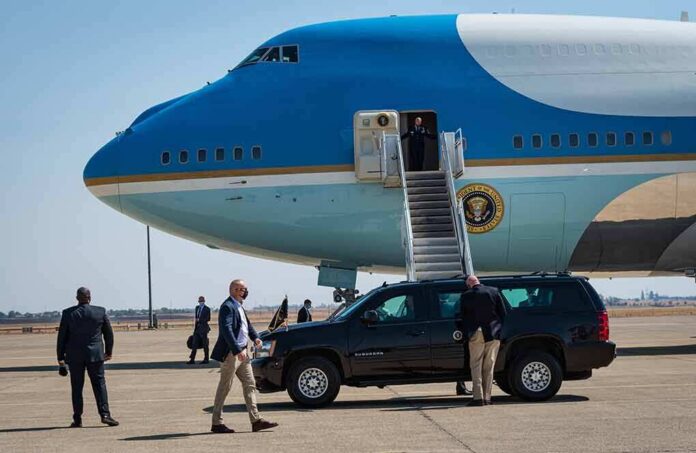
When a French president lands in Damascus with a planeload of corporate executives alongside his diplomatic staff, the message is unambiguous: this is not a courtesy call, it is a commercial opening bid on a country the West spent a decade trying to isolate.
At a Glance
- Emmanuel Macron visited Damascus as the first Western head of state to enter post-Assad Syria, arriving with a delegation of French business leaders to combine diplomatic normalization with concrete commercial deals.
- French firms have already moved aggressively: TotalEnergies signed a memorandum for offshore energy exploration, and CMA CGM secured a 30-year contract to manage the port of Latakia and dry ports near Damascus and Aleppo.
- Macron’s prior diplomatic groundwork — hosting Syrian President Ahmed al-Sharaa in Paris and lobbying the EU and US to lift sanctions — created the conditions that made this visit possible.
- The visit carries genuine complexity: al-Sharaa’s past leadership of Hayat Tahrir al-Sham, a group formerly linked to al-Qaeda, unresolved Kurdish autonomy tensions, and a deadly cafe attack in Damascus that forced cancellations of planned public events all shadow the agenda.
- Syria’s reconstruction is estimated to cost over €200 billion, and France is positioning itself as the primary Western gateway to that market before rivals can consolidate their own footholds.
The Architecture of a Historic Opening
Bashar al-Assad’s regime collapsed in December 2024 after a rebel offensive, led by Hayat Tahrir al-Sham (HTS), dismantled five decades of his family’s rule in roughly ten days. What followed was a scramble — quiet, rapid, and largely unreported in Western capitals — as regional and global powers repositioned themselves around a country that had been a geopolitical black hole for over a decade. Turkey reopened its embassy within days. Qatar followed. The EU dispatched an envoy before the month was out. France sent a diplomatic delegation almost immediately, with Acting Foreign Minister Jean-Noël Barrot confirming the move publicly. Macron’s visit to Damascus, arriving before the NATO summit in Turkey, represents the culmination of that eighteen-month effort — the moment when France’s early engagement converted into a head-of-state imprimatur.
The symbolic weight of being first matters in diplomacy precisely because it is not merely symbolic. The first Western leader through the door sets the template for the relationship, shapes the new government’s expectations, and — critically — arrives before the reconstruction contracts are fully allocated. France understood this calculus early. Macron hosted al-Sharaa in Paris, making it al-Sharaa’s first official visit to an EU member state, and subsequently invited him to the G7 summit. He lobbied Washington and Brussels to dismantle the sanctions architecture that had frozen Syria out of the international financial system. Most of those sanctions have since been lifted, a prerequisite for any serious commercial engagement. The visit to Damascus is the logical endpoint of a diplomatic sequence Macron himself engineered.
The Business Case: Energy, Ports, and a €200 Billion Reconstruction
The World Bank estimates Syria’s reconstruction needs at over €200 billion — a figure that encompasses ports, airports, energy infrastructure, housing, and the basic sinews of a functional state. That number, staggering as it is, functions in diplomatic circles less as a humanitarian assessment than as a market-size figure. France arrived early and with specific instruments. TotalEnergies has signed a memorandum of understanding for offshore hydrocarbon exploration, planting a flag in Syrian energy before the sector is opened to competitive bidding. CMA CGM, the Marseille-based shipping conglomerate that is one of the world’s largest container carriers, has secured a 30-year deal to manage the Mediterranean port of Latakia and dry ports serving Damascus and Aleppo. French aerospace and defense firm Thales has been in negotiations to reestablish air traffic management systems. These are not expressions of interest — they are structural positions in Syria’s economic recovery, negotiated and signed while most Western competitors were still conducting risk assessments.
Macron’s delegation to Damascus included high-level executives from energy, logistics, and transportation sectors, an explicit signal that this visit was designed to convert diplomatic momentum into binding commercial relationships. Syria’s strategic geography amplifies the economic logic considerably. During the G7 summit, Macron specifically highlighted Syria’s importance for future supply chains — the routes crossing Syrian territory to the Mediterranean, or through Lebanon to European markets — particularly salient given Europe’s vulnerability during disruptions in the Strait of Hormuz. A stable, France-aligned Syria is not just a reconstruction opportunity; it is a logistics corridor.
Al-Sharaa’s Legitimacy Problem and the West’s Pragmatic Answer
The most persistent complication in this entire diplomatic project is the man Macron is meeting. Ahmed al-Sharaa led Hayat Tahrir al-Sham, an organization with direct organizational lineage to al-Qaeda’s Syrian affiliate, Jabhat al-Nusra. That history has not disappeared simply because Assad fell; it sits at the center of every Western government’s internal debate about how far to extend normalization. The German Stiftung Wissenschaft und Politik, in its analysis of Syria’s political transition, argued that sanctions against HTS figures should remain in place until the new rulers demonstrably distance themselves from jihadism — through peaceful foreign relations, investigation of sectarian violence, and transparent transitional justice. That is a reasonable benchmark, and it has not yet been fully met.
Yet the pragmatic counter-argument has largely prevailed in Western capitals, and for reasons that are not difficult to reconstruct. Al-Sharaa has sought systematically to rehabilitate his image: engaging with UN envoys, pursuing Kurdish integration into a national army, presenting himself to Trump in Riyadh and subsequently visiting the White House in November 2025. Trump, for his part, praised Sharaa as a “strong leader” and signed an executive order lifting most U.S. economic sanctions in June 2025. The normalization is not a French eccentricity — it reflects a broad Western judgment that engagement is more likely to shape Syria’s trajectory than continued isolation. Macron has simply been more aggressive and more organized in acting on that judgment than his European peers.
Fault Lines That Complicate the Agenda
The visit’s complications are real and should not be papered over by the diplomatic choreography. A deadly attack on a Damascus cafe — killing ten people, including lawyers involved in trials of former Assad-era officials — forced the cancellation of Macron’s planned tour of Damascus neighborhoods and the inaugural session of the transitional parliament. Security instability in the capital is not merely a public relations problem; it is evidence that Syria’s transition remains fragile and that the new government’s control over the country’s internal security landscape is incomplete.
The Kurdish question is structurally unresolved. France and the United States spent years supporting Kurdish-led forces — primarily the Syrian Democratic Forces — as the primary ground partner against ISIS. Those forces agreed in January to integrate into the new Syrian national army, but the terms of that integration, and the degree to which Kurdish political autonomy will be preserved, remain contested. France now finds itself in the position of having to balance its longstanding relationship with Kurdish partners against its desire to work with Damascus — a tension that cannot be resolved by a single roundtable meeting. Similarly, the question of French citizens who fought with ISIS and their families, currently in Syria, represents a domestic security dilemma that Damascus has pressed Paris to resolve through repatriation. France has resisted, citing security concerns, and that friction will not disappear from the bilateral agenda regardless of how many commercial agreements are signed.
🇸🇾🇫🇷 BREAKING: French President Emmanuel Macron has arrived in Damascus, where he was welcomed at the airport by Syrian Foreign Minister Asaad al-Shaibani.
Macron becomes the first Western head of state to visit Syria since the fall of Bashar al-Assad 19 months ago. pic.twitter.com/IT1GOFXWNA
— ME24 – Middle East 24 (@MiddleEast_24) July 6, 2026
France’s Positioning in a Crowded Field
France is not operating in a vacuum. The post-Assad diplomatic rush has drawn in Turkey, Qatar, Saudi Arabia, India, and — most consequentially — the United States, whose sanctions relief was the single most important external factor enabling Syria’s economic opening. The Washington Institute’s analysis of U.S. policy toward Syria identified four core demands Washington made of al-Sharaa: joining the Abraham Accords, expelling foreign terrorist groups, assisting with ISIS suppression, and managing ISIS detention centers. These are American strategic priorities, and they will shape Syria’s foreign policy orientation in ways that France cannot fully control. Macron’s visit is partly about ensuring that France secures a seat at the table before Washington’s bilateral relationship with Damascus crowds out European influence.
The symbolic gesture of returning Syrian artifacts to Damascus aboard the presidential plane — confirmed by Syrian-French sources — is precisely the kind of act that communicates cultural respect and historical continuity without requiring any policy concession. It is soft power deployed with precision, and it illustrates the sophistication of France’s overall approach: commercial deals for structural leverage, diplomatic firsts for prestige, and cultural gestures for goodwill. Whether that combination is sufficient to make France the indispensable Western partner in Syria’s reconstruction — rather than one of several competing powers — depends on factors well beyond any single visit. But in the opening rounds of post-conflict normalization, first-mover advantage is real, and France has claimed it deliberately.
Sources:
insiderpaper.com, i24news.tv, apnews.com, youtube.com, reuters.com, dailymotion.com
© fixthisnation.com 2026. All rights reserved.