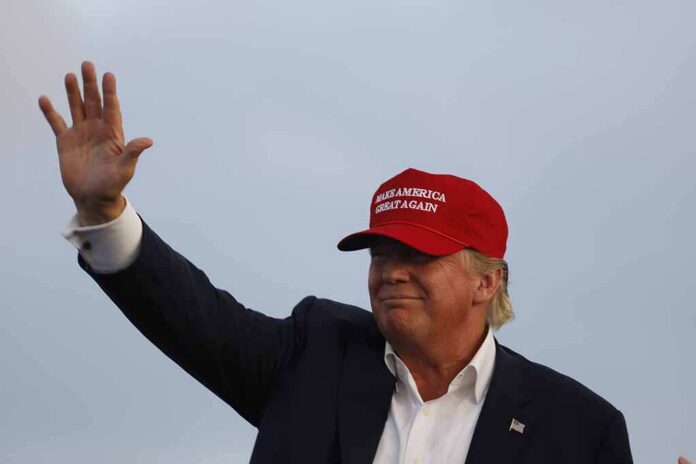
Disruption at modern political events is no accident; it is now part of the performance, and the Michigan episode where a protester repeatedly heckled President Trump before being removed shows how campaigns, crowds, and security choreograph their roles when conflict breaks into the open.
At a Glance
- During President Trump’s speech at General Motors’ Milford Proving Ground in Michigan, a protester repeatedly shouted “pedophile protector,” audibly interrupting the remarks.
- Trump paused, shot back by labeling the protester a “communist,” and the crowd responded with chants before security escorted the heckler out.
- Multiple outlets describe a sustained disruption and a visible security intervention; reports situate the event on July 27, 2026, at a specific venue.
- The incident fits a well-worn script: sustained interruption triggers removal, the speaker capitalizes rhetorically, and the audience bonds in opposition.
What Happened: A Sustained Interruption and a Predicable Removal
President Trump’s speech at General Motors’ Milford Proving Ground in Milford, Michigan, was repeatedly interrupted by a heckler shouting “pedophile protector.” Accounts align on the essential sequence: the interruption persisted long enough to halt the prepared remarks; Trump turned the moment into a counterattack—branding the protester a “communist”—and the crowd answered with chants of its own, after which security escorted the protester from the venue. The description is concrete in its particulars: a defined date, a named facility, audible outbursts captured on video, and the visible consequence of removal. While the reporting does not name the protester or detail any citation or arrest, the interruption-and-escort sequence is consistent across sources.
Several outlets, drawing on footage and attendee recordings, emphasize that the heckling was not a silent protest or a single outburst; it was sustained enough to overtake the room’s attention and interrupt the flow of the speech, which is the threshold that usually triggers intervention by event security. Trump addressed the disruption from the lectern, reframed it in ideological terms, and resumed his remarks as the crowd reasserted itself with chants.
How These Moments Work: Security, Speech, and the Rally Script
Large-scale campaign events run on a simple operational rule: the microphone belongs to the invited speaker. Private or ticketed venues—especially corporate campuses or controlled grounds like an automotive proving facility—typically condition access on rules against sustained disruption. Security professionals distinguish between expression from the audience that does not prevent the program from continuing and behavior that stops the event. Once the line is crossed, removal is the standard tool. That tool’s legality and propriety vary with the forum: public spaces carry constitutional baggage, while privately controlled sites can enforce content-neutral conduct rules more broadly.
There is also a political script. Candidates now anticipate hecklers; their teams coach pivot lines and rehearse crowd responses. The goal is to convert a loss of message control into a show of dominance and solidarity. Trump’s retort—“He’s a communist”—is a textbook attempt to recast a factual accusation into an ideological standoff, galvanizing supporters and moving the emotional center of gravity back to the stage. Chants serve the same purpose: they fill the audio field, reestablish the room’s cadence, and telegraph to cameras and microphones that the speaker retains command.
Where This Fits in the Broader Pattern
Disruptions at presidential events have a lineage stretching back decades, but the incentives have sharpened. Smartphones and social platforms reward short, transgressive clips; a single shouted line can become the night’s defining video, regardless of the policy content that preceded it. Academic work on the “outrage” dynamic in political media shows how conflict and moral condemnation are privileged by distribution algorithms and editorial choices, making confrontations valuable to both protesters and campaigns: protesters can puncture the event’s message, and campaigns can showcase defiance and crowd unity in real time.
The Michigan interruption matched that logic. The heckler’s phrase was engineered for virality, hooking into ongoing coverage about Jeffrey Epstein and public figures’ past associations, which ensures immediate interpretability without context. Trump’s counter-label—“communist”—likewise leans on a familiar, emotionally charged frame that his audience needs no elaboration to understand. The exchange traveled because it met the medium’s demands: brevity, clarity, and a jolt of moral heat.
Speech, Disruption, and the First Amendment Lens
Legally, the line between permissible dissent and removable disruption turns on forum type and the neutrality of enforcement. On public property opened to expressive activity, authorities cannot silence a viewpoint simply because it angers listeners—the “heckler’s veto” doctrine prohibits government from capitulating to audience hostility. But courts also allow neutral rules against sustained interruption that prevents a speaker from being heard. Put simply: protest is protected, but commandeering the event’s audio channel is not. At privately controlled venues, and at ticketed events with clear conduct conditions, organizers typically have wider latitude to remove disruptive attendees, provided they enforce rules without targeting pure viewpoint alone.
In Milford, the reported facts show a sustained audible interruption and removal, but they do not catalog the venue’s posted rules or an official incident narrative. That gap is unsurprising; campaign stops at corporate facilities often run as controlled-access events where internal security procedures are not publicly elaborated. What is clear is the operative principle: when a heckler’s voice supersedes the microphone, security acts; when the speaker regains the floor, the show goes on.
Why It Matters to Voters and Organizers Alike
These episodes are not detours from the campaign; they are an integral part of how modern politics communicates. For supporters in the room, the confrontation confirms identity—“our side” stands up to “their attacks.” For opponents, the clip confirms the inverse and rallies their networks. For organizers, the operational takeaway is consistent: establish conduct rules, train staff to act quickly and predictably, and equip the principal with crisp lines that neither inflame the situation into a safety issue nor surrender control of the message.
What to Watch Next
Expect more of the same. As long as the incentives of attention reward clipped confrontation, rallies will include orchestrated responses to unscripted disruptions. Campaigns will continue refining their playbooks: swift identification of the interruptor, decisive but proportionate removal, and a rehearsed rhetorical pivot that converts the moment into a loyalty test for the audience. The Milford incident followed that template closely, which is why the coverage converged on the same core facts and the same visuals: a shouted accusation, a counterpunch from the lectern, a crowd chant, and an escort to the exit.
Sources:
ground.news, radaronline.com, independent.co.uk, newrepublic.com, yahoo.com, mediaite.com, ibtimes.co.uk, colorado.edu, law.hofstra.edu, academic.oup.com
© fixthisnation.com 2026. All rights reserved.